 |
|
|
|
|
|
|
|
|
|
|
|
|
|
|
|
|
|
|
Introduction |
|
|
|
One my great loves is fossil collecting and I particularly collect sharks teeth, specialising in Great White (carcharodon carcharias) and Megalodon (carcharocles megalodon) teeth. The reason for this may well be due to my great grandfather, who was a ships captain in the Merchant Navy. He caught a shark in the Red Sea and I still have its jaws. I still cannot decide on the species but going by the tooth size I believe that it was around 8-10 feet long. I would NEVER buy any tooth from a modern animal but have been given some so I will show them on this site. Sharks are an endangered species as most produce few young. Shark finning is particularly cruel as the fins are cut off and the animal is thrown overboard causing it to drown, bleed to death or be easy prey for other predators. Unfortunately shark finning is a lucrative business for the production of shark fin soup. People who take it are only feeding the demand for the fins. Finally I think that people who deal in modern sharks tooth selling should be fed to them. Around 100 million sharks every year are killed by humans which I think is a pretty sad statistic for the future of one of the most important predators on earth.
The earth is around 4 1/2 billion years old and during that time many forms of life have evolved into the sharks we have today. Sharks are members of the elasmobranch family and are related to rays and skates. Sharks have been around for around 400 million years (MY) and many have become extinct due to evolutionary changes, that is "survival of the fittest". Many species became extinct as they couldn't adapt adapt to changes in sea temperature, they were not efficient enough hunters, or they simply starved to death. Also in some cases we are not fully sure of the reasons. Sharks have skeletons made of cartilage to reduce their weight. This doesn't usually fossilise however some ancient shark vertebrae (backbones) have survived as they were much harder than the rest of the cartilage. Sharks teeth are very common as sharks shed their teeth constantly. Some have 6 rows of teeth and soon as one falls out the one behind it flips forward ready for use.
|
|
|
|
The earliest sharks Part 1 |
|
|
|
 |
|
|
 |
|
|
|
|
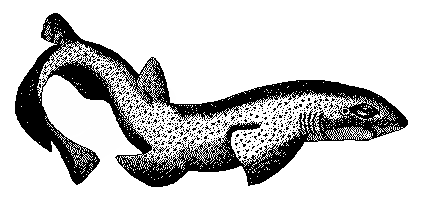
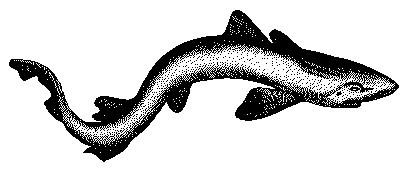
Two of the earliest sharks are shown above. |
|
|
|
Very little is known about the earliest sharks but the earliest shark scales known are from around 400 MYA. One of the earliest sharks was Cladoselache (not shown in the pictures). It appeared around 360 million years ago (MYA). It was around 4 feet long and it was a powerful swimmer, having a large tail but it had broader pectoral fins meaning it was agile. Its mouth was at the end of its snout unlike most modern sharks which have their mouths under their snout. Unlike any other species of shark male Cladoselache did not have claspers. How it reproduced is still uncertain. Around 100 MY later we had eel shaped sharks.
Around 200 MYA we had very odd-shaped sharks like Helicoprion, the whorl-toothed shark. It had a unique spiral shaped whorl inside its mouth like a circular saw and it is thought to have extended this to catch prey. There was also edestus, the scissor-tooth shark which had a very long jaw with strange teeth like a pair of scissors.
|
|
|
|
Home Page |
|
|
|
Contents |
|