
The following article is based on one written by Steven A. Alter for his website. It is copyright and must not be used without his permission. See the "Cool Links" page to contact him.
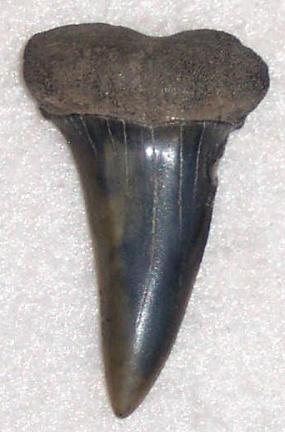
In Part 1 of this article we discussed the hypothesis (i.e. something that cannot be scientifically proven) that the Great White Shark (GW) came from a line of extinct Makos. They were called broad-form Makos, Isurus hastalis. The GW is only very distantly related to the enormous Megalodon (Meg).We will read much more about the Meg in this website as the ultimate in apex predators (i.e. at the top of the food chain, having no predators). In a relatively short period of time (i.e. maybe as "little" as a million years) the extinct broad-form Mako had fully evolved into the GW. True GW teeth have very coarse serrations otherwise they are almost exactly identical to the I. hastalis from which they have evolved. They are almost identical in size and thickness. They have exactly the same tooth positions. One isolated population in the West Americas (California, Chile, Mexico) was the source of the "transitional" teeth (i.e. GW teeth with fine serrations characteristic of I. hastalis). Fossil records from the Atlantic coast of the USA and Europe show no finds from GW until at least the Middle Pliocene and perhaps a little later than that even. All fossil GW teeth here are true GW, coarsely serrated and showing no transitional properties. Fossil GW teeth are widespread by the Late Pliocene in all areas. I have included a page on this site to show you prehistoric time periods as they will be referred to often in this site.
The impact the GW had on existing species would have been enormous. The first real victim was the Meg. and the GW possibly was part of the reason for its extinction around 1-2 million years ago (MYA). When GW began spreading into areas inhabited by the Meg the Meg population soon fell. By the Late Pliocene (about 1-2 MYA) the Meg was extinct. The GW would not have been the only reason for the extinction of the Meg but it would have played a role. GW would have been competing with young Megs for food and the faster GW would have been better equipped to catch the smaller prey (seals etc.) that the juvenile Megs relied on. The depleted prey would have led to fewer Megs surviving to adulthood. Fewer adults would produce fewer offspring and the circle would continue.
The next victim of the GW was its own predecessor I.hastalis. This survived on until the very late Pliocene but it would also become extinct. The serrated cutting edge of the GW would have been a more efficient hunter having expanded its diet to include different types of prey. About the same time in the Late Pliocene another large predatory shark became extinct. This was the Parotodus benedeni, which was a sister group to the Meg (evolving from the same ancestors about 60 MYA). It reached probably 25-30 feet long but was more an open-ocean species and was always much less commonly seen. The GW probably played a role in the demise of the benedeni in much the same manner as did the Meg and the extinct Mako.
So, the GW has had an enormous impact upon marine history. It thrived in an era of even larger sharks and contributed to their extinction. Today the GW is found worldwide and is one of nature's true wonders. No other shark sparks the inner fear of humans like they do or draws the most protection from the same humans. Hopefully they will be around as the apex predator in their domain until something better evolves to take its place- that is nature's way.
THIS ARTICLE IS CONTINUED IN PART 3