About the Great White Shark
The Great White Shark is the most feared shark in the world today. It is now an apex predator, i.e. it has no known predators apart from its own kind and humans. However very little is known about it. Fully grown adults average at 12-14 feet long and very rarely reach 23 feet long. It is perfectly adapted to its environment being very streamlined for fast swimming. It usually ambushes its prey from below and It is dark blue in colour on the top of its body hiding it from  prey looking down in the depths and light in colour on the bottom hiding it from predators looking up above in the bright sunlight. Females are larger than males due to them having reproductive organs and possibly to protect the young pups from the male. All male sharks have claspers which they use in mating with the females cloaca. Some sharks including Great Whites have live young and some have eggs.

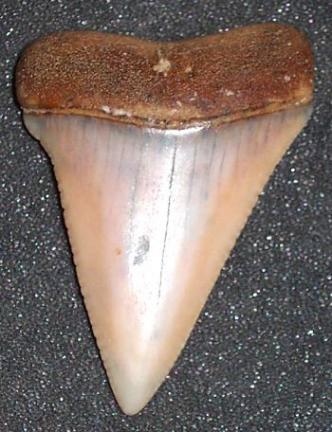
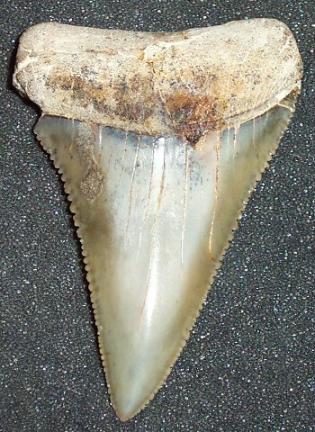
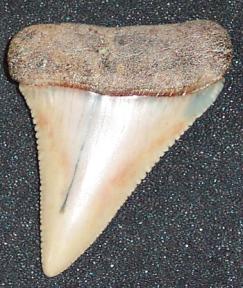
It has 3 anterior front teeth numbered 1 to 3 with the 1st upper tooth nearest the centre of the mouth. It has several lateral side teeth behind that and its rear teeth are flat posterior teeth. The 3rd upper tooth on Great Whites is significantly smaller than the 1st and 2nd. Teeth on the upper jaw are much broader in the blade and less rounded in the root than teeth in the lower jaw. Its teeth are very coarsely serrated making it a very efficient flesh cutter. Its teeth reach a maximum of around 2 1/2 inch. 

Shark teeth are designed to protect the tongue so one side of them is curved. This is the lingual (tongue) side and the other side of the tooth is usually flat. This is the labial (lip) side. Shark teeth are normally displayed showing the lingual view. Large upper teeth are about 10 times more common than large lowers. Great Whites shed upper teeth much more commonly so finding extremely large lowers can be almost impossible.
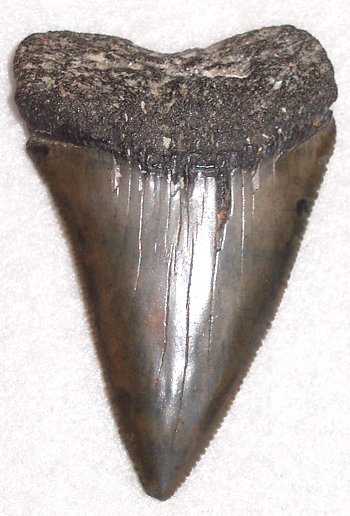
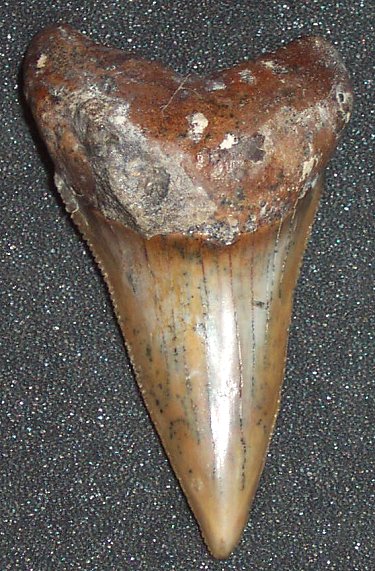
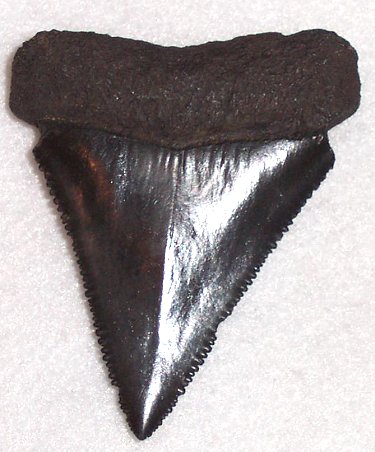
Some Great White teeth from my collection. They are left to right:: 1. Upper Tooth from U.S.A.  2. Lower tooth.  3 Upper lateral 2 3/4 inch from U.S.A.  4. Upper lateral pink tooth. 5.. Upper lateral with excellent serrations. Second row: 1. Pink tooth from Peru.
You can see that all these teeth above are different colours. The colour of a fossil tooth has nothing to do with its age but only the deposit in which it was buried. Teeth may be all sorts of colours and uncommon colours increase their value.

Prehistoric Great White teeth are much larger than modern teeth, around 3/4 inch difference in maximum sizes. The largest prehistoric Great White tooth ever found is 3 1/2 inch. The reason for this size difference is discussed in the next chapter which is about the origin of the Great White.Muscle is a survival risk so it is not surprising that the Great White gradually protected itself by getting smaller and having to eat less. This is true with many other prehistoric animals which are still alive today.
Contents
Homepage
Hosted by www.Geocities.ws

1