|
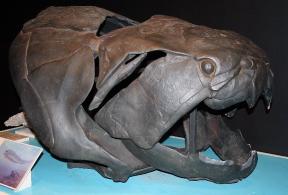
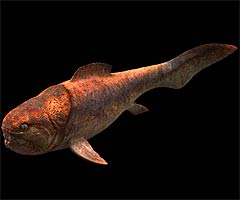
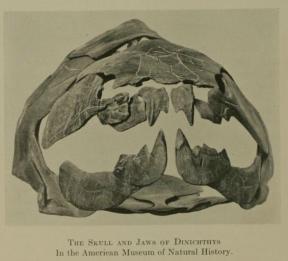
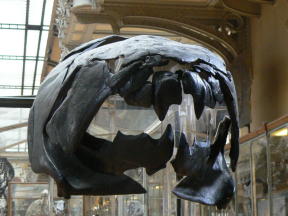
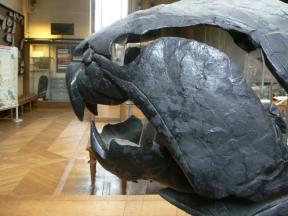
Around 360 to 415 MYA in the late Devonian Period we had armoured fish known as Placoderms. The most famous of these was the ferocious Dunkleosteus. It was around 30 feet long and was covered in thick armour plating to protect it from attack from members of its own species. It did not have any teeth but it had two pairs of bony spikes in its mouth which it used to crush its prey. It had the most powerful bite of any fish, past or present, exerting a force of 8,000 pounds per square inch putting it in the same league as crocodiles. It was probably an apex predator, i.e. having no known predators. Dunkleosteus fossils often have semi-digested fish in their stomach suggesting that they regurgitated their food rather than fully digesting it. It was also one of the first vertebrates to have to mate physically in order to reproduce. All Placoderms died out in the late Devonian Period for reasons that are not well understood. |
|