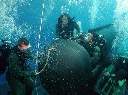
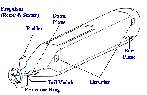
The SEAL Delivery Vehicle (SDV) MK VIII is a "wet" submersible, designed to carry combat swimmers and their cargo in fully flooded compartments. Submerged, operators and passengers are sustained by the individually worn underwater breathing apparatus (UBA). Operational scenarios for the vehicle include underwater mapping and terrain exploration, location and recovery of lost or downed objects, reconnaissance missions, and limited direct action missions. The vehicle is propelled by an all-electric propulsion subsystem powered by re-chargeable silver-zinc batteries. Buoyancy and pitch attitude are controlled by a ballast and trim system; control in both the horizontal and vertical planes is provided through a manual control stick to the rudder, elevator, and bow planes. A computerized Doppler navigation sonar displays speed, distance, heading, altitude, and other piloting functions. Instruments and other electronics units are housed in dry, watertight canisters. The special modular construction provides easy removal for maintenance. Major subsystems are Hull, Propulsion, Ballast/Trim, Control, Auxiliary Life Support, Navigation, Communications and Docking Sonar.
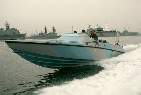
HSB- High Speed Boat
The HSB was originally intended to catch small and medium sze boats tormenting merchant and military shipping in odd corners of the world during the last decade or two. Very few of the costly complex boats were purchased, and they've mainly been used as "adviseries" to train the Navy to dealwith the fast hit and run attacks of the sort of mounted by Iraq and Iran. These are
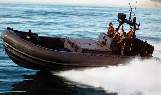
RIB - Ridgid Inflatable Boat
These boats are getting really popular. Even for civilain use!. They are fast and easy to produce. they come in 3 sizes and do lots of stuff the SEALs need.
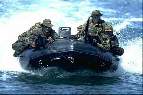
Combat Rubber Raiding Craft (CRRC)
The Combat Rubber Raiding Craft (CRRC) is used for clandestine surface insertion and extraction of lightly armed SOF forces. They are employed to land and recover SOF forces from over-the-horizon. The CRRC is capable of surf passages. The CRRC may be launched by air (airdrop/helo-cast), or by craft (LCU, LCM). It may also be deck-launched or locked-out from submarines. It has a low visual electronic signature, and is capable of being cached by its crew once ashore. It uses one 35-55 horsepower engine.
Advanced SEAL Delivery System
The Advanced SEAL Delivery System (ASDS) is projected to be in the Naval Special Warfare inventory by FY99. The ASDS is a dry, 1 ATM, mini-submersible that can transport a SEAL squad from a host platform, either surface ship or submarine, to an objective area. The ASDS has a lock-out chamber that is controlled by operators for lock-out from an anchored position. The ASDS will anchor above the bottom between 2-190 feet. The ASDS will be transportable by land, sea or C-5/17 aircraft.
Dry Deck Shelter
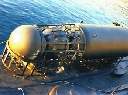
The Dry Deck Shelter (DDS) allows for the launch and recovery of an SDV or combat rubber raiding craft (CRRC) with personnel from a submerged submarine. It consists of three modules constructed as one integral unit. The first module is a hangar in which an SDV or CRRC is stowed. The second module is a transfer trunk to allow passage between the modules and the submarine. The third module is a hyperbaric recompression chamber. The DDS provides a dry working environment for mission preparations. In a typical operation the DDS hangar module will be flooded, pressurized to the surrounding sea pressure, and a large door is opened to allow for launch and recovery of the vehicle. A DDS can be transported by USAF C-5/C-17 aircraft, rail, highway, or sealift. The DDS is 40 feet long and weighs 65,000 lb.
The MATC, or Mini Armored Troop Carrier
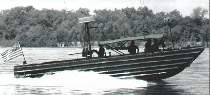
The Mini-Armored Troop Carrier (MATC) is a 36 foot all-aluminum hull craft designed for high-speed patrol, interdiction, and combat assault missions in rivers, harbors, and protected coastal areas. The MATC has a large well area for transporting combat equipped troops, carrying cargo, or for gunnery personnel operating the seven organic weapon stations. The MATC propulsion system is similar to that of the PBR, with an internal jet pump, which moves the water on the same principle as the air breathing jet engine. This type of propulsion is especially appropriate for beaching operations. A hydraulic bow ramp is designed to aid the insertion and extraction of troops and equipment. The craft has a low silhouette which makes it difficult to detect in all speed ranges. The unit is extremely quiet, particularly at idle speeds. A high resolution radar and multiple communications suite, provides a good all weather surveillance and command and control presence for interdiction and anti-smuggling operations. The overhead canopy can be removed or stowed below. Crew size is normally four but can be modified depending on the mission and mission duration.
The MK V
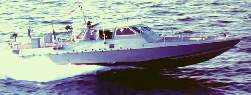
The MK V Special Operations Craft (SOC), is the newest craft in the Naval Special Warfare inventory. The MK V SOC primary mission is a medium range insertion and extraction platform for Special Operations Forces in a low to medium threat environment. The secondary mission is limited Coastal Patrol and Interdiction (CP&I), specifically limited duration patrol and low to medium threat coastal interdiction. The MK V SOC will normally operate in a two craft detachment with a Mobile Support Team. The Mobile Support Team (MST) provides technical assistance and maintenance support during mission turnaround. The MK V SOC is fundamentally a single sortie system with a 24 hour turn- around time. The typical MK V SOC mission duration is 12 hours. The MK V SOC is fully interoperable with the PC ships and NSW RIBs. As such, all could be employed from a Forward Operating Base (FOB), in a synergistic effect. A MK V SOC detachment, consisting of two craft and support equipment, will be deployable on two USAF C-5 aircraft into the gaining theater within 48 hours of notification. A detachment is transportable over land on existing roadways. Detachments are not consisting of two craft and support equipment, will be deployable on two USAF C-5 aircraft into the gaining theater within 48 hours of notification. A detachment is transportable over land on existing roadways. Detachments are not configured nor manned to provide their own security, messing, or berthing for personnel while forward deployed.
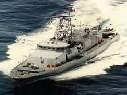
The Patrol Coastal Class Ship
The Combat Rubber Raiding Craft (CRRC) is used for clandestine surface insertion and extraction of lightly armed SOF forces. They are employed to land and recover SOF forces from over-the-horizon. The CRRC is capable of surf passages. The CRRC may be launched by air (airdrop/helo-cast), or by craft (LCU, LCM). It may also be deck-launched or locked-out from submarines. It has a low visual electronic signature, and is capable of being cached by its crew once ashore. It uses one 35-55 horsepower engine.