Vehicles In The Air
The Lockheed AC-130 Gunship
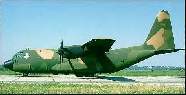
These heavily armed aircraft incorporate side-firing weapons integrated with sophisticated sensor, navigation and fire control systems to provide surgical firepower during extended loiter periods, at night and in adverse weather. Spectre has an impressive combat history. During Vietnam, gunships destroyed more than 10,000 trucks and were credited with many life-saving close air support missions. AC-130s suppressed enemy air defense systems and attacked ground forces during Operation Urgent Fury in Grenada. This enabled the successful assault of Point Salines airfield via airdrop and airland of friendly forces.
Gunships had a starring role during Operation Just Cause in Panama by destroying Panamanian Defense Force Headquarters and numerous command and control facilities by surgical employment of ordnance in an urban environment. As the only close air support platform in the theater, Spectre was credited with saving many friendly lives.HH-60H SeaHawk

Missions of the HH-60H are Combat Search and Rescue (CSAR) and Naval Special Warfare. CSAR is the rescue of downed aircrew or isolated forces in hostile terroritory. The rescue of Air Force Captain Scott O'Grady from Bosnia is a memorable example of CSAR in action. HH-60H aircrews utilize night vision goggles (NVGs) which allow extremely low and stealthy flight at night. They are armed with machine guns to suppress enemy fire during a rescue.
MC-130P Gunship
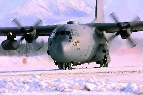
AFSOC MC-130P (referred to as the HC-130 prior to 1996) were deployed to Saudi Arabia and Turkey in support of Desert Storm. They operated from main bases and remote locations. Their missions included air refueling of special operations forces helicopters over friendly and hostile territory, psychological operations, and leaflet drops.
The mission of the MC-130P is clandestine formation/single-ship intrusion of hostile territory to provide aerial refueling of special operations helicopters and the infiltration, exfiltration, and resupply of special operations forces by airdrop or airland operations. To perform these missions, the primary emphasis is on night vision goggle (NVG) operations, but they can be accomplished during the day. The MC-130P primarily flies missions at night to reduce probability of visual acquisition and intercept by airborne threats. Secondary mission capabilities may include airdrop of small special operations teams, small bundles, and combat rubber raiding craft; as well as NVG takeoff and landing procedures, tactical airborne radar approaches, and in-flight refueling as a receiver.
Some aircraft are currently being modified with the Universal Air Refueling Receptacle Slipway Installation (UARRSI) system for inflight refueling as a receiver and all aircraft are modified with the self-contained navigation systems (SCNS) and Global Positioning System (GPS). The Special Operations Forces Improvement (SOFI) modification will give the aircraft an NVG HUD, a new modified radar, and a Infrared Detection System (IDS). These modifications will greatly increase the range and navigational accuracy of the MC-130 P. The aircraft normally carries eight crewmembers. Depending on mission profile and duration, additional crewmembers are carried. All crewmembers are NVG/formation and helicopter air refueling qualified. Special qualifications include high altitude low opening (HALO) airdrop, NVG airland, formation lead, inflight refueling (IFR), and Rigging Alternate Method Zodiac (RAMZ).
The MC-130P employs night terrain contour (NTC) procedures. NTC missions are flown in VMC using NVGs. The profile is flown at 500 feet above ground level using terrain masking. If necessary, the mission can be flown with visual and electronic-controlled emissions. The range of the mission depends on several factors: length of time on the low-level route, enroute weather, winds, and the air refueling offload requirements (see Planning Factors). Portions of the profile may be flown at high altitude to minimize fuel consumption. NTC procedures will be used to avoid enemy detection in a non-permissive environment to get the aircraft to the objective area.
The MC-130P normally flies in a formation of aircraft to provide the capability of multiple simultaneous refueling of large helicopter formations. An airborne spare tanker is also a part of the formation.
The MC-130P airdrop personnel or equipment. The drop zone point of impact (PI) must be marked. The location, size, and marking of drop zones must conform with AFI 13-217.
The MH-53J Pave Low
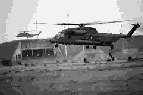
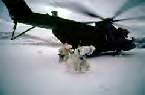
The MH-53J's mission is to perform low-level, long-range, undetected penetration into denied areas, day or night, in adverse weather, for infiltration, exfiltration and resupply of special operations forces.
MH-60G Pave Hawk
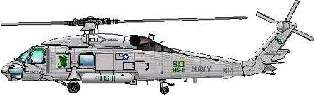
The MH-60G Pave Hawk is a modern, medium-lift, special operations helicopter for missions requiring medium-to-long-range infiltration, exfiltration, and resupply of special operations forces on land or sea. In addition, the SOF-unique mission equipment allows this aircraft to be used for recovery of injured special operations personnel. The MH-60G is equipped with forward-looking infrared radar to better enable the crew to follow terrain contours and avoid obstacles at night. The Air Force has 55 Pave Hawks in the active component and 25 in the Reserves.