The NCDUs saw their first action at Sicily, with Operation Husky. On July 10, 1943, the NCDUs were swimming around the island to note and/or clear any obstacles for landing craft. They found none in the water, but heavier troops and gun emplacements were seen on land. Their mission was changed to demolish wrecked Allies� boats during the invasion to clear the way for other craft.
Most of the NCDUs from Sicily reported back to Fort Pierce, Florida, where they became the instructors/creators of the new NCDU training center. The men who would go through the training would be volunteers from the Navy Seabees, Bomb and Mine Disposal, and the Naval/Marine Scout and Raiders units. The first week of this training was called Motivation Week, and in BUD/S, it is called Hell Week.
Other training courses consisted of swimming through Florida�s swamps, watching out for snakes, alligators, bloodsucking insects, and above all, the trainers. This kept the men on alert throughout the exercise, realizing that the instructors were not the only ones watching them.
It was found that conventional explosives like dynamite would not be acceptable for such a cause. It would often leave large fragments of the obstacle behind that were as dangerous as the obstacle in the first place. When using enough dynamite to eliminate this problem, the blast would be too large and deadly to any Allies nearby. Because of this, the new explosive C2 was invented. It and some counterparts (C4) are still used today.
Unfortunately, the NCDUs measured the water at high tide. The Marines� boats ran aground on the reefs, covered by about two feet of water. This resulted in Marines drowning because of being trapped in their boats, or being weighed down by their gear while trying to swim ashore.
After new training, the UDTs (Underwater Demolition Teams) moved on to Korea, where they performed similar tasks as in World War II. However, the winters in Korea were unbearably cold, and the UDTs used bulky dry suits to perform their missions. This resulted in more limitations that the UDTs had to deal with.
He had studies done to find out which current U.S. military unit would be best fitted to perform guerilla operations. He came up with the UDTs. Though the UDTs would be operating by land, their maritime reconnaissance capabilities were acknowledged as equally important.
Kennedy disbanded the UDTs. Although every UDT swimmer knew that he would help create a better unit, the end of the UDTs was a sad one.
Kennedy helped create guidelines as to what the new unit was being commissioned to accomplish. They were:
1. To develop a specialized Navy capability in guerilla/counterguerilla operations to include training of selected personnel in a wide variety of skills.
2. Development of doctrinal tactics.
3. Development of special support equipment.
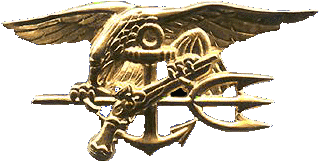
The new unit was first referred to as SOTs (Special Operations Teams). Then, in an effort to describe their operational environment, their name was code-named SEALs (Sea, Air, Land).