Well another month has gone by - the shortest day has been and gone, so hopefully the days will be getting longer and warmer.
The winter projects on Zephyrs will be coming along with some new cars making an appearance on our monthly runs. During June we had a great get together at the Vintage Car Club and thanks to John Hull, the rooms were warm on a cold night.
We enjoyed watching a video of the Zephyrs at Manfeild, the music, catching up with other members and the presentation of the Show & Shine trophies and Certificates.
Sunday, 17th June - Club Captain Peter Hunter organised a very enjoyable run out to Cannington where we looked through the old stone Cave Church and then stopped and looked at the massive stone gateway at the entrance to the old Burnetts' Station. It's a pity not more members could join us on this run, but we look forward to seeing a good turnout for our annual Night Trial - bring along some friends and make a great night of it.
Phil Rooke tells me that plans are going well for the weekend in Akaroa in September, so keep that date free.
We are still looking for a volunteer to help with the newsletter - maybe someone with a bit of time on their hands. Please let us know if you can help.
The Committee and Mike Constantine would really appreciate the help.
Happy Zephyring.
Bob Stevens
President.
Coming Events
Saturday 14 July Night Trial, 7.30 pm.
Meet Hobbs Street by Pak 'n Save entrance at 7.30 pm.
Proceeding to a venue for supper. Things to bring - $5 per head for supper, paper to write on, torch, pen, old newspaper, plastic bag, roll of tape, piece of string
12 August - keep this date in mind for August run. Time and place to be advised.
International Convention Revisited
Palmerston North Easter 2001
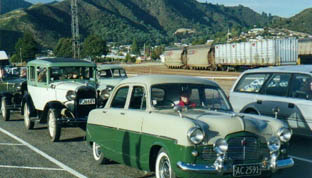
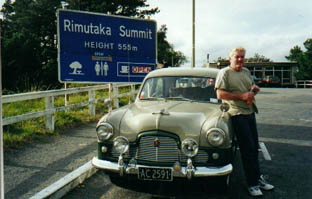
Twelve SC cars and 28 people made the trip to Palmerston North for the Central Region¹s International Convention 2001 in the 50th anniversary year of the Mk I Zephyr.
A good many of us travelled north together leaving on the Wednesday morning before Easter. We left from Washdyke at 9am and motored north in a staggered convoy, some going considerably faster than others!! Some stopped at Rakaia, and we met at Amberley for lunch where we also met up with a group of Christchurch members.
During the afternoon we crossed the Hundalees and met at another stop at Cave Rock before setting off again, some going into Kaikoura, some into Blenheim, all eventually arriving at Picton where we were booked to stay for the night. A pleasant evening was spent at a pub near the waterfront and at various restaurants in the area.
An early start on Thursday saw us all on the ferry on time, Zephyrs mingling with an interesting assortment of Morris Minors and Model A Fords, all off to their respective North Island rallies.
The crossing was calm, giving us all a chance to enjoy the stunning scenery of the Marlborough Sounds and enjoy an early lunch in comfort.
After disembarking we found our way out of Wellington with practised ease and made a stop at Southwards Car Museum at Paraparaumu.
We headed further north during the afternoon, finding Palmerston North and our temporary home at Supreme Motor Lodge with varying degrees of success.
The accommodation was ideal, with plenty of room for guests and their cars with the added luxuries of a heated indoor swimming pool, spa pools and a guest gymnasium.
Perhaps the gymnasium wasn¹t top of the pops, but many Zephyr enthusiasts could be seen scuttling around the complex clad in nothing but large, fluffy towels. The complex was also conveniently close to the Awapuni racecourse where the official functions were held.
It was great to see some of our Australian friends there, including our special SC-Australian, Barry.
Registrations were in full swing by Friday and members spent the morning polishing, tidying and making last-minute adjustments (or lying on a bed reading) until the first run which was an optional tour of the Manawatu.
We managed to complete this without getting lost and were treated to some attractive bush areas and fine sights through the Manawatu Gorge. The evening function comprised the official welcome and guest speaker ????????? who was he, followed by a spirited auction of Zephyr and Consul memorabilia.
Saturday began with cars assembling for judging at the Railway Land near the centre of Palmerston North, and once the vehicles were in place members wandered off for shopping, sightseeing or following Christine through the strategically-placed craft show. We met again at 1pm for the afternoon run to Manfield Park where sundry members who shall remain nameless relived their youth and testosterone peaks to travel around the Manfield circuit at speeds ranging from the sedate to the frankly terrifying.
Memories of the 60s were everywhere with Zephyrs once again leaning into a few sweeping bends. A great afternoon in warm sunshine with pleasant company - everyone had fun. The women of the expedition got their fun on the way back into town with a visit to Ezibuy. Buses were laid on to take us from the motor lodge to the racecourse for dinner - most of us were on time!! - for dinner, dancing and excellent entertainment provided by a live band and comedian MC to keep things moving.
A brilliant night, and great singing in the bus on the way back Phil!
Another early start on Sunday (well early for some!!) for the run in convoy to Foxton where all cars were on display at the Foxton Easter Gala. This was another great day - again the weather was super and we were in a great place to wander the fair or the town, view the large turnout of cars or just sit in the sun to be entertained by Hogsnort Rupert and his band.
The fair was large for such a small town, the stalls were interesting and diverse, and the home-made fudge was superb. The programme for the evening included dinner, the presentation of trophies and a continuation of the auction.
As has already been noted in an earlier magazine, our area did very well, with prizes going to Ray Taylor, Anne and Bob Stevens, Marilyn and Gavin Ladbrook, and Mary Jean Wood and Phil Rooke.
We also won the prize, involving some complicated formulae, for the club travelling the furthest distance with the greatest number of people and cars.
The convention ended on Monday morning with a display of the trophy-winning cars and morning tea.
A good many of the SC members headed further north to make the most of their time in the North Island and crossed back at varying times over the next couple of weeks.
The convention was another enjoyable time together where everyone enjoyed the cars and the company.
Carol Bell & Jim Macdonald
Photos: McDonald Collection
The Car Lovers Date
It's quite a Valiant effort
I met her in the Civic, I'd been Holden up the bar all night.
As she walked in I looked her Rover, I thought she seemed quite Familia, but that was just a Mirage.
I was sitting there with my mate Joe who broke wind, I said "Oh Peugeot"
Anyway, she was quite a Starlet, wearing a nice little Mini.
She came up to me of her own Accord, I said "Audi",
She told me that she thought me quite Galant.
I'd had a few Coronas.
I tried to Impreza, she told me not to Porche it.
I told her I wanted to Lancer, turns out she was an Escort. I thought to myself, "well that's Ford",
but I couldn't afford to pay, she said, "you don't know what you're Nissan", so I paid.
I took her back to my bedroom, or HQ as I like to call it. I was staying at the Sentra.
I had a big horn, and I was an absolute Legend, I even rubbed her Volvo, and we did it in the Anglia position.
Four minutes later when there was a Prelude, I went to see if there was any food in my Lada.
Now I was thinking about this a couple of weeks later, as I was sitting on the beach, watching the Skyline, watching the Surf roll in.
I was sitting there thinking it was a brilliant night I'd spent with that woman, but I should have worn a condom that fits my Mitsi, 'cos I'd left her with my Legacy, you know, a wee Bambina, and now I'm trying to Dodge the maintenance.
Isn't it amazing what you can do with a couple of joints and a used car sales page from the paper?
Ewen Gilmour
Celebrating 50 years of the Zephyr in New Zealand
Sometimes people are heard to talk of cool cars that have been in storage for decades, or that have had little use since they were new. You know, the "one careful lady owner' scenario.
After a while you start to wonder how many of these stories are factual and how many are simply wishful thinking. After seeing this amazing Mark II Zephyr PC can quite safely say that a least one of those stories is true... The 49,000 original miles on this New Zealand assembled vehicle's odometer have been very carefully clocked up, the first lady owner (truly!) being responsible for 35,000 of them.
Judging by the information on the original ownership papers she was a resident of Whakatane. Owner number two traversed 8800 and the third just 200. Why or how anyone could own a car like this and only cover 200 miles is beyond me. If the car were mine, I'd break out the Brylcream, fox tails and winkle-pickers every Saturday night and drive round town incessantly just for the hell of it.
Dave King of Hillsborough, Auckland, is of a similar mindset and he is the very proud fourth owner of this Warwick Green 1956 'flat-back' Zephyr. Dave firmly believes that cars are built for driving, with this being his daily driver. Not that you'd know it to look at this pristine example, as Dave does a masterful job of cleaning and detailing his pride and joy.
When asked at shows "How long did it take you to get the car looking like this?" Dave takes great delight in offering the reply: "A couple of hours".
To earn the spondoolies that are required to feed the automobile addiction, Dave plies his trade from a basement workshop restoring and repairing porcelain artifacts, something he has undertaken for around twenty years.
His skills in this fine art are evident in some of the work I viewed during my visit to his home, but it didn't take long for the conversation to revert to things automotive.
Along with the love of Zephyrs that he has nurtured since his teen years, Dave has a passion for old petrol pumps and there are examples in various stage of assembly or disassembly all round the house.
Some of the pumps that Dave has restored have fetched quite handsome prices too. Again a reflection of this man's varied skills.
While having a hankering for automobilia myself, I couldn't help but notice a rather large collection of running board petrol cans stacked neatly on some shelves in another portion of this basement wonder world. Apparently the set is complete bar one. That's something that I would find extraordinarily irritating but Dave, with his laid back attitude, can see the humour in it and no doubt he'll keep cruising the swap meets in search of that elusive last can.
Most of those on the darker side of forty would most likely have owned a Zephyr in the past, or at least spent some time in one or more. They are an important part of 'Kiwiana' and I had a MkIII that I still regard as one of my better cars but there's not a lot I can remember about it. It was the seventies after all...
Article courtesy "Petrolhead" Magazine
Photo:
http://www.100megsfree.com/racerphillIn the News.......
Two boys are playing football in a New Zealand park when one is attacked by a Rottweiler.
Thinking quickly, the other boy rips off a board of the nearby fence, wedges it down the dog's collar and twists, breaking the dog's neck.
A newspaper reporter who was strolling by sees the incident, and rushes over to interview the boy.
"Young All Blacks Fan Saves Friend From Vicious Animal," he starts writing in his notebook.
"But I'm not a All Blacks fan," the little hero replied.
"Sorry, since we are in New Zealand, I just assumed you were." said the reporter and starts again. "Little Kiwis League Fan Rescues Friend From Horrific Attack" he continued writing in his notebook.
"I'm not a Kiwis fan either," the boy said.
"I assumed everyone in New Zealand was either for the All Blacks or Kiwis. What team do you support?" the reporter asked.
"I'm an Aussie, so I'm a Wallabies fan," the child said.
The reporter starts a new sheet in his notebook and writes,
"Little Maniac Loser Kills Beloved Family Pet"
No Parking!
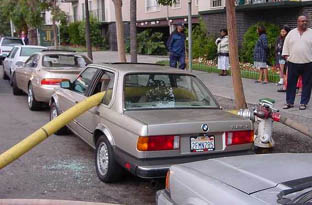
Photo: unknown
New Members
Trevor & Yvonne Jopson, Oamaru - MkI Convertible, MkIII Zodiac
Murray & Denise Robertson, Oamaru - MkII Zodiac
Hamish & Anna Rossiter, Kaiapoi - MkIII Zephyr
Andrew & Leanne Leash, Methven - MkI Zephyr Flatdash
Welcome to the club - we look forward to seeing you at club meetings and on future runs.
Defining moment
It was a defining moment for Ford back in 1956 when it’s then boss decided to soar with the Falcon, rather than a local version of the Zephyr
|
|
|
Imagine being in Ford's shoes in 1956 and planning your next move against a rival able to capture up to 90 per cent of your potential buyers. Holden had proved unstoppable with a car that was dated by 1950, despite the first Ford Zephyr being a worthy contender.
The Zephyr Mark I was not only a trailblazer in looks compared to the Holden when it was launched in 1952, it was also technically advanced with a modem mono-construction shell allied to a brilliant new MacPherson Strut suspension system. It also had superior brakes and a more powerful engine, so why didn't it blitz the Holden?
The Holden came at a time when the only alternative from strife-tom Ford US was increased local Content for its antiquated V8 range.
What followed effectively locked Ford and others out of the Australian market regardless of the merit of their later products.
Once it emerged that the Holden was the only real contender for the all-Australian car, GM reversed an initial undertaking to pay for the car, insisting that Australians put up the funds. This allowed Holden to achieve close to 100 per cent local content with local engine and stamping plants. With the savings of so many Australians tied up in the fortunes of Holden, was it coincidence that some of the tallest tariff walls and most restrictive import rules in the world protected GM-H?
The first Zephyr was a worldwide success and it's wrong to conclude that its higher price and low sales compared to the Holden made it a local failure. Without a press shop or an engine plant Ford could never meet local content rules for the Zephyr.
With demand outstripping supply, Ford priced the Zephyr according to what the market would pay, although Ford insiders believe it could have been priced directly against the Holden. By 1956, even this was under threat as Holden by then had a panel van and utility, and a station wagon was coming.
To maintain its position, Ford needed a utility and wagon as the British Zephyr wagon was unsuitable.
Ford had to play Holden at its own game if it was to be a serious contender, but having missed the government's gravy boat in the 1940s, it had to gamble its own money against a rival that had a stranglehold on the market
Decision time
To get an all-Australian Holden challenger to market by 1960, Ford had to make a decision in 1956 to allow for the three-year new model lead time. It also had to overhaul its existing infrastructure and build new facilities.
At first, the Zephyr Mark II seemed the perfect starting point. Given the eight-year life of the first Holden, it was a fair bet that the 1960 model would be based on the FE.
The Zephyr was already superior possessing a larger engine, a very strong bodyshell, bigger brakes, a longer wheelbase, and being wider.
The handsome new shape combined the best of the already well received 1954 and 1955 Ford Customlines. The downside was its extra weight, narrower track and extra height, but that was to come down in the 1959 lowline facelift.
Small local volumes dictated a long model life, so Ford US prepared Mark II styling proposals to take the local Zephyr past the British Mark III.
They were far better than the published sketches suggest, but couldn't disguise the narrow track, high roofed look that would instantly date the Zephyr when released in 1960.
Ford Australia also knew in 1956 that the Zephyr was to become the Granada in Britain and any Australian Zephyr may have to 'go it alone' as early as 1962. It was unrealistic to expect the local Zephyr to generate enough sales to fund a unique local model within two years, Yet the Zephyr seemed the only option.
Ford Australia, then a wholly owned subsidiary of Ford of Canada, had few direct dealings with Ford US.
This was a way of keeping trade within the former British Commonwealth to contain costs in an Australia with a currency tied to a British pound that was still recovering from war debt.
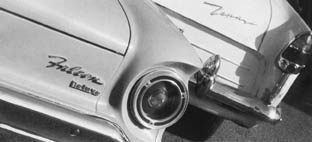
In this context, what happened next in the saga was extraordinary.
Theodore Emmett, vice-president of Ford Canada, responded to the misgivings of Ford Australia boss, Charlie Smith, about the Zephyr by showing him the new compact planned for the US and Canadian markets.
Smith liked what he saw and made the decision to swing the Falcon into full local production less than a year behind its US launch.
There were enormous risks but a look at the specifications of the contenders shows why Smith took those risks.
The Zephyr's 2.6-litre engine was at its limit vet the Falcon was starting with a big capacity lead over the Holden on a very short stroke.
A simple stroke increase, as happened in 1961 with the 2.8-litre Pursuit 170, and the Falcon would be way ahead.
The Zephyr had 300mm of fresh air between its rocker cover and bonnet. Because the Falcon bonnet and guards were dropped level with its grille, the Falcon immediately lost 300 mm in height, and some was returned to the cabin's glasshouse for an airier interior.
This still left the Falcon 200mm lower than the Zephyr with the bonus of a much wider tack and a longer wheelbase than either the Holden or Zephyr. Falcon passengers sat lower inside the wheelbase for a more comfortable ride, in a semi-reclining seating position.
With the memory of the FJ Holden fresh in his mind, Smith must have been gobsmacked by this radical new car.
From there, the Falcon's case only got stronger as lighter weight equalled superior performance and economy.
Bigger in all the major dimensions, it was slightly shorter than the Holden, the Falcon was a true six-seater, and exposed the Holden's narrowness. There was an auto gearbox and long service intervals to capitalise on two of the biggest shortfalls of the Holden, which didn't even have an oil filter. On the downside, the body's much lower profile brought more of the transmission tunnel inside and by local standards, the Falcon was under-tyred.
Its brakes, while not as big as the Zephyr's were bigger than the Holden's and that's what ultimately mattered.
The clinchers were a design cost that could match Holden's and a design life of at least 10 years, which would allow Ford to build on US development.
The first Falcon's US brief was to blitz cheap imports such as the VW by offering the cabin capacity and simplicity of the '49 Custom V8, at a VW price.
It shadowed exactly what GM had done a decade earlier with the first Holden. However its low design cost, its biggest strength in the US, would be its biggest weakness in Australia.
|
Once Ford decided to run with the Falcon, the time line was too tight to worry about whether the product would stand up under local conditions. Ford Australia had to place complete confidence in US Falcon development while it built a new engine plant, assembly plant, chassis plant and engineering centre. The scale of such a one-off gamble by a private company is unlikely to be ever seen again in Australia.Just how big is summed up by these figures: Ford's Geelong operations required a £7 million upgrade and the new Broadmeadows plant required £11 million plus land to get it open in 1959. Halfway through the first Falcon's model life in 1961, a further £15.5 million was invested in Broadmeadows production capacity. |
|
|
|
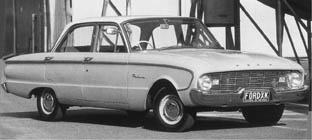
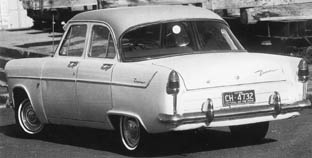
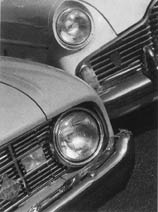
Ford Australia cleverly offered a wagon, utility and van on the sedan platform without the long rear overhang of their US counterparts. If only all Falcon problems were so easily fixed. Fight to survive US roads in 1960 were probably better than most Australian roads today while many of ours back then were Model T standard. Those who stuck to the blacktop loved the refinement and modem feel of the Falcon, but those who expected it to take the rough stuff like a Holden or Zephyr were sorely disappointed. The warning signs were there in the first road tests, when Modern Motor had to limp home minus second gear and with a damper that had lost its oil. The Falcon's front suspension was double wishbone, like the Holden, but the body-mounted coil springs acted on the upper wishbone from high up inside the wheelarch. The Falcon's front spring location fed suspension loads into the scuttle and up the windscreen pillars and rough roads had a predictable effect on the body. The Zephyr's strut towers were braced to the firewall but early illustrations show the first Falcon bodies without these braces, with devastating consequences. The owner of the early XK Falcon shown maintains that the dealer welded in the strut tower braces on his car. The Falcon also had ball joints some five years ahead of Holden but they were far too light for local conditions. After a brilliant launch, was soon fighting for its reputation but a heavy duty suspension and tyre package, specified by most buyers, helped get things back on track. Another factor was not so easy to rectify. Before the Falcon's arrival, life for Australia's biggest component suppliers was simple, tool-up for huge Holden volumes, keep GM-H happy on quality and price and bank the proceeds. Of all the problems that threatened the Falcon's future, according to Ford insiders at the time, it was the pricing, quality and availability of local components, not the durability of the original Falcon. Ford had to face the reality that a better Falcon alone would not ensure survival and it still had room to build the Zephyr Mark II and its Mark III replacement as well as the new compact Fairlane. Between them these kept traditional Ford buyers happy while Ford planned its next move for the Falcon. Until Ford could get the same deal as Holden from component suppliers the Falcon was ultimately stymied. Ford had to face the reality that a better Falcon alone would not ensure survival and it still had room to build the Zephyr Mark II and its Mark III replacement as well as the new compact Fairlane. Between them these kept traditional Ford buyers happy while Ford planned its next move for the Falcon. Until Ford could get the same deal as Holden from component suppliers the Falcon was ultimately stymied. This is why 1965, not 1960, the year when the last Zephyr was sold and the XP Falcon completed a desperate 113,000km durability run at an average 113km/h, is remembered by insiders as the year of the Falcon. It had become a product that the component industry dared not overlook and from that point on the Falcon's future was assured. Drive by It is very rarely that you return to cars 30 years after you last drove them and find that they are not dogs. The original low mileage Zephyr Mark II and XK Falcon in the photos proved to be as appealing as I remembered them. Graham Moore's Zephyr Mark II is the in-between 1958 model with the early high roofline and later front that introduced the first auto early in 1959. Moore's manual drove exactly as I remembered and how could anyone resist that beautiful exhaust note! Overall, the car felt remarkably similar to a Star Model Customline I once owned with its amazing flexibility and swift acceleration, no doubt helped by the Zephyr's short final drive ratio. The Zephyr sits you up high with a commanding view of the road, you also get a clear sense of the body's rigidity and weight, which are a giveaway that this car came from Britain, not the US. |
||
|
|
Ian Northey's XK Falcon is one of the first and if the Zephyr is class, the Falcon is modern. Visibility was a pre -occupation of 1960 road tests and the first Falcon must be an object lesson in safety because of the way it allows the driver to see in every direction. Because you sit so low, the Falcon has a ground-hugging feel. The sleek horizontal aspect, refinement and roadholding were its unique selling points in 1960 and it feels just as good today, providing you overlook the long steering column that pushes you back into the front seat. |
|
As successive Falcon stylists and engineers built on these, the car was a sure winner. A regular drive of a good XK Falcon should be compulsory for anyone charged with maintaining the Falcon tradition.
Article and photos courtesy Unique Cars magazine
Classified
For Sale
Set of whitewall tyres
695x14 for MkIV - 3 brand new and 2 used, but as new.Phone Mike for more details 03 688-8391
MkII Zephyr 1957 Interesting car with MkIII running gear, floor change, bucket seats. Original running gear available if required $1200 Also MkIV Zephyrs - 2 available, great order.
Contact Neville 03 318-4812