
For Sale Mk III Zephyr grill $50, tail lights complete $100 - excellent condition. Phone Bob Stevens 03 688-1296 Buy Mk III sun visor - Expanded metal type Phone Mike 03 688-8391 Printer wanted by editor for use on magazine. Contact Carol Bell 03 684-7733 if you have anything you think might be suitable. |
SC 10th Annual All British Day - Timaru, All Ford Day - Westport |
Mick and Paddy are out in the country shooting rabbits. Suddenly, right in front
of his friend Paddy, Mick falls to the ground, throws a quick spasm, then lies
perfectly still. He doesn't seem to be breathing, his eyes are rolled back in
his head, in fact, he looks pretty well dead! Quick as a flash a horrified Paddy whips out his mobile and dials 111. He gasps breathlessly to the operator: "Mick just fell to the ground right here in front o' me! He's not breathing. He has no heartbeat! I tink he's dead! What can I do?" Accustomed to this sort of situation, the emergency operator responds with her most soothing tone: "Okay Paddy, you must try to stay calm. If there's anything can be done, we'll do it. But you will have to keep your cool, then we can take it one step at a time! Okay now?" "Sure! Sure! Of course, you're right. I'm fine. Just tell me - what must I do?" "Great! Now first of all, let's make sure he's dead." The line goes silent, then a shot is heard ... Paddy's voice comes back down the line ... "OK! What next?" |
Pre-production Zephyr and Consul |
I removed the engine and gearbox, cleaned and painted the engine bay and boot, then
towed it to Brady�s panel shop. Gilbert said that if I wanted to do the preparation
work on it in the corner of the workshop they would see to the odd small
dent, undercoat and paint it for me. |
I completely stripped the car - doors, windows, seats, panels etc; sanded and rustproofed
where necessary, then it was undercoated, sanded down and masked
by me and painted by Trevor McDonald, Gilbert�s son. I then put it back together, painting the seats and inside panels myself. It was while the car was at this stage that, through John Hull, I found that there was a Zephyr club and we would be welcome to join. This we did and we have enjoyed being a part of it. Incidentally, a couple of years ago the Zephyr was using oil in one cylinder and the compressions were very good so I replaced all the rings and capped in the valves, and it has not used oil since. The trouble in the No.2 cylinder was the centre expander segment end lip had broken and it overlapped causing no tension on the oil scraper rails - unusual. There are still a few bits and pieces that need doing like carpets, window rubbers, driver�s window etc, but I will get around to that one day. In the meantime Colleen and I enjoy the outings with the other club members and to me that�s what it�s all about, rather than having the sharpest machine in the line. Laurie Spillane Temuka Mk III Zephyr |
Being Southlanders they were really friendly and made us most welcome. They
passed on their best wishes to our club, as they know several of our members.
Each February the Southland club meets in Kingston. Perhaps next year our club could join them. Wayne Philips |
April is here and autumn is truly with us with the cooler weather, not that we have
had much of the warm stuff!! During March the club had a run to Fairlie - it was the social convenor�s run. > The big events for this month will be �The International� in Brisbane and the Southern Connection in Christchurch - reports on these events in a later mag. This will be the first magazine for our new editor, and Carol tells me she is still coming to grips with the system and computer programme, but I�m sure, with help from Mike and the club, we will have a great magazine. I would like to ask members to submit articles, information and reports for the magazine, as it is these that make interesting reading. Please contact Carol if you have any ideas or adverts for the buy/sell section. We have international readers and you may be surprised at the interest in this page. May 6 is our annual meeting, so give some thought to standing for positions on the committee, as new faces bring new ideas and keeps the club interesting. The day for our run to Fairlie was wet so it was surprising but pleasing to see so many members turn out. It was great to see Robin and Lois Marshall, new members from Ashburton, as well as Peter and Mary Hunter, Peter and Gail Casey, Bob Duke and Denise, Max and Doreen Rose, Don and Ruth Campbell as well as our English friends Laurie and Jo Cushing. We left town via Eric Scott�s address, just in case they wanted to join in. It was great to see the old steam train running as we passed through Pleasant Point, and who saw the old Mk IV Zephyr and Bradford trucks at Raincliff? The scenery on the run was enjoyed by our English friends, as were the old familiar cars. I hope everyone had a great Easter. Happy Zephyring Bob Stevens President. |
South Canterbury Zephyr & Zodiac Enthusiasts Club Timaru New Zealand |
Club Magazine April 2002 |
|
|








|
|
March 10 Rookies Run (sorry - no Rookie nor instructions) Six cars left Pak �n Save on Sunday afternoon. It was great to have Robin and Lois Marshall, our new members from Ashburton, join us in their Mk I. Bob Stevens led the run over Kellands Hill, through Rosewill to Pleasant Point, up Totara Valley, and through Raincliff to the Fairlie/Geraldine highway. We stopped for afternoon tea at the Farm Barn, then continued through Fairlie and stopped again at the Cave Hotel before motoring home. Eric please note: Most Z-cars have windscreen wipers. Peter Hunter Club Captain |
|
|
|
|
|

Top |
Top |
Top |
Top |
Top |
Top |
Top |
Top |
At our February meeting I was looking at other clubs� magazines when it was pointed
out to me that the Southland club was meeting at Kingston the following weekend.
As we were going to our house at Kingston that weekend Carolyn and I decided to take our Mk II down for its fourth trip there. |
On Saturday morning we parked our Mk II out the front to see if anyone would stop.
Sure enough two Southland club members stopped and came over. They invited us to join them down at the beach where they had several boats. Carolyn and I went down later on and joined them for a few drinks, but didn't go to their barbecue, although we had been invited. Two members also have houses there and had spotted our Mk II there in the past. |
After selling our motor garage I thought I might restore the little green and yellow
Austin A35 I used to park outside the service station, but I flagged
the idea as I didn�t consider the Austin a good enough road car for outings. Also my wife Colleen would not ride in it - only the grandchildren and my dog would be seen in it - so I decided to look for a Zephyr of some type as a good travelling car. This was in 1997, and when I told the story to an old motor trade mate in Oamaru, Robin Mortimer, he mentioned they had recently done a WOF on one which was about to be put up for sale - in sound but tatty condition. I contacted the chap at 45 South just above Oamaru, had a look at it, and ended up driving it home. This is the capsicum green Mk III I have now. |
We have not had British-built Fords in New Zealand for more than a decade, and with
the closure of vehicle manufacture at Dagenham last month, it is doubtful we
ever will again. Dave Moore and The Press in Christchurch explain. |
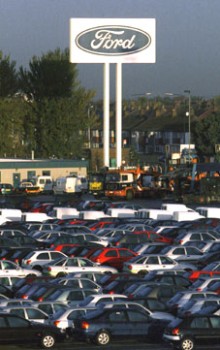
The last cars - Fiestas - to be built by Ford in Britain rolled off the Dagenham
assembly line last week. The Dagenham site is to become Ford�s global centre of excellence for diesel engines. The new role comes after more than 70 years of building Ford vehicles including the Prefect, Popular, Consul, Zodiac, Zephyr, Anglia, Cortina, Granada, Sierra, and Fiesta, many of which made their way to New Zealand. By the time the last car rolled off the line, Dagenham had assembled 10,980,368 vehicles. The story of Ford at Dagenham began at Trafford Park, Manchester, in October 1911. The factory was intended to be an assembly plant and the largely improvised enterprise soon outgrew itself when it became clear that there was a need for a factory specially designed for large-scale production. In 1923, Edward Grace of Henry Ford and Son of Cork was sent to England to find the site for a miniature of Ford�s main US plant to serve European markets. The choice of the Dagenham marshes came as a surprise to many, who said the $NZ500,000 site was unworkable. It presented a considerable challenge to the construction engineers, but the geographical advantages were obvious. The Thames-side location presented easy routes to Europe, as well as good access for raw materials. The London County Council was building a vast new housing estate nearby, and labour would be readily available, while the nature of the surrounding area allowed for future expansion. The site at Dagenham�s low water-soaked tract still looked highly unpromising when Henry Ford�s son Edsel cut the first sod of earth on the site on May 17, 1929, but the public had already expressed its confidence in the entire venture by heavily oversubscribing for shares. By 1931, the factory, built on 22,000 concrete piles driven 25m into the marshland, was complete, with its own blast furnace, foundry, jetty, and power station. The key to the decision to purchase the site had been the Thames, and soon vessels of up to 10,500 tonnes were berthing, ready to link the plant directly with the world. |
Within a few days of the last car rolling off the production line at Trafford Park,
the new Dagenham complex came to life. Special trains carried 2000 employees with families and possessions to Dagenham from Trafford Park while others were hired locally and elsewhere. At 1.16pm on October 1, 1931, the first vehicle to be built at the new Dagenham plant, a model AA truck, left the production line. Dagenham had opened in the depths of the Depression. Business was so bad that in the last three months of 1931 Ford only sold five cars, though production of trucks was brisker. At the time the press referred to Dagenham as a �magnificent gesture of faith in Britain�s commercial future - a lighthouse of hope in a storm-tossedd sea of industry�. In it first full year, Dagenham produced 22,595 cars and trucks. As the Depression lifted, so the number of vehicles produced increased. In 1933 6900 employees built 36,424 cars, plus 14,318 trucks and tractors. From 1939 to 1945 it was all hands to the war effort and the plant produced 360,000 light vans, army trucks, balloon winches, mobile canteens, and Ford V8-powered bren gun carriers - plus 34,000 Merlin aero engines. Dagenham�s Fordsons also accounted for 95 per cent of Britain�s tractor production during the war. |
The company made up for time lost during the war years. In 1950 the revolutionary
new Consul and Zephyr range of cars was launched, the first Ford cars to employ
completely integral body/chassis construction. A 50 per cent increase in floor space helped double production capacity from 233,624 cars, trucks and tractors in 1953 to 459,405 in 1959. Until the 1960s, virtually all the company�s cars, commercial vehicles and tractors were produced at Dagenham with an increasing number of components being supplied from subsidiary plants, but by the middle of the decade a new pattern of production had emerged. Car and light van manufacture was shared between Dagenham and a new factory at Halewood on Merseyside; tractors were built at Basildon, Essex; trucks and medium vans were made at Southampton and Langley, Berkshire. The next major new car produced at Dagenham - and destined to become one of New Zealand�s favourites - was the Ford Cortina. By the time the last Cortina Mk IV left the line in 1981 the plant had built more than three million of them. By this time Dagenham was already producing the Ford Fiesta, introduced in 1976, while the Ford Sierra started production in 1982. |
In 1990, Dagenham became a single car-line plant. Sierra production was transferred
to Ford�s factory at Genk, Belgium, leaving Dagenham to concentrate on the
manufacture of the Fiesta range alone. With Ford sourcing future European stock
from Genk and our own Wiri plant, the Sierra, almost without us noticing, had
become New Zealand�s final British Ford. May 2000 saw Ford announce the ending of vehicle assembly at Dagenham as part of its European restructuring. This saw a silver Fiesta rolling off the production line last month as the last of almost 11,000,000 Dagenham-built vehicles. Workers began leaving the Dagenham complex as the last cars made their way down the production line. The final Fiesta was, they said, delayed slightly because of a shortage of parts |
At the end of the war, Dagenham�s manufacturing facilities stood virtually as they
had been in 1931, but pent-up demand at home and abroad now created opportunities
for expansion. |
06 April |
Winchester Swap Meet there will be some display space for vintage and classic cars, so take the Z-car. |
14 April |
Lakes Run - leave Caltex, King St at 9am to travel through Waimate and up around the
lakes. BYO lunch and food to cook for barbecue tea (BBQ supplied). |
19 May |
Show & Shine - this year it is intended to have a breakfast then a run before we meet at a venue
for our Show & Shine. More details later. |
06 May |
Annual General Meeting - RSA Rooms |
May - date tba |
Rotary Classic Car Run, Ashburton |
28 April |
All British Car Day, Oamaru |
27 April |
All British Car Run, Oamaru - Leave Caltex, King St at 9.30am for Oamaru to join the Oamaru All British
run leaving at 11am. Run includes a pub lunch (own expense or BYO) then to a homestead for afternoon tea and prizegiving. Cost $5 per car plus $5 a head for admission to the homestead and afternoon tea. |
For Sale Offered for sale to finance new opportunity, this unique Mk I Zephyr convertible, devil red with white upholstery. A real good looker, and a great runner. Comes complete with personalised plates, continental kit, power hood, etc but minus the Starfires. To discuss further please contact Garey Hanifin, Phone (03) 688-6663 or (025) 323-516. |
02 June |
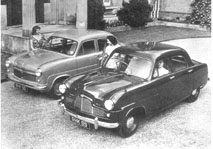
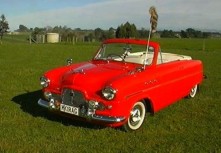
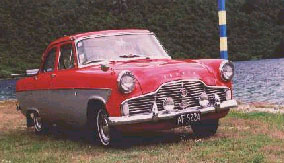
Photo: Wayne Phillips |
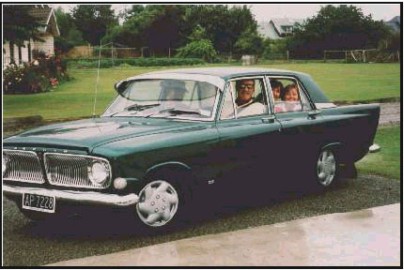
Photo: Laurie Spillane |