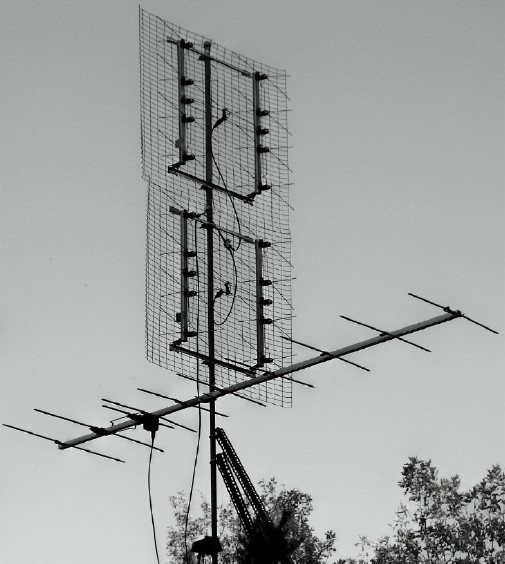
YOU MAY NEED an antenna system
like this one near Pollock Pines to receive DTV after February 17,
2009.
Free foothill DTV may cost you plenty
You've seen the ads on TV. Just hookup a
simple-to-use converter box to your analog TV set with rabbit-ears and you're
all set for the switch to digital TV this February 17, 2009 (now delayed to June 12, 2009 for most, but not all TV stations.) The
government even gives you free $40 coupons to pay for the boxes. But in
the Sierra foothills, when you hookup that converter box, all you're likely to
see is a blank screen and the words "No Signal". What the ads don't tell
you is that you may need to spend $300 or more on an outdoor antenna system to
be able to receive the DTV signals, and you may still not receive the signals
even after spending all that money and effort on a converter box and
antenna. It all depends on your location. A clear view of the
Sacramento Valley from a hilltop, and you're fine. Surrounded by hills and
trees, good luck. You do need to act now. Don't wait until February
to install an outdoor antenna system in the middle of winter. The ads also
don't tell you most portable analog TVs will be useless. Even digital
portable TVs will be useless outside of areas close to DTV transmitters.
You would need to haul along a huge antenna system with your portable digital TV
to use it on a remote camping trip.
The problem is that most DTV stations will be
broadcasting on UHF frequencies instead of VHF frequencies readily received by
analog TVs with rabbit-ear antennas. The much higher frequency UHF signals
get weaker over much shorter distances than VHF signals and are much more
affected by moisture, trees, hills, and atmospheric conditions.
Additionally, DTV reception is "all or nothing". If the signal is strong
enough, DTV gives you a perfect picture. If the DTV signal drops below a
certain point, the picture and sound will start to breakup and dropout and you
may receive nothing at all. With analog TV, as the signal drops, you still
get a viewable, albeit snowy, picture. The Sierra foothills, in addition
to being distant from Sacramento area DTV transmitters, are plagued by all the
conditions that make UHF reception just plain lousy. Also reception
differs by season. Atmospheric instability in the summer and fall may
cause disruptions and loss of signal lasting for days or weeks. A
top-notch, "deep fringe" outdoor antenna system is absolutely essential for
successful DTV reception in the foothills. Your alternative is to forever
pay monthly fees for cable or satellite TV, an absolute minimum of about $25 a
month for the most basic service on just one TV. Not happy about it?
This is a Federal mandate. If you can't receive DTV, advise the TV
stations and direct your complaints to the FCC and to your Federal government
representatives.
How can you prepare for the February DTV
transition? First, check if any nearby neighbors can get DTV and ask what
antenna system they are using. Next, ask if you can borrow a friends
converter box or a small digital TV and try it out in your home to see if you
can currently get DTV without any additional cost. Move your antenna
around and outside to see if that helps. If you get nothing, realistically
assess your situation. If there is a huge hill between you and Sacramento
and you are more than 50 miles from Walnut Grove (southwest of Sacramento where
all the major DTV transmitters exist), you might want to give up the idea of
free over-the-air DTV and go with cable or satellite (if you can afford
it.) If you wish to proceed, then, next, go to the websites, www.antennaweb.org and
www.tvfool.com.
These 2 websites allow you to input your address and receive valuable data about
DTV stations you may or may not be able to receive at your location as well as
the direction to point your antenna and how strong the signal may be. If
the data looks promising, then you can decide whether to proceed with buying a
converter box or digital television and investing in an antenna system.
(Note some of the station data on www.tvfool.com is
incorrect.)
To acquire a converter box, you should first
apply for up to 2 per household free $40 coupons from the U.S. government.
You can apply for them at www.dtv2009.gov or by
calling 1-888-388-2009. They must be used within 90 days from the mailing
date and cannot be combined (1 per box). California sales tax does not
apply to the $40 portion of the cost of a converter box. A converter box
costs between $40 and $70, and most are $60. Coupons can legally be given
to friends or relatives. Local stores selling converter boxes include
Radio Shack, WalMart, Kmart, Sears, Rite Aid, Target, Best Buy, Circuit City, and, the
more distant, Fry's Electronics. Many stores are having trouble keeping
converter boxes in stock. Circuit City did have a nationwide reputation of
maintaining a good stock of Zenith DTT901 boxes before going-out-of-business. A list of coupon eligible
converter boxes can be found at www.dtv2009.gov and
additional converter box information, specifications, and user manual links can
be found at www.ezdigitaltv.com/Converter_Box.html. Converter box reviews can be found at http://dtvconverterboxes.blogspot.com. The www.avsforum.com
website has a "Coupon Eligible Converter Box (CECB)" discussion forum where you
can find comments and opinions and ask questions about most converter
boxes. The www.avsforum.com "HDTV
Technical" forum similarily discusses topics about antennas and DTV
reception.
Any eligible converter box should do the job, but
features differ between boxes. You should get a box with analog
pass-through which easily allows you to bypass DTV and use your antenna for
analog TV. (After February 17, 2009, some low power stations will still
broadcast analog signals.) You may wish to consider price, warranty, ease
of setup, weak signal sensitivity, remote control button-size and functions, how
many programs can be displayed in the "Electronic Programming Guide" (EPG),
S-Video and "Smart Antenna" outputs, event timers to work with your VCR
recorder, battery pack or access to your car battery for portable power,
etc. The Channel Master CM-7000 has S-Video output. The DISH Network
TR-40CRA is only $40. The DISH Network DTVPal has event timers and an
elaborate EPG. (EPGs are only as good as the data sent to the box by the
individual DTV stations.) The RCA DTA800B1 has an easy to use remote
control with large buttons. The Winegard RCDT09A has an optional battery
pack available. Consumer Reports thinks the Tivax STB-T8 has a superior
picture. The most popular and probably best all-around converter box (easy
to setup, good station reception, and low power consumption) is the Zenith
DTT901 (identical to the Insignia NS-DXA1-APT sold by Best Buy.) (Note:
avoid the earlier Zenith DTT900/Insignia NS-DXA1 which does not have analog
pass-through and was widely reported to have audio quality problems.)
Some websites which can help you choose an
antenna are www.hdtvprimer.com and
www.hdtvantennalabs.com. You will need an antenna system that can receive
both UHF and VHF. If you live in a home covered by homeowner
association rules, federal law says such rules cannot prevent you from
installing an outdoor antenna to receive television broadcast stations (see:
www.fcc.gov/cgb/consumerfacts/consumerdish.html). VHF channels 2-6 will not be used for most DTV, but
DTV will be broadcast on VHF channels 7-13. (Some low power stations will
still use channels 2-6.) The government has already auctioned off low VHF
frequencies to industries for $19 billion and is reserving remaining low VHF
frequencies for an inter-agency emergency communication system. While most
Sacramento area stations will broadcast on UHF, KVIE DTV will be on channel 9
and KXTV DTV will be on channel 10 in February. Some Bay area stations,
such as KGO on channel 7 and KNTV on channel 12, will also be on VHF as well as
Reno/Tahoe stations KRNV on 7, KOLO on 8, and KTVN on 13.
In most cases, for DTV reception in the
foothills, you will need the best "deep fringe" antenna you can find. You
will also need a good antenna preamplifier which is mounted on the antenna mast
powered by low DC voltage supplied through the antenna cable by an AC-to-DC
power adapter attached to the other end. It is usually better to have
separate UHF and VHF antennas. Because all major Sacramento area DTV
transmitters are in one location, Walnut Grove, an antenna rotator is not
necessary. In fact, looking from Pollock Pines, nearly all Sacramento and
Bay area DTV transmitters line up in one direction. Only one spanish
language station, KUVS, is off this line. If there is just one station or
a few stations you want off in another direction, rather than use a rotator, it
may be cheaper to have a separate antenna aimed at that station and run a
separate cable to an antenna switch ahead of your converter box or digital
TV.
There are basically 2 types of antennas to choose
from. One is the yagi-type which is a long boom, often 10 feet or longer,
with many metal elements protruding horizontally from it. UHF yagi
antennas also have a "corner reflector" at the back end of it. The second
type is the "bowtie" UHF antenna which consists a large flat rectangular metal
wire reflecting grid and up to 8 "bowtie" metal elements arranged in front of
the grid. Deep fringe yagi and 8-bay bowtie UHF antennas give similar
performance. The low-cost Channel Master 4228 8-bay UHF antenna has a
unique advantage over yagi UHF antennas as well as other 8-bay antennas in that
it is moderately capable of receiving VHF channels 7-13. Many people
consider the Channel Master 4228 the best deep fringe UHF antenna. The
Channel Master 4228, however, weighing around 10 lbs, requires a heavy duty mast
while a yagi may weigh only a few pounds, an advantage if mounted on a very tall
antenna mast.
Besides the Channel Master 4228, other 8-bay UHF
antennas include the Antennas Direct DB8 and the Winegard HD8800. Deep
fringe UHF yagis include the Antennas Direct 91XG, the Antennacraft MXU59 and
the Winegard HD9095P. For a VHF reception, if you have an old outdoor VHF
antenna, you can use that. If you don't plan on viewing any low power
analog stations on channels 2-6, then you only need a VHF antenna designed for
channels 7-13. Long range yagi VHF antennas for channels 7-13 include the
Winegard YA-1713 and the Antennacraft Y10-7-13. Instead of having separate
UHF/VHF antennas, you can buy a combined UHF/VHF deep fringe antenna such as the
Winegard HD7698P and the Channel Master 3671. To increase antenna gain
even more, it is also possible to gang two identical antennas together, in
phase, pointing them in the same direction.
The purpose of a mast preamplifier is to boost
the signal and reduce noise by amplifying the signal before noise is added to
the signal passing through the antenna cable. If you amplify the signal
after it passes though the cable, you will also amplify the noise which won't
improve anything. A low-noise, high-gain preamplifier will permit you to
run an RG6 cable up to 250 feet between the antenna and the TV with little noise
gain. For deep fringe foothill reception, a good low-noise, high-gain
preamplifier is essential. The preamp should be able to filter out FM
frequencies. Strong FM transmissions, such as from cell towers, could
otherwise overload the preamp. There are really only 2 mast preamplifiers
you should consider, the Winegard AP-8275 and the Channel Master 7777
UHF/VHF preamplifiers. Of these, the Channel Master 7777 has
separate inputs for a VHF and a UHF or UHF/VHF combined antenna and a lower
noise figure for UHF where the Winegard AP-8275 only has one input for a
combined UHF/VHF antenna.
Location and height of the antenna is
critical. Ideally a very expensive portable signal analyzer would help
find the best location. Even if you could find a professional with such an
analyzer, because atmospheric conditions change UHF reception so much, one would
need to analyze the reception at various times of the day over a period of
several weeks to determine the best location for the antenna. So, just
find the highest spot away from heavy tree growth and powerlines that has the
least obstructed view towards Walnut Grove, and mount the antenna on the
highest, heavy-duty mast you can afford or manage. This may be on your
roof, or, if your property allows, on a free-standing mast atop a high point up
a slope or on a hill. Telescoping masts up to 50 feet in height supported
by well-anchored guywires every 10 feet are available, but a crew of 4 or 5
volunteers is needed to set it up, one each pulling taut on 3 or 4 guywires and
one raising the mast sections. Strong enough UHF signals can "bend" and
make it over hills and through trees, but every foot of antenna height you can
muster helps. "Line-of-sight" gives the best reception. Remember,
with a preamplifier, you can run an RG6 antenna cable up to 250 feet to the best
location with little signal loss.
Finding deep fringe antennas, quality mast
preamplifiers, telescoping masts, etc. in stores locally is not really an
option. Cable and satellite has wiped out the once big market for roof-top
antennas. Even Radio Shack only has a very limited selection of its own
outdoor antennas. Some big box and small hardware stores may carry one or
two models of suburban-type outdoor antennas. Fry's Electronics does stock
Channel Master 4228 and 3671 antennas, but not the Channel Master 7777
preamp. Your best option for selection and discount pricing is to simply
order the antennas over the internet. Several reputable websites with a
large antenna selection include www.warrenelectronics.com, www.solidsignal.com,
and www.summitsource.com.
Currently, reliable reception of all Sacramento
area DTV stations may not be possible all of the time. Don't fret
yet. After February 17, 2009, when analog TV goes off the air freeing-up
channels, DTV stations will be making changes much improving our ability to
receive reliable DTV. DTV stations have several ways to improve the DTV
signals they transmit. Some DTV stations now broadcasting on UHF will
switch to VHF, greatly improving the area of coverage and reliability.
Some UHF stations will switch to other UHF channels to allow power increases
that don't cause adjacent channel interference. Most UHF DTV stations will
be increasing the Effective Radiating Power (ERP) of their transmitters to the
maximum allowed by the FCC which is 1000 kW. ERP required for VHF stations
is very much lower. (Transmitters actually operate at a typical power of
20 to 50 kW. Transmitting antennas concentrate the signal into a narrow
beam radiating parallel to the ground in all directions with a much higher
Effective Radiating Power given by the transmitter power times the gain of the
transmitting antenna. The higher the gain, the narrower the beam.)
DTV stations will also be increasing DTV antenna heights, replacing the analog
antennas now occupying the highest spots on antenna towers. This will make
it easier for viewers to achieve a "line-of-sight" to the transmitting antennas
and improve reception in the foothills.
Many DTV stations will also improve signals in
the foothills by switching from horizontal polarization to elliptical or
circular polarization. Polarization refers to the plane in which the
electric portion of an electromagnetic wave travels. UHF signals penetrate
through hills and trees significantly better when the waves travel with at least
some vertical component of polarization. Analog television has always been
broadcast with horizontal polarization. That's why TV antennas have
elements sticking out horizontally. AM radio is vertically polarized which
is why your car antenna sticks up vertically. If the vertical and
horizontal components are equal, that's circular polarization. If the
horizontal component is greater than the vertical component, that's elliptical
polarization.
Here is a short compilation of the changes you
can expect from DTV stations after February 17, 2009 based on information
obtained from the FCC website, www.fcc.gov/mb/video/tvq.html. Antenna height is given as Height Above Average
Terrain (HAAT) which considers both the antenna tower height and the elevation
of the ground the tower is sitting on (which may be a hill.) "Pre" and
"Post" refer to before and after February 17, 2009. Some stations (KCRA, KOVR, KMAX in Sacramento and some Bay Area stations with antennas on the Sutro Tower) may not complete upgrades to their transmitting antennas until late September 2009 or later. Note that converter boxes identify DTV stations by their old analog channel numbers even though the actual DTV transmission is on a different channel. For example, the converter box displays KCRA as channel 3, but KCRA actually transmits DTV on channel 35:
• KCRA-TV, NBC, Channel 3, Sacramento,
Hearst-Argyle Stations, Inc. -
Pre: Channel 35 UHF, ERP 1000 kW, Antenna Height
1516 ft, Horizontal Polarization;
Post: Channel 35 UHF, ERP 1000 kW, Antenna Height
1900 ft, Horizontal Polarization.
• KVIE, PBS, Channel 6, Sacramento,
KVIE, Inc. -
Pre: Channel 53 UHF, ERP 360 kW, Antenna Height
1857 ft, Horizontal Polarization;
Post: Channel 9 VHF, ERP 33 kW, Antenna Height
1958 ft, Elliptical Polarization.
• KXTV, ABC, Channel 10, Sacramento,
KXTV, Inc. -
Pre: Channel 61 UHF, ERP 1000 kW, Antenna Height
1946 ft, Horizontal Polarization;
Post: Channel 10 VHF, ERP 34.5 kW, Antenna Height
2008 ft, Circular Polarization.
• KOVR, CBS, Channel 13, Stockton,
Sacramento Television Stations, Inc. -
Pre: Channel 25 UHF, ERP 760 kW, Antenna
Height 1939 ft, Horizontal Polarization;
Post: Channel 25 UHF, ERP 1000 kW, Antenna Height
2014 ft, Elliptical Polarization.
• KUVS-TV, Univision, Channel 19,
Modesto, KUVS License Partnership, G.P. -
Pre: Channel 18 UHF, ERP 500 kW, Antenna Height
1821 ft, Elliptical Polarization;
Post: No Change Applied For.
• KSPX, ION, Channel 29, Sacramento,
Paxson Sacramento License, Inc. -
Pre: Channel 48 UHF, ERP 1000 kW, Antenna Height
1604 ft, Horizontal Polarization;
Post: No Change Applied For.
• KMAX, CW, Channel 31, Sacramento,
Sacramento Television Stations, Inc. -
Pre: Channel 21 UHF, ERP 850 kW, Antenna Height
1907 ft, Horizontal Polarization;
Post: Channel 21 UHF, ERP 1000 kW, Antenna Height
2014 ft, Elliptical Polarization.
• KTXL, FOX, Channel 40, Sacramento,
Channel 40, Inc. -
Pre: Channel 55 UHF, ERP 1000 kW, Antenna Height
1906 ft, Horizontal Polarization;
Post: Channel 40 UHF, ERP 950 kW, Antenna Height
1972 ft, Horizontal Polarization.
• KQCA, MY58, Channel 58, Stockton,
Hearst-Argyle Stations, Inc. -
Pre: Channel 46 UHF, ERP 600 kW, Antenna Height
1903 ft, Horizontal Polarization;
Post: No Change Applied For.
• KTFK-TV, Telefutura, Channel 64,
Stockton, Telefutura Sacramento LLC -
Pre: Channel 62 UHF, ERP 195 kW, Antenna Height
3068 ft, Horizontal Polarization;
Post: Channel 26 UHF, ERP 850 kW, Antenna Height
1952 ft, Elliptical Polarization.
KQCA 58 DTV does not now have reliable
foothill reception and currently has no plans to increase ERP from the current
600 kW. I have been in contact with KQCA engineering advising them of
reception problems, and, hopefully, corrective action will be taken to assure
reliable foothill KQCA reception by February. KTXL 40 DTV is actually
reducing ERP from 1000 kW to 950 kW in February, negating a small increase in
antenna height, and has no current plans to switch from horizontal to elliptical
polarization, and that concerns me because the KTXL signal now occasionally
drops out. I find KOVR 13 DTV currently gives the most solid reception
closely followed by KTXL 40 DTV and KSPX 29 DTV. KXTV 10 DTV is currently
poorly received, but, after switching to VHF in February, KXTV 10 DTV reception
should be among the strongest. KTFK 64 DTV is not now viewable, but will
be. The other DTV stations are currently viewable most of the time.
KUVS 19 DTV is viewable, but, because it is not located in Walnut Grove,
requires a different antenna orientation for solid reception.
So what system did I end up with to be able to
receive DTV near Pollock Pines, some 59 miles from Walnut Grove? I have a
Zenith DTT901 converter box, two Channel Master 4228 8-bay UHF antennas ganged
together, a Winegard YA-1713 yagi VHF antenna, and a Channel Master 7777
preamplifier mounted on a 20 foot free-standing mast made of galvanized pipe
hauled up an 80 foot slope above my home connected via 210 feet of RG6
cable. I currently receive up to 9 Sacramento area stations (16 channels
total), though not all of them all of the time. I also briefly receive
signals in the early am at times from the Bay area including KGO, KQED, KNTV,
and KKPX. After the February 17, 2009 transition, I expect DTV station
transmission improvements will enable solid, reliable reception of all
Sacramento area stations plus occasional reception of some Bay area
stations. (Note: As of June 13, 2009, post-transition, KVIE 6, KXTV 10, KXTL 40 have been upgraded and now transmit strong, solid, reliable signals. KOVR 13, KSPX 29 signals are unchanged but still strong. KMAX 31, KCRA 3 are viewable most of the the time, but remain unreliable awaiting transmitter and antenna upgrades. KQCA 58 is unviewable with no plans yet submitted for improvement.)
Switching to DTV is far more complicated and
expensive in the Sierra foothills than the FCC and TV stations have made it out
to be. It was a big, time consuming, and costly project for me requiring a lot of research and trial and error. This letter gives you have the
benefit of my knowledge and experience. Those free coupons are not near
enough to help many of you make it through the analog to digital TV
transition. I sympathize with those who don't have the ability to deal
with the change and cannot afford cable or satellite service. This is your Federal government at work. Good luck!
Contact: [email protected]