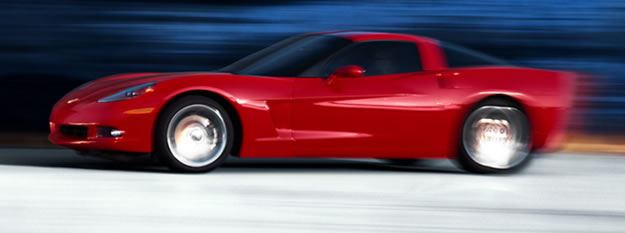
Get your assets in gear. A revolution in sports car history is now playing on a road near you. Introducing the sixth-generation 2005 Corvette, a machine that advances the sports car driving experience � in every dimension. Competes confidently at the highest level with the world�s finest sports cars.(3) Most powerful standard Corvette ever. Refined interior and leather seating surfaces. The precision-build requirements of a luxury car with minimized wind and road noise. Available in two body styles � coupe and convertible. The 2005 Corvette. The official car of your dreams.
Four-Speed Auto Transmission With Performance Shift Algorithm
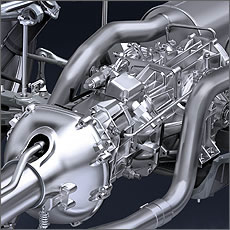
The new automatic transmission available in the sixth generation is significant for several reasons. Most importantly, it is the first Corvette automatic equipped to handle the 400 lb.-ft. of torque put out by the LS2 engine. It also features a technology known as Performance Shift Algorithm. Using sophisticated electronic controls that sense vehicle dynamics and driver input, it responds by selecting the best gears for the driving situation. Sensor input from the car body and the steering determine if the car is being driven enthusiastically on challenging roads or cruising on a freeway. If it�s the former, the transmission will remain in a lower gear to maintain maximum performance. Performance Shift Algorithm can also tell when the car is coasting downhill and maintain a lower gear to maintain engine braking.
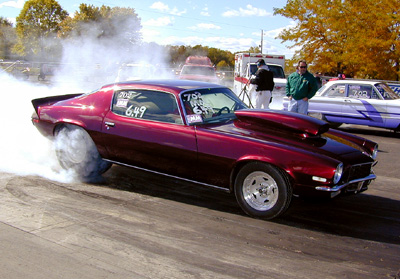
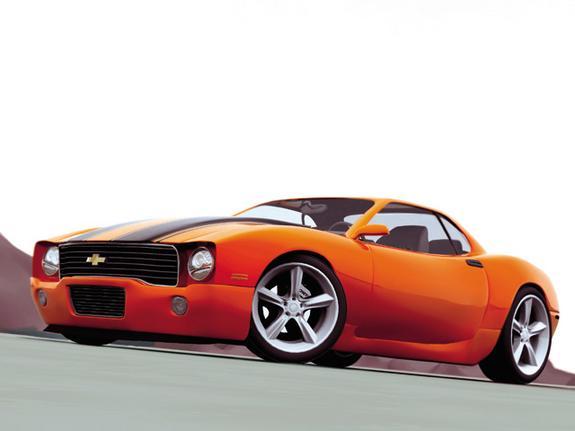
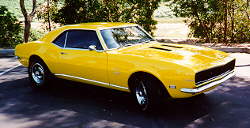
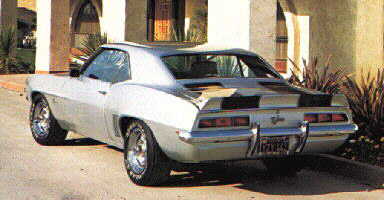
The Super Sport option had always indicated one of Chevrolet's top performers, from the SS 409 Impalas of the early sixties through the SS Chevelles. When Chevrolet decided to add a Super Sport option to the Camaro line, they made sure that it would continue the tradition of high performance. Curiously, Chevy never called it a Super Sport, referring to the option only as "SS."
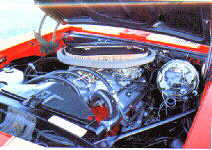
The first engine offered in the Camaro SS was the 295 horsepower 350 cubic inch engine. This was the only Camaro offered with the new 350. In November of 1966 Chevrolet introduced the 396 Mk IV big block, producing 325 horsepower, to the SS lineup.
The plan worked, with the Camaro taking the title in '68 and '69. The Z/28 got its own identification badges in '68 and the sales took off, with 7,098 of the total 235,147 Camaros sold that year carrying the Z/28 option. They did even better in '69 when 20,302 Z/28s out of 243,085 were sold.
As originally conceived, the Special Performance Equipment Option consisted of the F41 heavy-duty suspension, front disc brakes, metallic-lined rear drum brakes, 24:1 quick-ratio steering gear, 15x6 Rally wheels with 7.75x15 tires, a special air intake, the M21 close-ratio 4-speed transmission, and the 302 V8 engine. When the option hit the order sheets, however, it didn't include the brakes or the transmission. You were required to add these options seperately, adding another three to four hundred dollars to the standard four hundred dollar price of the Z/28 option.
Camaro engine
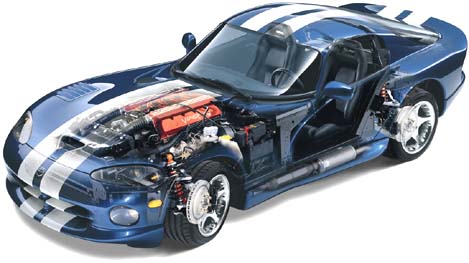
Viper's 8.0-liter engine is the largest and most powerful available today in an American production sports car. Viper GTS Coupe and RT/10 Roadster share the same 450 horsepower (460 in GT2 and ACR models) engine, suspension, brake system and adjustable pedal set.
Air intake is through a cast aluminum manifold with formed tubes, including an integral fuel rail cored in the castings. The dual throttle bodies and bottom-feed high-impedence fuel injectors control fuel flow and mixture. Fuel is fed to the injectors by a sequential multipoint injection system.
The engine's forged aluminum pistons are set in cast iron liners. The aluminum cylinder head features a conventional two valves per cylinder with higher-revving dual valve springs.
While a natural extension of the classic American V-8 (the small-block LA series, to be exact), a number of the V-10's unusual design features were derived from Formula One engines. Among these features are a closed tappet gallery for better intake manifold seating, and a sophisticated internal water flow system which traces its route outside the engine block, inside the cylinder head, around each cylinder and inside each combustion chamber for increased engine cooling.
Spent combustion gasses travel through a stainless steel tubular exhaust manifold, then pass through unique sill-mounted catalytic converters and exit at the center rear.
The six-speed manual transmission was designed to harness Viper's substantial power and match its high-performance expectations. It boasts an electronic reverse lockout feature and first-to-fourth skip-shift for fuel economy.
In developing this engine, Team Viper set out to maintain the simple powertrain design of classic high-performance sports cars -- because simplicity leads to durability, reliability and serviceability.
Chassis ConstructionViper's massive V-10 engine is mounted on what is believed to be the stiffest sports car chassis ever built.
The engine is cradled by two massive rectangular-tube frame rails, which turn out at the front bulkhead and continue on down the sides. Positioned between the front bulkhead and the back of the cockpit is a central backbone of smaller rectangular tubes. This is attached at the back to a cage or box which encompasses the rear suspension, a 19-gallon fuel tank, a spare tire, the battery and the trunk.
The fully independent front and rear suspensions feature unequal-length upper and lower "A" arms and coil-over springs made of lightweight, yet strong micro-grain alloy steel. High-performance gas-filled shocks minimize aeration.
The power-assisted rack-and-pinion steering system features positive on-center feel and a fast 16.7:1 steering ratio for quick and responsive maneuvering. Lock to lock is accomplished in a mere 2.4 turns. Viper's turning circle is 40.5 feet and its maximum turning angle is 28 degrees.
Viper's high performance brake system features four-piston front calipers with huge 13" x 1.26" vented rotors up front and 13" x.86 vented rotors at the rear. This system was specially designed to help meet the stated test-track goal of 0-100-0 mph in less than 15 seconds.
Truly massive high performance Michelin Pilot Sport tires created for the Viper are instrumental in translating the car's abundant horsepower and torque to more linear terms. These directional tires, 275/35ZR18 front and 335/30ZR18 rear, are a major factor in Viper's 1g lateral acceleration capability.
The tires are mounted on forged aluminum wheels with Viper logo centers (BBS forged aluminum wheels with chrome Viper Head center caps for the GT2 and ACR models).
Finally, Viper's cooling system consists of a lightweight copper-core radiator and an electronically controlled dual-speed electric fan. A front-mounted engine air-to-oil cooler is also standard.
Assembly And TestingEach Dodge Viper is hand-assembled at a special Detroit, Michigan facility on Conner Avenue by carefully chosen, skilled UAW workers with over 300 hours of training each.
Each Viper is made up of approximately 50 component modules which are shipped to the Viper facility from locations throughout North America. Stamping, casting, painting and welding take place off-site. Composite body panels arrive already painted. Complete instrument panels are supplied with the gauges tested and set in place. Engines are assembled and tested at a Chrysler engine plant.
The Conner Avenue Assembly Plant has adjacent work stations. Adjustments are made at each work station by individual craftspersons acting as their own inspectors, eliminating traditional repair stations and inspectors. Problems are immediately dealt with, even if they require a discussion with the on-site Team Viper engineer. All procedures are verified by assembly team members, with working team leaders coordinating efforts through craft managers.
The Viper assembly process is as unique as the car itself, even extending to testing procedures. For example, as is the case with race cars, wheel alignment includes adjustment of "bump steer." A special machine is used to align all four wheels off their wheel hubs. In this way, the wheels are moved up and down in their suspension travel and alignment is set in three different positions.
Every Viper is also "roll tested," which involves running the car at speed, in place, on special rollers right at the assembly center while the car is a "hot rolling chassis" minus all body panels. It is driven through all six speeds of its transmissions, up to 90 mph, in order to validate the proper functioning of all systems under actual driving conditions.
1965 Dodge Chargers
There was a 1965 Dart produced in small numbers with the "Charger 273" name. 180 were made at the factory, and 300 kits were dealer-installed. It was based on a Dart GT either as a hardtop or convertible and all of them were yellow with a black top and interior, with the Hi-Po 273, 13X6 Cragar mag wheels, and special Charger emblems.
1966 to 1967 Dodge Chargers
The centerpiece of Dodge's 1966 efforts was the Charger, based on the Coronet's body shell, but with a fastback roofline. The grille resembled the Coronet, but had retractable headlights, giving the car a sporty look.
The Charger came standard with a sturdy 318 V-8, then still new. The 2bbl 361 and 4bbl 383 were also options; the Hemi came in mid-year. The 318 Charger came standard with a 3 speed manual, and the bigger engines came with either a 4 speed manual or the Torqueflite automatic. The Charger did very well on the NASCAR circuit, winning the manufacturer's championship, but sales were poor, with only 37,344 1966 Chargers sold, a mere 468 with the 426 Hemi engine (which sold for about 1/3 of the car's base price!).
In its second year, a mere 15,000 were sold, including 118 Hemis, even though the 361 was replaced by a two-barrel 383 and the hot 375-horsepower 440 Magnum became available as an option.
1968 Dodge Chargers
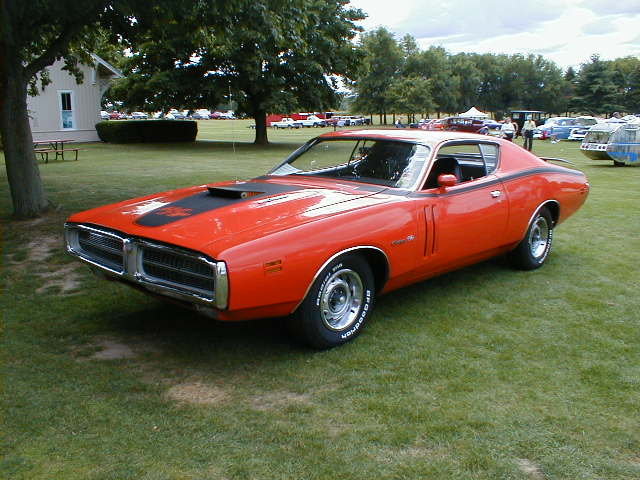
The restyling of the 1968 Dodge Charger is unquestionably the main reason for its sales success, since the 440 Magnum and Hemi were already available in 1967, and sales were dismal. The new "Coke bottle" look made the Charger one of the best-looking muscle cars, period, with many considering it the best-looking performance car of the 1960s.
The model line up expanded to include the Charger R/T, equipped like the Coronet R/T - it came came with a 440 Magnum, heavy duty suspension and brakes, and the bulletproof Torqueflite 727 3 speed auto with a 4 speed manual optional. The rear bumblebee stripes were a deletable option. The base Charger came standard with the corporate 225 slant 6 or 318 V-8, neither of which was a performance engine.
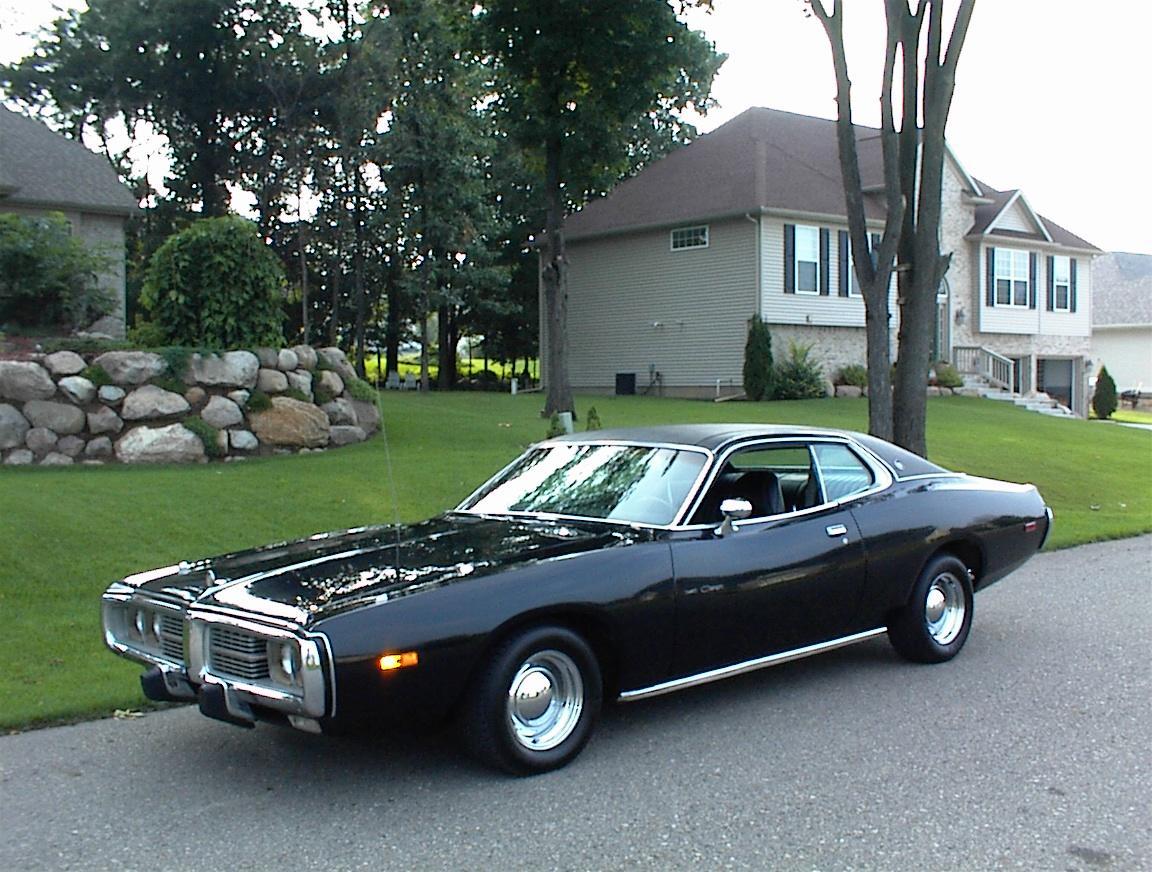
Dodge was understably torn between the usual annual styling changes and not wanting to mess with a good thing; they made minor changes to the grille as a compromise. The 1968 has a chrome bumper under the grille, the 1969 has a chrome center divider in the grille, and the 1970 has a rectangular chrome bumper around the grille.


 Camaro engine