Folia Sahariana, Vol.1, No.4 (2001)
P��sp�vek k pozn�n� bionomie a roz���en� dvou druh� pod�eledi Paussinae (Coleoptera: Carabidae)
v Maroku a Tunisku
A contribution to the knowledge of the bionomics and distribution
of two species of the the subfamily Paussinae (Coleoptera: Carabidae) in Morocco and Tunisia
[email protected]
Bionomics, diurnal activity, faunistics, Carabidae, Paussinae, Paussus (Klugipaussus) otini,
Paussus (Katapaussus) thomsoni, ant-host, Camponotus, Morocco, High Atlas, Tunisia, Sahara,
Madagascar
Abstract. Diurnal activity of Paussus (Klugipaussus) otini Antoine, 1943 in High Atlas,
Morocco was
observed and the ant genus Camponotus Mayr, 1861 is reported as its probable host. Data on the mass
occurrence of Paussus (Katapaussus) thomsoni Reiche in J. Thomson, 1860 in the evening before storm at
Douz, Tunisia, are presented. New records of Paussus otini from Morocco and of Paussus
thomsoni from Morocco and Tunisia are given. Notes on the distribution and taxonomy of
both paussinae species are supplemented. A brief discussion on the diurnal activity of the
adults of Paussus otini and of Paussinae in general is given, including original data on the diurnal
activity of the individuals of subgenus Cochliopaussus Kolbe, 1927 in Madagascar (Toamasina province).
�VOD
MATERI�L A POZOROV�N�
DISKUSE
LITERATURA
SUMMARY
MATERIAL AND OBSERVATIONS
DISCUSSION
�VOD
Bionomick� pozorov�n� t�kaj�c� se pod�eledi Paussinae ze severn� Afriky jsou v literatu�e
sporadicky zastoupena informacemi o hostitelsk�ch druz�ch (tam, kde je mo�n� nal�zat imaga
v nadzemn�ch ��stech hn�zd mravenc�) (Antoine 1951, Hellmann 1985) pop��pad� o jejich no�n�
aktivit� (jednotliv� sb�ry na sv�tlo) (Bedel 1900, Normand 1933, Mateu 1964).
Tato pr�ce obsahuje p�vodn� pozorov�n� a poznatky o chov�n� imag dvou druh� pod�eledi
Paussinae a okolnostech souvisej�c�ch s jejich hromadn�m v�skytem mimo hn�zda mravenc� a
�daje o jejich v�skytu na dal��ch lokalit�ch v Maroku a Tunisku. D�le je uveden soupis
v�ech dosud publikovan�ch �daj� o v�skytu druh� Paussus otini Antoine, 1943 a Paussus thomsoni
Reiche in J. Thomson, 1860 v Maroku.
Rodov� nomenklatura je uvedena podle Lorenze (1998).
MATERI�L A POZOROV�N�
Paussus (Klugipaussus) otini Antoine, 1943
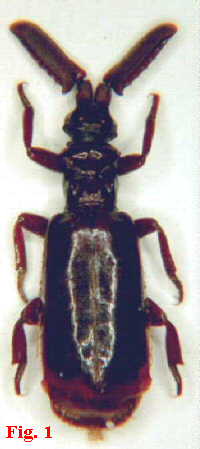
Materi�l: Maroko, Vysok� Atlas, Tizi-n-Test, (30� 52� S, 8� 23� Z), 24.-25.VI.1998,
17 samc� (Fig.1).
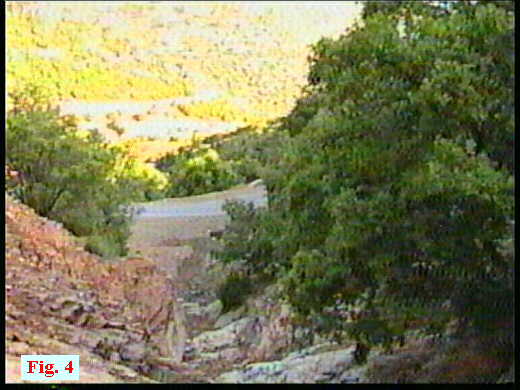
Pozorov�n�: Imaga P. otini byla pozorov�na r�no po dva dny ve 3-4 strm�ch skalnat�ch
sout�sk�ch severoz�padn� orientace v nadmo�sk� v��ce cca 2000-2100 m (Fig. 4).
Pozorov�n� bylo prov�d�no 24.VI. v 7,30-10,00 hod. a 25.VI. v 6,30-7,30 hod. M�sta v�skytu brouk� byla do
cca 10 hod. zast�n�na dubov�m lesem na h�ebenech nad sout�skou. Brouci zasti�en� brzy r�no
sed�li jednotliv� (nalezeny maxim�ln� 3 ex. na plo�e zhruba 3 m2) na kamenech a na zemi ve
vzd�lenosti cca 0,5-2,5 m od vchod� do hn�zd mravence Camponotus sp. (P. Werner det. )
pozd�ji mezi 9-10 hod. �ile pob�hali a poletovali.
Vzhledem k n�lezov�m okolnostem p�ich�z� mravenec rodu Camponotus Mayr, 1861 v �vahu
jako pravd�podobn� hostitel. Hn�zdo nem�lo ��dnou nadzemn� ��st a cel� bylo hluboko v udusan�
su�ovit� zemin�, proto jej nebylo mo�n� prozkoumat. Jin� druhy mravenc� nebyly na lokalit�
zji�t�ny. Zat�m jsou oba z�stupci podrodu Klugipaussus Kolbe, 1927 v Maroku - P. otini
resp. P. olcesei Fairmaire, 1856 - uv�d�ni pouze z hn�zd mravenc� rodu Pheidole Westwood,
1841, (Bedel 1900, Antoine 1943, Luna de Carvalho 1960).
Rod Camponotus je jako mo�n� hostitel v souvislosti s pod�eled� Paussinae zmi�ov�n s
pochybnostmi u druhu Paussus (Cochliopaussus) turcicus Frivaldsky, 1835 z Kavkazu
(Luna de Carvalho 1960).
Pozn�mky k roz���en� a determinaci: Druh P. otini byl doposud zn�m pouze ve 4 ex. z typov�
s�rie: �Lokalita.- Oblast St�edn�ho Atlasu: Tizi-n-Ifar, mezi Ksiba a Arhbala ! 1 ex. (typ)
; mezi Arhbala a Tassennt, 2 ex. (Otin); horn� ��st �dol� Tassennt, pobl� planiny jezer,
1 ex. (Otin). Tyto �ty�i exempl��e byly chyceny 11., 12. a 13. �ervna 1942, prvn� na svahu,
dal�� dva v mraveni�ti rodu Pheidole, posledn� pod zapu�t�n�m kamenem v �e�i�ti, docela
�iv� a ve v�born�m stavu" (Antoine 1943).
Znaky v�ech 17 ex. z Tizi-n-Testu (studov�ny i vn�j�� genit�lie) odpov�daj� znak�m uv�d�n�m
(Antoine 1955) pro druh P. otini. Luna de Carvalho (1960, 1962) v�ak zpochyb�uje validitu
druhu P. otini s t�m, �e vid�l exempl�� se sm�en�mi znaky mezi P. otini a P. olcesei.
Rovn� P. Nagel (osobn� sd�len�) nepova�uje morfologick� rozd�ly mezi P. otini a P. olcesei
ud�van� Antoinem (1943) za druhov�. Smyslem t�to pr�ce ale nen� vy�e�en� nejasnost� v
taxonomii, tak�e materi�l je pracovn� ozna�en druhov�m jm�nem P. otini.
Paussus (Katapaussus) thomsoni Reiche in J. Thomson, 1860
(= Paussus verticalis auct. nec Reiche, 1847; = P. saharae Bedel, 1900; = P. andreinii Gestro,
1909; = P. cymbalista Alluaud, 1923; = P. magrettii Gestro, 1923; = P. algerianus Luna de
Carvalho, 1957; synonymika viz Nagel 1977)
Materi�l a n�lezov� okolnosti: 1. Maroko, M-Hamid, 90 km ji�n� od Zagory, (29� 50� S, 5� 35� Z),
kemp, men�� p�se�n� duny s ��dk�m porostem Tamarix sp. a Phoenix dactylifera, 12.VI.1996, 6 samc�
a 1 samice na UV z��ivku (PHILIPS TL 4W/08) a 1 samec mrtv� v plynov� lamp�.
Doba sv�cen� byla �asov� omezena od 20,00 do 23,00 hod. Od 23,30 hod. foukal
siln�j�� v�tr, kter� cca v 8,00 hod. dne 13.VI. zes�lil v m�stn� p�se�nou bou�i.
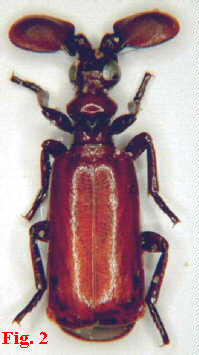
2. Tunisko, Douz, (33� 27� S, 9� 01� V), 11.IX.1996, 63 ex., (34 samc�, 1 samice in coll.)
(Fig. 2), na UV z��ivku (PHILIPS TL 4W/08). Doba sv�cen� byla �asov� omezena od 20,00 do
22,30 hod. Brouci p�il�tali po celou dobu sv�cen�. Lokalitou byl otev�en� prostor ve sm�en�m
biotopu slanisek, p�se�n�ch dun a palmeri�. Cel� odpoledne bylo slunce pod mrakem, velmi dusno,
p�ibli�n� v 19,30 hod. se stm�valo. Kolem 3,00 hod. r�no 12.IX. se zvedl siln� v�tr a nastala
pr�tr� mra�en doprov�zen� bou��. N�sleduj�c� noc foukal na lokalit� siln� v�tr a hust� pr�elo a
��dn� dal�� jedinci P. thomsoni ji� na sv�tlo p�il�k�ni nebyli.
N�lez na lokalit� Douz p�edstavuje zaj�mav� doklad hromadn�ho jednor�zov�ho v�skytu tohoto
druhu, jeho� p���inou byl s nejv�t�� pravd�podobnost� o�ek�van� p��chod vydatn�ho de�t�
(zm�na tlaku, p��padn� vy��� vlhkost vzduchu). O tomto jevu, kdy je na Saha�e mo�n� p�ed bou��
naz�vanou �siroco" p�il�kat na sv�tlo velk� mno�stv� jedinc� n�kter�ch druh� hmyzu, se v
souvislosti s P. thomsoni zmi�uje Normand (1933). Bedel (1897) p�ipom�n� tento jev v souvislosti
s druhem Heteracantha depressa Brull�, 1834 (Carabidae: Harpalini). S ur�itost� v�ak nen�
popisovan� zm�na po�as� nezbytnou podm�nkou pro b�nou no�n� aktivitu - imaga druhu P. thomsoni
jsou jednotliv� sb�r�na na sv�tlo po celou dobu v�skytu.
Pozn�mky k roz���en� a synonymice: Tento druh nen� v r�mci zem� Maghrebu nal�z�n v Maroku tak
�asto a v takov�m mno�stv� jako je tomu v Al��rsku �i Tunisku (Nagel 1977). Nagel (1977)
synonymizoval marock� druh P. cymbalista s druhem P. thomsoni. Tot� pojet� synonymiky Nagel
(1979) zast�v� i na z�klad� morfometrick�ho m��en� 2 ex. z Maroka a 50 ex. z Al��rska, Tuniska a
Egypta a 20 ex. z v�chodn� Afriky a Ar�bie.
Z Maroka jsou dosud uv�d�ny tyto n�lezy P. thomsoni: 1 ex., Tiznit, 5.IV.1922 (Alluaud 1923);
[po�et ex. neuveden], El Aioun du Draa, VI. [rok neuveden] (Peyerimhoff 1944); 4 ex., Ainchaib,
III. 1947 (Luna de Carvalho 1957); 4 ex., Sous, [datum neuvedeno] (Luna de Carvalho 1960);
1 ex., Sidi Ifni [datum neuvedeno] (Luna de Carvalho 1960); [po�et ex. neuveden], Erfoud, [datum neuvedeno]
(Kocher 1963); 1 ex., Sidi Ifni, 28.III.1985 (Hellmann 1985). Domn�v�m se, �e by bylo vhodn�
doplnit morfometrick� �daje o marock�ch populac�ch druhu Paussus thomsoni (cf. Nagel 1979)
prozkoum�n�m po�etn�j��ho materi�lu s d�razem na vz�jemn� srovn�n� lok�ln�ch populac�.
DISKUSE
Z�stupci pod�eledi Paussinae se vyzna�uj� no�n� aktivitou. Obvykle jsou loveni v noci na sv�tlo,
ve dne pak sb�r�ni pod kameny v mraveni�t�ch. Nen� mi zn�mo, �e by v literatu�e byla denn�
aktivita z�stupc� pod�eledi Paussinae p��mo zmi�ov�na. Peyerimhoff (1943) uv�d� u druhu
Carabidomemnus pallidus (Raffray, 1885) - podle Nagel (1982) jde z�ejm� o z�m�nu s druhem
Carabidomemnus mollicellus (Dohrn, 1880), �e byl chycen 1 ex. za letu v al��rsk�m poho�� Hoggar,
Tamanrasset, �ervenec 1941, bez bli���ho up�esn�n� �asu. H. Tanabe (Sakai & Tanabe 1996)
popisuje n�lez 1 samce japonsk�ho druhu Ceratoderus venustus Hisamatsu, 1963, kter� byl pozorov�n
�p�i vych�zce za ��elem fotografov�n� hmyzu" mimo dosah jak�hokoliv mraveni�t�, jak lezl po
mrtv�m strom� le��c�m na zemi.
Denn� aktivita byla pozorov�na (O. Hovorka observ.) i u dvou druh� rodu
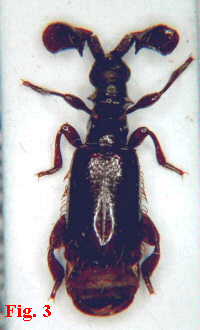
Paussus Linnaeus, 1775 v provincii Toamasina (Madagaskar). Jeden samec Paussus (Cochliopaussus)
sp. (Paussomorphus (Cochliopaussus) sp. sensu Jeannel 1946) (Fig. 3) byl chycen 27.I.2000 v 9,15 hod.
p�ibli�n� 1,5 km v�chodojihov�chodn� od Amboditafonana (17� 27� 43�� J 48� 44� 44�� V), kdy�
p�ilet�l na stan. Jedna samice Paussus (Cochliopaussus) sp. (druhov� skupina P.(Scaphipaussus) fissifrons
Fairmaire, 1902 sensu Jeannel (1946)) byla ulovena 30.I.2000 ve zbytku p�vodn�ho
lesa 4 km v�chodn� od Amboditafonana (17� 27� 32�� J 48� 46� 18�� V) smykem vegetace v 11,00
hod. Oba jedinci byli aktivn� za slune�n�ho a tepl�ho po�as� (O. Hovorka, osobn� sd�len�).
Leston (1978) b�hem sv�ho v�zkumu odchytil do Robinsonova lap�ku s UV sv�tlem o v�konu 125 W
v pr�b�hu 400 dn� v Legonu v Ghan� 1063 ex. �esti druh� brouk� pod�eledi Paussinae, z nich�
13 ex. (t. j. 1,2%) n�le�elo druhu Paussus (Klugipaussus) klugi Westwood, 1838.
Podle Kauppa & R�dela (1996) je v�ak v Lestonov� (1978) pr�ci pod jm�nem Paussus klugi
ve skute�nosti uveden Paussus latreillei Westwood, 1845.
B�hem jejich v�zkumu v n�rodn�m parku Como� (Pob�e�� Slonoviny) byl uloven pouze 1 ex.
P. latreillei z celkov�ho po�tu 336 jedinc� pod�eledi Paussinae (t.j. 0,29%),p�i�em� den� aktivita
z�stupc� po�eledi Paussinae nebyla pozorov�na.
Z dostupn�ch informac� nevypl�v�, zda je denn� aktivita charakteristick� pro podrod
Klugipaussus obecn� nebo je specifick� pro P. otini. Nask�t� se ot�zka, zda n�zk� pod�l
P. klugi v Lestonov� sb�ru (Leston 1978) nesouvis� s mo�nou ��ste�nou denn� aktivitou tohoto druhu.
POD�KOV�N�. Pod�kov�n� pat�� Dr. O. Hovorkovi (Praha) za koment�� k obsahu pr�ce a za postoupen�
vlastn�ch �daj� k publikaci a Prof. P. Nagelovi (Basle) a C. Wurstovi (Heilbronn) za
poskytnut� informac� nezbytn�ch k
publikov�n� �l�nku. D�le d�kuji Dr. J. Vitnerovi (Praha) za kritick� p�ipom�nky k rukopisu a Dr. P.
Wernerovi (Praha) za determinaci dokladov�ho materi�lu mravenc�.
LITERATURA
- ALLUAUD C. 1923: �tude des carabiques recueillis dans le Sous en Mars-Avril 1922 (Insectes Col�opt�res).
Bull. Soc. Sci. Natur. Maroc, 3: 11-18.
- ANTOINE M. 1943: Notes d�entomologie marocaine XL(I). Sur quelques Carabiques marocains.
Bull. Soc. Sci. Natur. Maroc, 23: 43-55.
- ANTOINE M. 1951: Notes d�entomologie marocaine LV. Additions et remarques taxomiques. Bull. Soc. Sci. Natur. Maroc, 31: 103-119.
- ANTOINE M. 1955: Col�opteres carabiques du Maroc (premiere partie). M�m. Soc. Sci. Natur. et Phys. du Maroc, N. S., Zool.
1: 1-177.
- BEDEL L. 1897: Catalogue raisonn� des Col�opteres du nord de l� Afrique. Premi�re partie. Soc. Entomol. France,
Paris, 402 pp.
- BEDEL L. 1900: Notes sur les Paussus du Nord de l� Afrique et sur les especes du groupe de P. cornutus Chevr.
(Col.). Bull. Soc. Entomol. France, 14: 278-279.
- HELLMANN V. 1985: Ein Beitrag zur Biologie der Gattung Edaphopaussus Kolbe (Coleoptera: Paussidae),
Entomol.Zeitschr., 95 (19): 285.
- JEANNEL R. 1946: Col�opteres Carabiques de la r�gion malgache (Premiere partie).
Faune de l'Empire Francaise, 6: 1-372.
- KAUPP A. & R�DEL M.-O. 1996: Die F�hlerk�fer der Elfenbeink�ste, Faunistik und Ph�nologie
(Coleoptera: Carabidae: Paussinae). Koleopterologische Rundschau 66:7-17.
- KOCHER L. 1963: Catalogue Comment� des col�opteres du Maroc. Fascicule I. Carabiques. Trav. Inst. Sci
Ch�rif., S�r. Zool., 27, Inst. Sci. Ch�rif., Tanger, 170 pp.
- LESTON D. 1978: Seasonality and the flight of paussids (Coleoptera) in west Africa. Psyche,
84: 210-217.
- LORENZ W. 1998: A systematic list of extant ground beetles of the world (Coleoptera
"Geadephaga": Trachypachidae and Carabidae incl. Paussinae, Cicindelinae, Rhysodinae).
W. Lorenz, Tutzing, 502 pp.
- LUNA DE CARVALHO E. 1957: Quelques Paussides pal�arctiques et ethiopiques r�colt�s par M. Bruneau de
Mir� (Col. Carab. Isochaeta). Rev. Fr. Entomol., 24: 281-287.
- LUNA DE CARVALHO E. 1960: Essai monographique sur les paussides palearctiques (Col. Carab. Pauss.)(4e
contribution pour l��tude monographique des Paussides). Atti Soc. It. Sc. Natur., 99: 344-359 + pl. XXIII.
- LUNA DE CARVALHO E. 1962: Observacoes sobre Paussus do grupo Klugi e descripcao de uma nova esp�cie
(Col. Carab. Pauss.). Mem. Estud. Mus. Zool. Univ. Coimbra, 278: 1-19 (in Portuguese).
- NAGEL P. 1977: Revision der Paussus armatus - Gruppe (Coleoptera, Carabidae, Paussinae). Stuttgarter Beitr.
Naturk., Ser.A, 293: 1-95.
- NAGEL P. 1979: Metrische Untersuchungen an Paussus thomsoni Reiche (Carabidae Paussinae). Entomol. Bl�tter,
74: 140-144.
- NAGEL P. 1982: Die F�hlerk�fer Kameruns (Coleoptera, Carabidae, Paussinae). Bonn. Zool.
Beitr., 33: 383-406.
- NORMAND H. 1933: Contribution au Catalogue des Col�opteres de la Tunisie. Fascicule 2. Bull. Soc. Hist
nat. Afr. Nord, 24 (8): 295-307.
- MATEU J. 1964: Les Col�opteres Carabiques de Beni-Abbes et regions Limitrophes. Bull. Soc. Sci. Nat.
Maroc, 44: 17-47.
- PEYERIMHOFF P. 1943: Mat�riaux pour un Catalogue des Col�opteres sahariens. II. Descriptions d'esp�ces
nouvelles. Bull. Soc. Hist. Natur. Afr. Nord, 34: 7-35.
- PEYERIMHOFF P. 1944: Col�opt�res du Sahara Marocain et du Sahara occidental. Bull. Soc. Sci. Natur. Maroc,
26: 90-110.
- SAKAI M., TANABE H. 1996: Rediscovery of Ceratoderus venustus Hisamatsu (Coleoptera, Paussidae).
Jpn. J. Syst. Entomol., 2: 273-274.
SUMMARY
Bionomical observations concerning subfamily Paussinae from the North Africa consist of short
notes about their ant hosts when beetles are collected in the ant nests (Antoine 1951, Hellmann
1985), and about nocturnal activity when beetles are attracted to light (Bedel 1900, Normand 1933,
Mateu 1964).
This paper summarises original observations on circumstances associated with collective diurnal
and nocturnal activity of two species of the subfamily Paussinae outside of the ant nests,
with a brief summary of published findings of Paussus otini and Paussus thomsoni from Morocco.
The generic classification follows Lorenz (1998).
MATERIAL AND OBSERVATIONS
Paussus (Klugipaussus) otini Antoine, 1943
Material: Morocco, High Atlas, Tizi-n-Test, (30� 52� N, 8� 23� W) 24.-25.6.1998, 17 males,
(Fig 1.)
Observations: All 17 specimens of P. otini were observed in 3-4 steep rocky gorges of NW
orientation about 2000 - 2100 m a.s.l. (Fig. 4) between 7:30-10:00 a.m. on 24.6.1999 and 6:30 - 7:30 a.m.
on 25.6.1999. The beetles occurred in places that were shaded until approx. 10 a.m. by the oak
growth on the ridges above the canyon. In the early morning, specimens were observed sitting
on stones and ground (up to 3 specimens were found on the area of approx. 3 square meters) in
the vicinity of nests of Camponotus sp. (ant specimens P.
Werner det.), later (9:00-10:00 a.m.) they were seen running and flying readily.
Because of the above circumstances, the undetermined Camponotus species is a possible host of P. otini.
The ant nest was subterranean and situated in a firm, talus-like soil without any above-ground
part, it was therefore impossible to search in the nests. No other ant species were found on
the locality. Both species of subgenus Klugipaussus Kolbe, 1927 known from Morocco - P. otini
and P. olcesei Fairmaire, 1856 - have been so far recorded from Pheidole nests so far (Bedel 1900;
Antoine 1943; Luna de Carvalho 1960).
Camponotus has been listed as possible host for Paussus (Cochliopaussus) turcicus Frivaldsky,
1835 from Caucasus (Luna de Carvalho 1960).
Notes on the distribution and identification of the species: P. otini has been so far known in
only 4 specimens of type series: "Localit�.- Zone de jonction du Moyen -Atlas: Tizi-n-Ifar, entre
Ksiba et Arhbala ! 1 ex. (type) ; entre Arhbala et Tassennt, 2 ex. (Otin) ; haut oued Tassennt,
pr�s du plateau des Lacs, 1ex. (Otin). Ces quatre individus ont �t� captures les 11, 12 et 13
juin 1942, le premier sur un talus, les seconds dans des fourmilieres du genre Pheidole,
le dernier sous une petite pierre immerg�e dans l�oued, et d�ailleurs bien vivant et en parfait
�tat." (Antoine 1943).
All 17 specimens from Tizi-n-Test (external genitalia examined) agree well with the
description of P. otini (Antoine 1955), although Luna de Carvalho (1960, 1962) considered
P. otini as a variety of P. olcesei (since he saw a specimen with intermediate characters.
P. Nagel (pers. comm.) also means that comparison of the males of P. otini and P. olcesei by
Antoine (1943) does not indicate any specific difference. For the purpose of this paper
I use name P. otini without trying to delve into this taxonomical problem.
Paussus (Katapaussus) thomsoni Reiche in J. Thomson, 1860
(= Paussus verticalis auct. nec Reiche, 1847; = Paussus saharae Bedel, 1900; = Paussus andreinii
Gestro, 1909; = Paussus cymbalista Alluaud, 1923; = Paussus magrettii Gestro, 1923; =
Paussus algerianus Luna de Carvalho, 1957; synonymy see Nagel 1977):
Material and collection circumstances: 1. Morocco, M-Hamid, 90 km South of Zagora,
(29� 50� N, 5� 35� W), in a camp surrounded by small sand dunes with sparse growth of Tamarix sp.
bush and palm trees Phoenix dactylifera. 12.6.1996, 5 males, 1 female at ultraviolet light (PHILIPS TL
4W/08), and 1 male dead in gas lamp. The light
trap was operated from 8:00 p.m. to 11:00 p.m. The wind became stronger around 11:30 p.m., and changed into
a local sand storm the next morning.
2. Tunisia, Douz, (33� 27� N, 9� 01� E ) 11.9.1996, 63 spec., (Fig. 2),
on ultraviolet light (PHILIPS TL 4W/08). The UV Lamp was operated between 8:00 pm.
and 10:30 p.m.. in an open space in a mixed biotope of salt swamps, sand dunes and gardens of
palm oases.
The afternoon was cloudy, very muggy, and the sun set at 7:30 p.m. Early next morning (at about 3:00 a.m.)
a strong wind started to blow, followed by heavy rain with thunder-storm. The second night at the
locality was also very windy, with dense rain, but no further specimens were attracted to light.
This interesting short-time mass occurrence could be triggered by the coming heavy rain
(probably a change of pressure or higher air humidity). This phenomenon, when a huge member
of specimens of certain species are attracted to light in the Sahara desert before storm called
�siroco" is mentioned with P. thomsoni by Normand (1933). Bedel (1897) noted this for
Heteracantha depressa Brull�, 1834 (Carabidae: Harpalini).
Such a change of weather is certainly not necessary for normal activity of this species.
Adult specimens of P. thomsoni are collected at light throughout the long period of adult occurrence.
Notes on the distribution and synonymy: This species is very common in Algeria and Tunisia.
From Morocco there are few findings. Nagel (1977) synonymised Moroccan specimens originally
described as P. cymbalista with P. thomsoni. Nagel (1979) came to a similar conclusion based
on the morphometric data obtained from two specimens from Morocco, 50 spec. from Algeria, Tunisia and
Egypt, and 20 spec. from eastern Africa and Arabia.
Only the following records have been published from Morocco: 1 spec., Tiznit, 5.4.1922
(Alluaud 1923); [number of specs. not stated], El Aioun du Draa, 6. [year is not stated]
(Peyerimhoff 1944); 4 spec., Ainchaib, 3. 1947 (Luna de Carvalho 1957); 4 spec., Sous,
[date is not stated] (Luna de Carvalho 1960); 1 spec., Sidi Ifni [date is not stated] (Luna de Carvalho 1960);
[number of specs. not stated], Erfoud, [date not stated] (Kocher 1963); 1 spec., Sidi Ifni,
28.3.1985 (Hellmann 1985). Further morphometric data on the Moroccan Paussus thomsoni are needed
(cf. Nagel 1979), with emphasis on the comparison of local populations.
DISCUSSION
Members of the subfamily Paussinae are known to have a nocturnal activity. They are usually
collected at light or in ant nests under stones during daytime. To my knowledge, a diurnal
activity of the subfamily Paussinae has not been expressly mentioned in the literature.
Peyerimhoff (1943) stated that one specimen of Carabidomemnus pallidus (Raffray, 1885)
(according to Nagel (1982), this specimen is probably Carabidomemnus mollicellus (Dohrn, 1880)),
was collected at flight in Algerian Hoggar Mts., Tamanrasset, in July 1941, without any
specification of daytime. Tanabe (Sakai &Tanabe 1996) described a record of one male of the Japanese
species Ceratoderus venustus Hisamatsu, 1963, which was seen during "a trip for taking a picture
of insects" as it "was walking alone on a dead tree lying on ground and no associates including
ants were found around there."
The activity through daytime was observed in two species of Paussus Linnaeus, 1775 in Toamasina district (Madagascar)
(O. Hovorka observ.). One male of Paussus
(Cochliopaussus) sp. (=Paussomorphus (Cochliopaussus) sp. sensu Jeannel (1946)) (Fig. 3) was captured 27.1.
2000 at 9:15 a.m. approximately 1,5 km ESE Amboditafonana (17� 27� 43�� S, 48� 44� 44�� E)
after landing on a tent. One female of Paussus (Cochliopaussus) sp. (P. (Scaphipaussus)
fissifrons Fairmaire, 1902 species group sensu Jeannel 1946) was collected 30. 1. 2000 in
the rest of primary forest 4 km E Amboditafonana (17� 27� 32�� S, 48� 46� 18�� E) by sweeping
of vegetation at 11:00 a.m. Both specimens were active during a sunny and warm weather (O. Hovorka,
pers. comm.).
Leston (1978) collected 1,063 specimens of six species of Paussinae in a 125 watt Robinson
ultraviolet light-trap which was run for 400 days in Legon, Ghana. In this material only 13
specimens (i. e. 1.2 %) belonged to Paussus (Klugipaussus) klugi Westwood, 1838. According to Kaupp &
R�del (1996) Paussus klugi sensu Leston (1978) is in fact Paussus (Klugipaussus) latreillei Westwood,1845.
During their research in the Como� National Park (Ivory Coast) only one specimen of P. latreillei
has been collected among 336 Paussinae beetles (i.e. 0.29%). No diurnal activity
of Paussinae was observed.
From the information available, it is impossible to conclude whether the diurnal activity also
occurs in other species of subgenus Klugipaussus. We can hypothesize that a low proportion of P.
klugi in Leston's material (Leston 1978) was caused by partially diurnal activity of this species.
ACKNOWLEDGEMENTS.
I am very obliged to Old�ich Hovorka (Praha), Peter Nagel (Basle) and Claus Wurst (Heilbronn)
for providing important data and/or comments on this paper.
Jan Vitner (Praha) critically commented the manuscript. I thank to Petr Werner (Praha) for determination of
Camponotus.
� [email protected]
