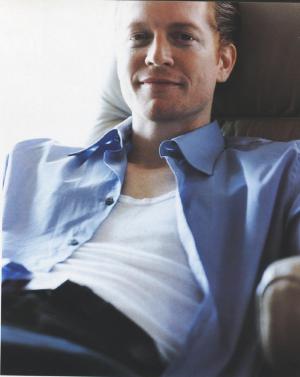
"Stoltz enjoying the ride on Chicago Hope"
By Jane Wollman Rusoff, Entertainment News Service
Eric Stoltz hasn't owned a television set for nearly 20 years, and he's not about to buy one -- even though he's co-starring, in his first TV-series cast job, on the Emmy-winning CBS drama, "Chicago Hope."
"If a person drives a bus, he doesn't go home and buy a bus to drive around in his free time," says the actor. No, rather than take a busman's holiday, Stoltz spends his spare time reading books -- or running "ridiculous errands." Today, for instance, he's off to the DMV, the bank and then to buy food for his German shepherds. "Those annoying chores I always put off until the last minute. Like the laundry -- and then I realize I have no clean clothes," says the 37-year-old bachelor, whose basic seriousness is peppered with a wry humor.
He first drew attention playing a boy suffering from a badly disfiguring disease in the 1985 movie, "Mask." He's gone on to portray a wide range of both dramatic and comic characters in dozens of features, many of them small independent films, including "Pulp Fiction" and "Little Women." In 1992, Stoltz starred in the Sundance Film Festival winner, "The Waterdance." And he'll soon be seen in "Hi Life," a comedy, and on Showtime TV in "The Passion of Ayn Rand" with Helen Mirren.
Stoltz joins medical drama "Chicago Hope" in its fifth season. He plays Dr. Robert Yeats, a practicing Buddhist and brilliant surgeon whose background in Eastern medicine puts him at odds with the hospital's high-tech approach to healing.
Stoltz describes his character as "funny, spiritual and complex" but still evolving: "That's what's great about having 20 weeks to develop a (role) -- we don't have to make any hard-and-fast decisions. ... One week, I'm meditating in the locker room, the next, I'm flirting with Dr. Austin (Christine Lahti) by boxing with her," Stoltz points out.
Stoltz's decision to commit to a series is tied in with his suffering from a "pre-midlife crisis. I'm finding myself doing things I've always wanted to do but never got around to: taking ballroom-dance lessons; I test-drove an electric car; maybe I'll go back to school and take an astronomy class. I cut off all my hair. My friends had a rather stricken look when I did that. But you get to a point where you say, 'I'm sick of myself! I'm gonna change everything!'" says the redhead, whose hair color has both helped and hindered his acting career.
But Stoltz's new attitude marks a self-imposed psychological makeover to, as he puts it, "shed old bad habits. I've become much less rigid about my life. I'm trying to be more open to things that happen across my path," he says. "Chicago Hope" is one of them. Last summer, the Tony Award nominee for "Our Town" was co-starring in a play when, he says, "out of the blue," the offer came.
He'd never seen "Chicago Hope," but after reading some scripts and watching tapes, he discovered, "It was a terrific show. ... To be frank, the scripts are better than most of the film scripts I've read in the last year. A lot of really fine writers are working in television now, (like) in the '50s, when they kidnapped all the great young writers." (His new deal also has Stoltz starring in a CBS movie within a year or two.) That his character hadn't been set in stone was "part of the allure," he says. "I asked (the producers), 'What do you have in mind?' They said, 'We don't know. What do you have in mind?' So we got together to come up with something, rather than trying to fit me into a predetermined slot."
Stoltz's new job certainly is keeping him hopping -- what with long production work days, plus meetings with UCLA Medical Center's chief of East-West Medicine, who helps the star bone up on Dr. Yeats' specialty.
The actor has never played a physician -- and he's "a little queasy about it. We did an appendectomy this week and discovered worms in this guy's belly. It was quite a shock. They used real worms -- dead, but they were 12-inch worms that burrow inside your intestines and live off you.
"When the cameras roll," he explains, "and they pour (fake) blood on your hands, and you reach into a belly to pull out worms, it's repulsive. OK, it's (only) acting; but 37 percent of the world has these worms inside them. I'm learning all these facts, which I'm sure will continue to gross me out for as long as I live."
Ever since his wormy day on the set, Stoltz has been careful to check the shooting rundown before breakfasting. But skipping a meal won't be hard, he says, because the studio commissary's food stinks. He does confess that he's spoiled. "On feature-film sets, they hire caterers who cook every day. Here, the food is like stuff from a school cafeteria -- not very healthy. I've been going off-campus to eat or bringing in my own lunch -- yogurt and fruit or a salad."
The German-French-English-Scottish son of a teacher and a high school principal, Stoltz was born in Los Angeles but as a toddler, moved with his family to American Samoa. The South Pacific was home for seven years. "It was like growing up in heaven," he recalls. The redheaded kid was "something of a freak because the Samoans are a huge, huge black people and I was a tiny, tiny orange child," he says. "They'd come up and rub my head and laugh in amusement. It made me feel good. So I didn't get a complex."
He started acting as a teen in Santa Barbara, Calif., and by 23, was co-starring in a breakthrough role that brought him a Golden Globe nomination: In "Mask," Cher played his mother. Working together, "she was a mama lion -- protective and strong and beautiful. You couldn't take your eyes off her," he recalls fondly.
Stoltz, "happily single" -- he's proud to say -- lives with a menagerie of dogs and cats near a Los Angeles beach and also has a ranch in New Mexico. Career-wise, his productiveness indeed screams workaholic. Oddly, though, the actor insists his "self-image is of someone who's rather lazy and hedonistic. "I'd just as soon lie around in a hammock with a good book as do anything else ... I wouldn't say I'm driven to achieve in the classic American male way. I have (actor) friends who are on a superhighway to success: They set goals and achieve them. My approach has always been to get off the superhighway and get lost on some weird country road that sometimes dead-ends or is filled with potholes. But to me, that's more interesting. I might not be as rich or a household name, but I'm enjoying the ride."
His "Chicago Hope" contract runs for one season only. However, if all goes well, Stoltz presumably would stay on, unless, he jokes, Dr. Yeats "gets some disease, ends up having an MRI, and they kill him at the end of the year."