--Leena Mehendale [1] IAS
The fast declining rate of female to male sex ratio as has been brought to the fore in the latest census of 2001 has created a wide- spread alarm among the government circles, the voluntary sector and academicians all over the country. There is no doubt that this kind of decline is not natural but is a result of rampant sex detection tests and female foeticides, thanks to the advances made by medical profession. For the first time, the sex ratio for children under 6 years ( 927) has gone below the All India average of� 932 for all age groups. As part of my private study on crime against women, I thought it worthwhile to study the relationship between fmr and female literacy.
To be born and to be educated are the most fundamental rights of anyone. Hence the scenario of their denial can be combined to see the pattern together. It has been argued earlier that the awareness created by education would, as a first step, lead women to go for lesser number of children and hence a more vigorous male child preference.(CWDS study). I decided to see what was the actual picture.
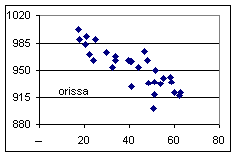
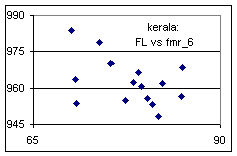
Apparently it would be expected that fmr should increase with increase in education. The actual trends are quite the reverse. Two scatter graphs plotting female literacy rates vs fmr for children below the age of 6 (fmr_6) for Orissa and Kerala in fig 1 and 2 below are typical examples of this trend. These two scatter diagrams depict very clearly, that districts having higher literacy rates among females have lower fmr_6. This is almost as if women must be denied either the right to be educated, if not, then the very right to be born. Or, is it as if better access to education which is supposed to bring modernization, liberation, economic productivity and awareness about rights of women has, as the first consequence, bound women more firmly to the patriarchic values of male�child-preference by helping them to access the required medical care without compunction?
The enormity of the situation strikes harder by the comparison of the two states. In Orissa, the lowest female literacy rate is 18 in the district of Nabarangpur. There onward, the right to education has improved but the right to be born has declined. In, the most literate state Kerala, lowest female literacy rate is as high as 70 in Kasargod district. And yet there is a falling curve when we plot female literacy and fmr6.
The reason for comparing fmr_6 rather than overall fmr is obvious. Firstly, the overall fmr may be skewed for reasons such as migration of male labourers. Secondly, if there has been a deliberate selective abortion of female foetus during the last decade, then the same will be reflected more clearly in the sex ratio for children rather than for adults.
An even sharper comparison can be made if the figures of fmr_1, that is children below the age of 1 are available. In fact, these figures are available with the anganwadi workers and up to the district level. Beyond that level however, they are not compiled gender-wise. �The women and child development department can look into this aspect.
Two things need to be said about the above observation. Firstly, it is not to suggest any cause and effect relationship between higher female literacy and a decline in fmr. Over the past decade, just as educational facilities have been extended to far flung areas, covering larger children population, so have the medical facilities extended especially in private sector, making foetus-sex determination and termination of pregnancy an easier, safer and quicker job. The male-child preference which had always existed has been reinforced by the availability of the medical techniques. The important point to be made here is that increase in literacy levels was not sufficient to counteract these tendencies.
Sadly enough, the same inverse proportionality between fmr_6 and female literacy is� also seen in Himachal, Rajasthan, West Bengal, Haryana, Gujrat, UP, Uttaranchal, Assam, and Jharkhand.
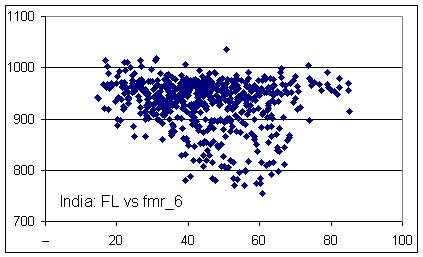
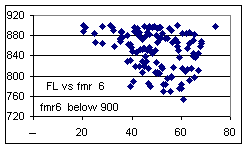
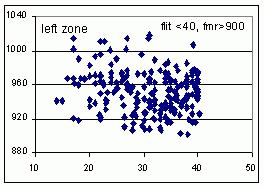
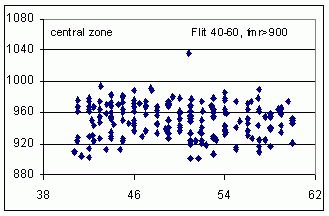
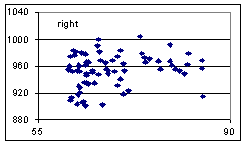
Fig.
3, 4, 5 : Relationship of fmr_6 vs. female lit. All
�India, lower zone and right
zone.
It is worthwhile to take a detailed look at these zones. How do various societies recognize, respect and uphold the right to be born and to be educated and who deny them and how?
Chart 1 gives �at a glance� how various districts are distributed among these zones across all the states in the country
Chart 1
|
State |
districts |
lower |
left |
central |
right |
na |
Av fmr6 |
flit |
mlit |
|
Punjab |
17 |
17 |
|
|
|
|
793 |
56 |
66 |
|
Haryana |
19 |
19 |
|
|
|
|
820 |
48 |
67 |
|
Chandigarh
|
1 |
1 |
|
|
|
|
845 |
67 |
76 |
|
Delhi
|
9 |
8 |
|
|
1 |
|
865 |
64 |
75 |
|
Gujarat |
25 |
16 |
5 |
2 |
1 |
x |
879 |
48 |
66 |
|
Himachal
|
12 |
5 |
|
5 |
1 |
x |
897 |
59 |
73 |
|
Uttaranchal |
13 |
1 |
1 |
9 |
2 |
|
906 |
51 |
71 |
|
Rajasthan |
32 |
12 |
17 |
3 |
|
|
909 |
36 |
62 |
|
UP |
70 |
25 |
41 |
4 |
|
|
915 |
35 |
57 |
|
Maharashtra |
35 |
9 |
1 |
17 |
8 |
|
917 |
58 |
74 |
|
Daman
& Diu |
2 |
|
|
1 |
1 |
|
925 |
60 |
78 |
|
MP |
45 |
4 |
22 |
19 |
|
|
933 |
42 |
63 |
|
Goa |
2 |
|
|
|
2 |
|
933 |
68 |
79 |
|
J
& K |
14 |
2 |
10 |
2 |
|
|
937 |
36 |
57 |
|
Bihar |
37 |
3 |
33 |
1 |
|
|
938 |
27 |
49 |
|
Tamil
Nadu |
30 |
4 |
|
14 |
12 |
|
939 |
58 |
73 |
|
Karnataka |
27 |
|
7 |
16 |
4 |
|
949 |
50 |
66 |
|
Orissa |
30 |
|
13 |
15 |
2 |
|
950 |
44 |
65 |
|
pondicheri |
4 |
|
|
1 |
3 |
|
958 |
66 |
78 |
|
Arunachal
|
13 |
|
10 |
3 |
|
|
961 |
36 |
53 |
|
Manipur |
9 |
|
1 |
7 |
1 |
|
961 |
52 |
68 |
|
West
Bengal |
18 |
|
4 |
11 |
3 |
|
963 |
52 |
67 |
|
Kerala |
14 |
|
|
|
14 |
|
963 |
78 |
83 |
|
Andhra |
23 |
|
12 |
9 |
2 |
|
964 |
45 |
62 |
|
Assam |
23 |
|
5 |
17 |
1 |
|
964 |
47 |
60 |
|
a&n
island |
2 |
|
|
1 |
1 |
|
965 |
65 |
76 |
|
Jharkhand |
18 |
|
15 |
3 |
|
|
966 |
32 |
56 |
|
Mizoram |
8 |
|
1 |
|
7 |
|
971 |
72 |
77 |
|
D
& N Haveli |
1 |
|
1 |
|
|
|
973 |
35 |
61 |
|
lakshadweep |
1 |
|
|
|
1 |
|
974 |
69 |
80 |
|
Chhatisgarh |
16 |
|
5 |
11 |
|
|
975 |
44 |
65 |
|
meghalaya |
7 |
|
2 |
4 |
1 |
|
975 |
48 |
53 |
|
Nagaland |
8 |
|
2 |
3 |
3 |
|
975 |
53 |
62 |
|
Tripura |
4 |
|
|
3 |
1 |
|
975 |
57 |
71 |
|
Sikkim |
4 |
|
|
4 |
|
|
986 |
52 |
66 |
|
All
India |
593 |
126 |
208 |
185 |
72 |
2 |
927 |
46 |
64 |
How many districts from which state contribute to this zone?
All 17 of Punjab, Chandigarh, all 19 of Haryana, 8 out of 9 districts of Delhi,
5 out of 12 from Himachal, 16 out of 25 of Gujrat, 12 out of 32 from Rajasthan,
9 out of 35 from Maharashtra, and 25 out of 70 in UP contribute to this phenomenon. Minor additions are from Bihar, J&K, MP, Tamilnadu and Uttaranchal.
After the enactment of PNDT Act in 1994 various state governments have yet to declare an Appropriate Authority in every district who can register the ultrasound and abortion clinics and monitor if any doctor is conducting pre- natal sex- selection tests and carrying out female foetus abortions. Only in a few isolated cases medical professionals have been taken to task for performing these tests and abortions. Newspapers carrying out open advertisements are not taken to task by the government. Supreme Court, in one PIL matter had to �order� the government to appoint appropriate authorities. More importantly, the present PNDT Act talks of banning only such techniques which were then prevalent. With the advances in science, new techniques keep coming and often a legalistic plea is taken that the PNDT Act cannot deal with them. Perhaps the Act can be renamed as sex imbalance prevention Act so that even future methods that will come with newer inventions can be dealt with effectively.
This also shows that merely making enactments is not sufficient. Merely appointing personnel will also not be sufficient. The medical professionals themselves have to shed their �business outlook� and act in a more responsible manner.
Despite the enormous dangers of such an adverse male- female ratio, and the fact that medical professionals are the first to understand it, despite the oath that every doctor takes to protect the human life, despite all the much tomtomed Ethical Committees and Medical Associations, we have yet to see an ultrasound clinic or a gynecologist who refrains from being a party to this �medically introduced� phenomenon, and takes pride in not being instrumental to it and has courage to openly display her/his pride by putting up a board outside the clinic. They have yet to publicly denounce their co-professionals who adopt these practices. Any such honest display will achieve far better results than all the seminars and stage talks, so often resorted to by IMA and such other bodies. Instead, the gynaecologists are busy telling people that abortion per say, is not prohibited or punishable, so they have no role to play in any plan of action.
����������� Recently, an attempt has been made to involve religious leaders. No religious leader has yet started to persue the subjects of either lower fmr or lower female literacy as a personal mission.
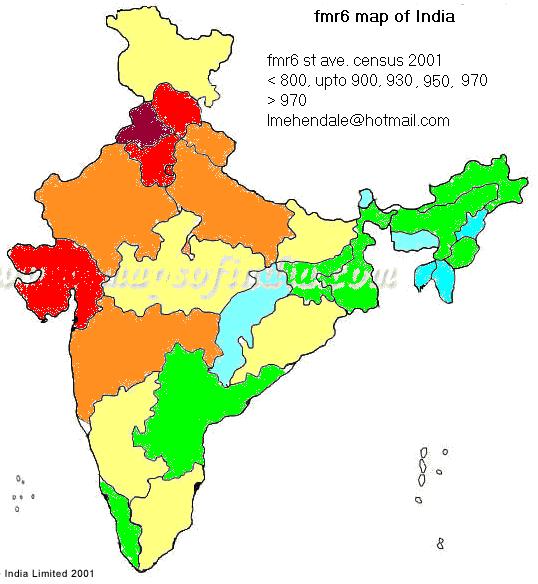
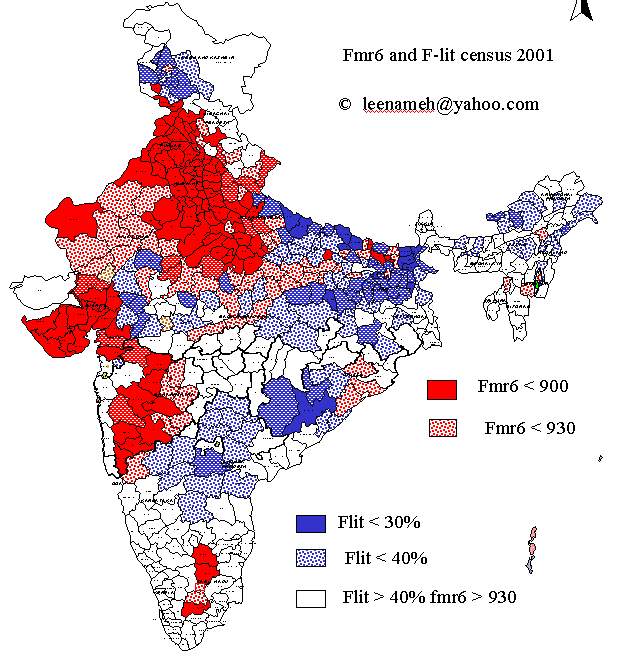
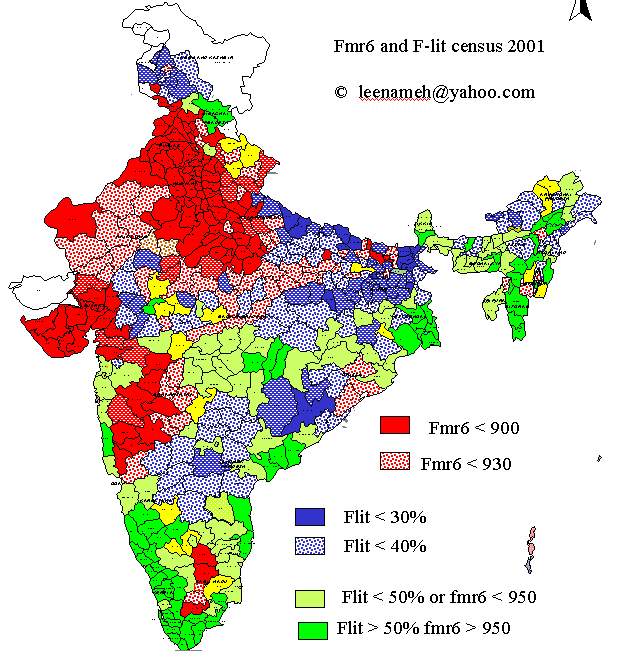
A quick look at the state- average-map of India shows the states having alarming and not so alarming fmr6 ratios. However the real picture can be had only by disaggregating the data further, at least upti district level.
An All-India map showing district wise distribution shows that 3 trends are running throughout the country: In the west, with Punjab as epicenter we get a spread of districts where fmr6 is lower than 900, or 910 (this gives contiguity in the map) or 930. These are Punjab, Hartna, chandigarh, Delhi, Rajasthan, Gujrat Maharashtra, J&K and HP. On east, with Bihar as epicenter we get a spread of� districts with female literacy below 20 or 30 or 40. These districts are in Bihar, UP, MP, North- Eastern states,� Orissa, Andhra. In the south we have a spread of districts from Kerala, Karnatak and Tamil nadu where both the situations are better except in the Salem- Madurai belt of Tamilnadu. In UP, Jharkhand and Bihar if a district is not in the low literacy zone, it is invariably in the low fmr6 zone and vice- versa.
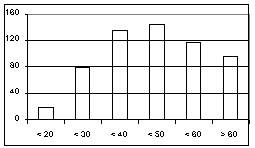
�����Readres with activist inclinations are referred to see the distribution of number of districts in different ranges of flit
������ All this only shows that women activism has a long way to go.
[Synopsis: The census of 2001 has brought out that for the first time, the sex ratio for children under 6 years ( 927) has gone below the sex- ratio for total population ( 932); this being largely the effect of female foeticide. Similarly, despite all efforts, the female literacy has remained low in some states. A possibility was earlier predicted in a study by CWDS that we may find more literate districts showing worse skewed sex ratios.This article aims at statistical analysis and mapping of those districts where either the right to be born or the right to be educated or both are denied to the girl child. Is there a correlation? Some of the observations are: (1) Fateh- garh Saheb district in Punjab has lowest fmr_6, namely 754. All districts of Punjab, and� two- thirds of haryana� have fmr_6 lower than 820. (2) With Punjab as epicenter, there is a continuous stretch� encompassing Haryana, Delhi, Gujrat, Rajasthan, Maharashtra and western UP that needs to be watched out for� low fmr. Policies like gender �desegregated census analysis of children below 1 year, more frequent census, village �wise analysis and stricter registration of ultra- sonography clinics need to be persued. (3) In the east, with Bihar as epicenter, there is a continuous stretch encompassing the districts of Bihar, Jkharkhand, eastern UP, Assam, Orissa, MP, and Andhra where female literacy is low and the efforts for girl-child education need to be strengthened. (4) Many states show a typical trend wherein the districts with higher female literacy have lower fmr_6. This points to a need for paradigm shift in our educational value system. (5) The PNDT Act may be replaced by Sex Imbalance prevention Act to effectively tackle future medical techniques and to make the focus sharper. ]
[1] The author is joint secretary to government of India working with National Commission for Women. This article is a part of her private study of Crimes Against Women in India.