
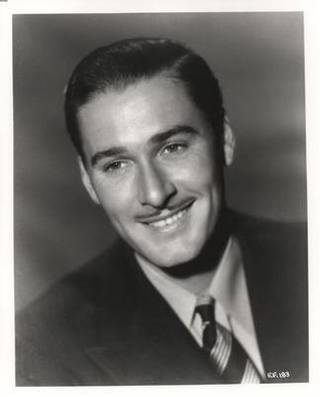
 Errol
Flynn was born to parents 'Theodore Thomas Flynn', a respected biologist,
and Marrelle Young, an adventurous young woman and decendent of a midshipman
of HMS Bounty fame. Young Errol Flynn was a rambunctious child who could
be counted on to find trouble. When the family took up residence in England,
Errol managed to have himself thrown out of every school he was enrolled
in. In his late teens he set out to find gold, but instead found a series
of short lived odd jobs. Information is sketchy, but the positions of police
constable, sanitation engineer, treasure hunter, sheep castrator, shipmaster
for hire, fisherman, and soldier seem to be among his more reputable career
choices. Staying one jump ahead of the law and jealous husbands forced
Flynn back to England. He took up acting, a passtime he had previously
stumbled into when asked to play (ironically) Fletcher Christian in a film
called In the Wake of the Bounty (1933). Errol Flynn's natural athletic
talent and good looks attracted the attention of Warner Brothers and soon
he was off to America.
Errol
Flynn was born to parents 'Theodore Thomas Flynn', a respected biologist,
and Marrelle Young, an adventurous young woman and decendent of a midshipman
of HMS Bounty fame. Young Errol Flynn was a rambunctious child who could
be counted on to find trouble. When the family took up residence in England,
Errol managed to have himself thrown out of every school he was enrolled
in. In his late teens he set out to find gold, but instead found a series
of short lived odd jobs. Information is sketchy, but the positions of police
constable, sanitation engineer, treasure hunter, sheep castrator, shipmaster
for hire, fisherman, and soldier seem to be among his more reputable career
choices. Staying one jump ahead of the law and jealous husbands forced
Flynn back to England. He took up acting, a passtime he had previously
stumbled into when asked to play (ironically) Fletcher Christian in a film
called In the Wake of the Bounty (1933). Errol Flynn's natural athletic
talent and good looks attracted the attention of Warner Brothers and soon
he was off to America.
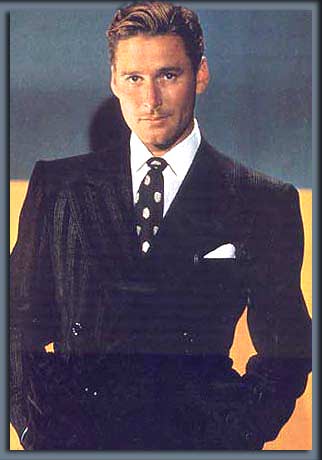 The
handsome, devil-may-care hero of Hollywood's most exciting swashbucklers,
Flynn shot to overnight stardom when brought on as a last-minute replacement
for Robert Donat to play the title role in Warner Bros.' pirate epic Captain
Blood (1935). His flamboyant charm and dashing magnetism quickly established
Flynn as the sound era's claimant to the Douglas Fairbanks swashbuckling
crown as he effortlessly portrayed a legion of heroic characters. A rebellious,
adventurous, peripatetic youth who was expelled from several schools and
held various jobs before turning to acting, Flynn made his film debut as
Fletcher Christian in a small Australian film, In the Wake of the Bounty
(1933). After appearing in an English-made quota quickie for Warner Bros.,
Murder at Monte Carlo (1935), Flynn was brought to the company's Hollywood
studio, where he played the small roles of a corpse in The Case of the
Curious Bride and a playboy in Don't Bet on Blondes (both 1935). After
the great success of Captain Blood Warner Bros. put Flynn in everything
from light comedies to Westerns, but it was his romantic adventure films
that were most popular with the public. Olivia de Havilland, his Captain
Blood leading lady, was again cast opposite him in The Charge of the Light
Brigade (1936). Loosely based on Tennyson's immortal poem, this thundering
spectacle was directed by hard-driving Michael Curtiz who, despite the
personal animosity between himself and his star, made Flynn unforgettable
leading the charge into the Valley of Death. Curtiz eventually directed
12 of Flynn's better films. Again teamed with de Havilland (with whom he
made eight films in all), Flynn had his best-remembered role, as the definitive
"merrie rogue" of Sherwood Forest, in The Adventures of Robin Hood (1938).
This was the part he was born to play; indeed, few of his peers could don
ornate period costumes, speak flowery heroic dialogue, or swing a saber
with such valiance or grace. Flynn expanded his buccaneering in The Sea
Hawk (1940, another of his biggest hits), and later played two larger-than-life
historical figures: Cavalry General George Armstrong Custer in the sweeping
Western They Died With Their Boots On (1941) and boxing champ James J.
Corbett in the evocative period piece Gentleman Jim (1942).
The
handsome, devil-may-care hero of Hollywood's most exciting swashbucklers,
Flynn shot to overnight stardom when brought on as a last-minute replacement
for Robert Donat to play the title role in Warner Bros.' pirate epic Captain
Blood (1935). His flamboyant charm and dashing magnetism quickly established
Flynn as the sound era's claimant to the Douglas Fairbanks swashbuckling
crown as he effortlessly portrayed a legion of heroic characters. A rebellious,
adventurous, peripatetic youth who was expelled from several schools and
held various jobs before turning to acting, Flynn made his film debut as
Fletcher Christian in a small Australian film, In the Wake of the Bounty
(1933). After appearing in an English-made quota quickie for Warner Bros.,
Murder at Monte Carlo (1935), Flynn was brought to the company's Hollywood
studio, where he played the small roles of a corpse in The Case of the
Curious Bride and a playboy in Don't Bet on Blondes (both 1935). After
the great success of Captain Blood Warner Bros. put Flynn in everything
from light comedies to Westerns, but it was his romantic adventure films
that were most popular with the public. Olivia de Havilland, his Captain
Blood leading lady, was again cast opposite him in The Charge of the Light
Brigade (1936). Loosely based on Tennyson's immortal poem, this thundering
spectacle was directed by hard-driving Michael Curtiz who, despite the
personal animosity between himself and his star, made Flynn unforgettable
leading the charge into the Valley of Death. Curtiz eventually directed
12 of Flynn's better films. Again teamed with de Havilland (with whom he
made eight films in all), Flynn had his best-remembered role, as the definitive
"merrie rogue" of Sherwood Forest, in The Adventures of Robin Hood (1938).
This was the part he was born to play; indeed, few of his peers could don
ornate period costumes, speak flowery heroic dialogue, or swing a saber
with such valiance or grace. Flynn expanded his buccaneering in The Sea
Hawk (1940, another of his biggest hits), and later played two larger-than-life
historical figures: Cavalry General George Armstrong Custer in the sweeping
Western They Died With Their Boots On (1941) and boxing champ James J.
Corbett in the evocative period piece Gentleman Jim (1942).
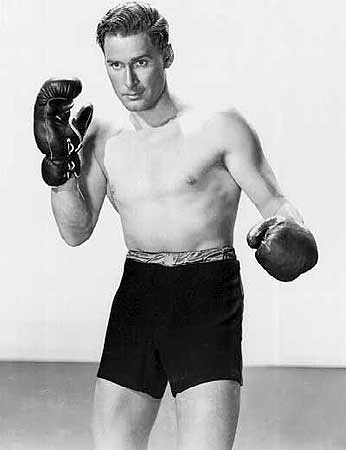 In
the former, moviegoers readily accepted the Irish-accented Tasmanian in
the lead role of this largely fictional retelling of the events leading
to the Little Big Horn battle. In fact, he played Western heroes throughout
his career, in such films as Dodge City (1939), Santa Fe Trail, Virginia
City (both 1940), San Antonio (1945), Rocky Mountain and Montana (both
1950). Flynn was less successful in brief forays into light comedy; the
public clearly favored him swinging sabers rather than serving as comedic
foil in the likes of Perfect Specimen (1937) or Four's a Crowd (1938).
He was more popular in war films, notably a 1938 remake of the WW1-set
The Dawn Patrol and the WW2 adventures Dive Bomber (1941), Desperate Journey
(1942), and Objective, Burma! (1945). Flynn's offscreen life was, incredibly,
even more colorful than his movies. An unabashed hedonist and insatiable
womanizer, he was notorious for his nonstop drinking, wenching, and general
highspirited bacchanalia. In 1942, at the height of his popularity, he
was charged with (but later acquitted of) statutory rape. The ordeal of
the trial and resultant publicity crushed Flynn's spirit. Never a person
to take acting seriously, his on-screen energy ebbed and he slid into a
gradual but steady decline in the postwar years. The best of his earlier
Warner Bros. films saw Flynn in roles that exuded a lust for adventure
and derring-do, but few of his later films had the same effect. Only when
cleverly cast in the title role of the tonguein-cheek Adventures of Don
Juan (1949) did he show a final glimpse of the magic that had made him
popular. Flynn's health deteriorated as well; the years of hard drinking
showedharshly-in his later screen appearances. Several of his final films
saw Flynn cast as an alcoholic; in the film adaptation of Hemingway's The
Sun Also Rises (1957) he limned a drunken American expatriate of the "lost
generation" with an accuracy born of experience and in Too Much, Too Soon
(1958) he portrayed his old boozing crony and fellow actor John Barrymore.
The star's final years found him aboard his beloved yacht "Zaca," anchored
in Port Antonio, Jamaica. Here in an island paradise he said reminded him
of his boyhood wanderings in New Guinea, Flynn worked on his posthumously
published autobiography, the slyly titled "My Wicked, Wicked Ways" (1959).
Flynn starred in the title role of William Tell a European production begun
in 1954 but never finished.
In
the former, moviegoers readily accepted the Irish-accented Tasmanian in
the lead role of this largely fictional retelling of the events leading
to the Little Big Horn battle. In fact, he played Western heroes throughout
his career, in such films as Dodge City (1939), Santa Fe Trail, Virginia
City (both 1940), San Antonio (1945), Rocky Mountain and Montana (both
1950). Flynn was less successful in brief forays into light comedy; the
public clearly favored him swinging sabers rather than serving as comedic
foil in the likes of Perfect Specimen (1937) or Four's a Crowd (1938).
He was more popular in war films, notably a 1938 remake of the WW1-set
The Dawn Patrol and the WW2 adventures Dive Bomber (1941), Desperate Journey
(1942), and Objective, Burma! (1945). Flynn's offscreen life was, incredibly,
even more colorful than his movies. An unabashed hedonist and insatiable
womanizer, he was notorious for his nonstop drinking, wenching, and general
highspirited bacchanalia. In 1942, at the height of his popularity, he
was charged with (but later acquitted of) statutory rape. The ordeal of
the trial and resultant publicity crushed Flynn's spirit. Never a person
to take acting seriously, his on-screen energy ebbed and he slid into a
gradual but steady decline in the postwar years. The best of his earlier
Warner Bros. films saw Flynn in roles that exuded a lust for adventure
and derring-do, but few of his later films had the same effect. Only when
cleverly cast in the title role of the tonguein-cheek Adventures of Don
Juan (1949) did he show a final glimpse of the magic that had made him
popular. Flynn's health deteriorated as well; the years of hard drinking
showedharshly-in his later screen appearances. Several of his final films
saw Flynn cast as an alcoholic; in the film adaptation of Hemingway's The
Sun Also Rises (1957) he limned a drunken American expatriate of the "lost
generation" with an accuracy born of experience and in Too Much, Too Soon
(1958) he portrayed his old boozing crony and fellow actor John Barrymore.
The star's final years found him aboard his beloved yacht "Zaca," anchored
in Port Antonio, Jamaica. Here in an island paradise he said reminded him
of his boyhood wanderings in New Guinea, Flynn worked on his posthumously
published autobiography, the slyly titled "My Wicked, Wicked Ways" (1959).
Flynn starred in the title role of William Tell a European production begun
in 1954 but never finished.
Biography by Leonard Maltin
|| Home
| Pictures
| Movies
| Cool Stuff
| Links |
Contact ||
Copryright © 2003 FlynnGirl