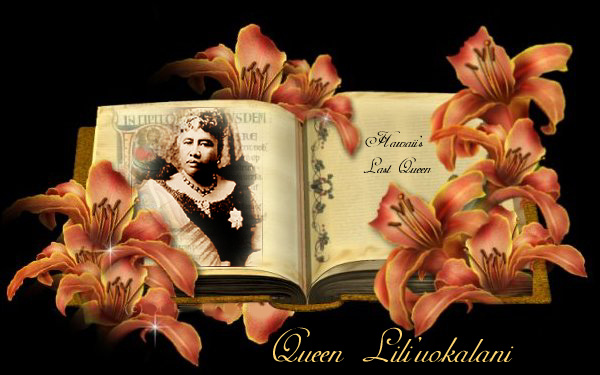
HAWAII'S LAST QUEEN
On January 16, 1893, four
boatloads of United States Marines armed with Gatling guns and hundreds
of rounds of ammunition came ashore in Honolulu, capital of the independent
Kingdom of Hawaii. As the Royal Hawaiian band played a concert at the Hawaiian
Hotel, 162 troops marched through the streets of Honolulu, heading for
the palace. The Queen of Hawaii, Lili'uokalani, looked down from her balcony
as the troops took up their positions.
The following day, she surrendered
at gunpoint, yielding her throne to the government of the United States.
A provisional government led by wealthy white sugar growers assumed control
of Hawaii and petitioned the US for annexation.
Born in 1838, Lili'uokalani
was trained by missionaries in Western academic disciplines and the ways
of polite American society. She was well-travelled and even attended Queen
Victoria's Golden Jubilee in 1887. Yet she never forgot her native language,
was fiercely proud of Hawaiian traditions and was always loyal to her people.
A talented composer, Lili'uokalani wrote more than 165 songs, including
"Aloha Oe," probably the most widely recognized Hawaiian song.
In 1881 her brother, King
Kalakaua, went on an extended journey around the world, leaving the 43-year-old
Princess in charge. Although she had no experience governing, she soon
had the chance to display her mettle when an epidemic of smallpox erupted,
killing many Hawaiians. The source of the disease was Chinese laborers,
brought by ship to work in Hawaii's sugar cane fields, the island's economic
mainstay. To protect the Hawaiians, Lili'uokalani immediately closed the
port, an act that infuriated the wealthy sugar growers.
"The outpouring of protest
by the business community was tremendous," says historical researcher Glen
Grant. "But she stood her ground. I think she clearly demonstrated that
the welfare of her people was far more important than the profits for the
business community."
Following her succession
to the throne after her brother's death in 1891, Lili'uokalani would work
secretly to frame a new constitution that would restore power to native
Hawaiians. But two months into her reign, the US government effectively
revoked Hawaii's favored position on the American sugar market and Lili'uokalani's
kingdom was on the brink of economic collapse. The sugar growers were convinced
there was only one way to survive-annexation to the United Sates.
The clash of interests that
ensued drew plantation owners, native Hawaiians, the US government, and
the Queen's cabinet into the fray. Eventually, Lili'uokalani would lose
her throne and the Hawaiian people would lose their kingdom. Hawaii was
recognized as part of the United States in 1898 by President William McKinley.





Home
Back