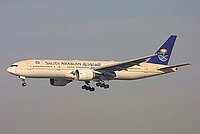
Boeing's advanced widebody 777 twin
incorporates more advanced technologies than any other previous
Boeing airliner, and has been progressively developed into increasingly
longer range developments.
The 777 was originally conceived as a stretched 767, but Boeing
instead adopted an all new design. Notable 777 design features
include a unique fuselage cross section, Boeing's first application
of fly-by-wire, an advanced technology glass flightdeck with five
liquid crystal displays, comparatively large scale use of composites
(10% by weight), and advanced and extremely powerful engines.
The 777 was also offered with optional folding wings where the
outer 6m/21ft of each would fold upwards for operations at space
restricted airports.
The basic 777-200 as launched in October 1990 was offered in two
versions, the basic 777-200 (initially A-Market) and the increased
weight longer range 777-200IGW (Increased Gross Weight, initially
B-Market). The IGW has since been redesignated 777-200ER.
The 777-200 first flew on June 12 1994, with FAA and JAA certification
awarded on April 19 1995. The FAA awarded full 180 minutes ETOPS
clearance for PW4074 -200s on May 30 that year. First customer
delivery was to United Airlines in May 1995. The first 777-200IGW/ER
was delivered to British Airways in February 1997.
The 777-100X was a proposed shortened ultra long range (16,000km/8635nm)
model, dropped in favour of the 777-200LR (originally 777-200X)
design study. Boeing claims the 777-200LR will be the longest
ranging airliner, capable of flying 16,417km (8865nm) - 18 hours
flying time. It will achieve this with awesomely powerful 489kN
(110,000lb) thrust GE90-110B1 turbofans, a significantly increased
max takeoff weight and optional auxiliary fuel tanks in the rear
cargo hold. Other changes include 2m (6.5ft) raked wingtips, new
main landing gear, structural strengthening and optional overhead
crew and flight attendant rest stations above the cabin. The 777-200LR
was launched in 2000, but is now delayed until 2006.