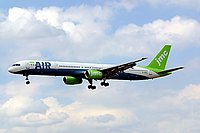
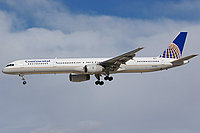
The stretched, 240 seat Boeing 757-300
is the first significant development of the basic 757-200 and is
aimed primarily at the European vacation charter market.
Although design work on the original 757 began in the late 1970s
and its entry into service was in 1983, it wasn't until over a
decade later in the mid 1990s that Boeing began to study a stretched
development of its popular narrowbody twin. This new 757 stretch
was covered by the 757-300X designation until its launch at the
Farnborough Airshow in England in September 1996.
The most obvious change over the 757-200 is the 300's 54.43m (178ft
7in) long fuselage, which is 7.11m (23ft 4in) longer than the
standard aircraft (and only fractionally shorter than the 767-300).
This fuselage stretch allows a 20% increase in seating to 225
to 279 passengers, depending on the interior configuration. Lower
hold freight capacity is also increased by 40% over the 757-200
by virtue of the longer fuselage.
Another feature of the 757-300 is its new interior which is based
on that developed for the Next Generation 737 models. Features
include a new sculptured ceiling, larger overhead bins, indirect
overhead lighting and vacuum toilets.
The 757-300 shares the 200's cockpit, wing, tail and powerplant
options, although the 300 will feature strengthened structure
and landing gear to cope with the increased weights, new wheels,
tyres and brakes and a tailskid.
The 757-300 first flew on August 2 1998, with certification in
January 1999, and entry into service (with launch customer Condor
- the charter arm of German flag carrier Lufthansa) in March 1999.
The -300's 27 month development program from final configuration
to planned first delivery is the fastest for any Boeing airliner
(the 777-300 took 31 months for example). Other early customers
are Icelandair, Arkia, Northwest, American Trans Air, Continental,
and JMC Air.