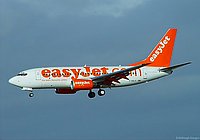
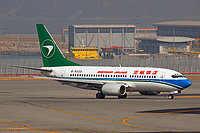
| The 737-600 and -700 are the smaller
members of Boeing's successful Next Generation 737-600/700/800/900
family.
Among the many changes, the Next Generation 737s feature more
efficient CFM56-7B turbofans. The CFM56-7 combines the core of
the CFM56-5 with the CFM56-3's low pressure compressor and a 1.55m
(61in) fan. The 737's new wing has greater chord, span and wing
area, while the tail surfaces are also larger. The 2.4m (8ft)
high winglets first developed for the Boeing Business Jet development
are now offered as an option on the 737-700 (and -800).
The new engines and wings allow the 737 to cruise at Mach 0.78
to Mach 0.80, while the larger wing allows greater fuel tankage
and transcontinental USA range. Other features include a 777 style
EFIS flightdeck with six flat panel LCDs which can be programmed
to present information as on the 777 or as on the 737-300/400/500
series, allowing a common pilot type rating for the two 737 families.
The improved Next Generation Boeing 737 family (originally covered
by the 737X designation) was launched in November 1993. The 737-700
was the first member of the new family to be developed, and is
based on the 737-300, while the 737-600 is based on the 737-500.
The 737-700 rolled out on December 7 1996, was granted certification
in November 1997 and entered service (with Southwest) the following
month. The 737-600 was launched was launched on March 16 1996,
first flew on January 22 1998 and entered service (with SAS) in
September that year.
The Boeing Business Jet or BBJ (described separately) is based
on the fuselage of the 737-700 with the larger 737-800's wing.
The BBJ's airframe also forms the basis for the convertible passenger/freighter
variant of the 700, the 737-700QC, which has been ordered by the
US Navy as the C-40A Clipper (to replace the DC-9 based C-9B).
The C-40 first flew on April 17 2000. The naval aircraft can be
converted to carry 121 passengers, or 3 pallets of cargo plus
70 passengers, or 8 pallets of cargo only. These aircraft are
currently (2002) based at Naval Air Station Fort Worth, Texas
(VR-59) and Naval Air Station Jacksonville, Florida (VR-58).
The US Air Force has bought two ex-Fordair BBJs, which are designated
C-40B.
|
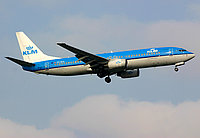
Boeing's Next Generation 737-800
and 737-900 are the largest members of the strong selling 737
family. Unlike the other Next Generation 737s, the -800 and -900
introduce new fuselage lengths, extending 737 single class seating
range out to 189, compared with 100 in the original 737-100.
Like the -600 and -700, the -800 and -900 feature the Next Generation
improvements including more efficient CFM56-7B turbofans, the
new wing with greater chord, span and wing area, larger tail surfaces
and the 777 style EFIS flightdeck with six flat panel LCDs which
can present information as on the 777 or as on the 737-300/400/500
series, the latter allowing a common pilot type rating for the
two 737 families. A HUD is optional. BBJ style winglets are offered
as an optional feature for the -800.
Until its launch on September 5, 1994 the 737-800 was known as
the 737-400X Stretch. Compared with the -400 the -800 is 3.02m
(9ft 9in) longer, taking typical two class seating from 146 to
162, while range is significantly increased. The -800 has sold
strongly since its launch, and early 2002 was the highest selling
Next Generation model. First flight was on July 31 1997, first
delivery (to Hapag Lloyd) was in April 1998.
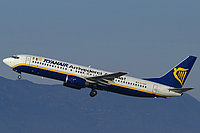
The largest single order for the -800 series has come from the
Irish budget carrier, Ryanair. After 28 had already been ordered
earlier, a firm order for 100 aircraft was made in January 2002,
with an option of another 50, to be delivered over the next 8
years. Ryanair will use the aircraft in a single class configuration,
to seat 189 passengers
A variant of the 737-800 is the Boeing Business Jet 2 (BBJ2),
which is described separately.
The 737-900 is the largest and latest member of the 737 family,
and was launched on September 10, 1997 with an order for 10 from
Alaska Airlines. A 1.57m (5ft 2in) plug forward of the wing and
a 1.07m (3ft 6in) plug rear compared with the -800 increases seating
to 177 in two classes (maximum seating is the same as the 737-800's
due to emergency exit requirements). First flight was made August
3, 2000, and the first delivery (to Alaska Airlines) May 15, 2001.
|