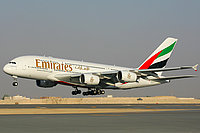
The 555 seat, double deck Airbus A380
is the most ambitious civil aircraft program yet. When it enters
service in March 2006, the A380 will be the world's largest airliner,
easily eclipsing Boeing's 747.
Airbus first began studies on a very large 500 seat airliner in
the early 1990s. The European manufacturer saw developing a competitor
and successor to the Boeing 747 as a strategic play to end Boeing's
dominance of the very large airliner market and round out Airbus'
product line-up.
Airbus began engineering development work on such an aircraft,
then designated the A3XX, in June 1994. Airbus studied numerous
design configurations for the A3XX and gave serious consideration
to a single deck aircraft which would have seated 12 abreast and
twin vertical tails. However Airbus settled upon a twin deck configuration,
largely because of the significantly lighter structure required.
Key design aims include the ability to use existing airport infrastructure
with little modifications to the airports, and direct operating
costs per seat 15-20% less than those for the 747-400. With 49%
more floor space and only 35% more seating than the previous largest
aircraft, Airbus is ensuring wider seats and aisles for more passenger
comfort. Using the most advanced technologies, the A380 is also
designed to have 10-15% more range, lower fuel burn and emissions,
and less noise.
The A380 features an advanced version of the Airbus common two
crew cockpit, with pull-out keyboards for the pilots, extensive
use of composite materials such as GLARE (an aluminium/glass fibre
composite), and four 302 to 374kN (68,000 to 84,000lb) class Rolls-Royce
Trent 900 or Engine Alliance (General Electric/Pratt & Whitney)
GP7200 turbofans now under development.
Several A380 models are planned: the basic aircraft is the 555
seat A380-800 (launch customer Emirates). The 590 ton MTOW 10,410km
(5620nm) A380-800F freighter will be able to carry a 150 tonne
payload and is due to enter service in 2008 (launch customer FedEx).
Potential future models will include the shortened, 480 seat A380-700,
and the stretched, 656 seat, A380-900.
On receipt of the required 50th launch order commitment, the Airbus
A3XX was renamed A380 and officially launched on December 19,
2000. In early 2001 the general configuration design was frozen,
and metal cutting for the first A380 component occurred on January
23, 2002, at Nantes in France. In 2002 more than 6000 people were
working on A380 development.
On January 18, 2005, the first Airbus A380 was officially revealed
in a lavish ceremony, attended by 5000 invited guests including
the French, German, British and Spanish president and prime ministers,
representing the countries that invested heavily in the 10-year,
�10 billion+ ($13 billion+) aircraft program, and the CEOs of
the 14 A380 customers, who had placed firm orders for 149 aircraft
by then.
The out of sequence A380 designation was chosen as the "8"
represents the cross-section of the twin decks. The first flight
is scheduled for March 2005, and the entry into commercial service,
with Singapore Airlines, is scheduled for March 2006.
Apart from the prime contractors in France, Germany, the United
Kingdom and Spain, components for the A380 airframe are also manufactured
by industral partners in Australia, Austria, Belgium, Finland,
Italy, Japan, South Korea, Malaysia, Netherlands, Sweden, Switzerland
and the United States. A380 final assembly is taking place in
Toulouse, France, with interior fitment in Hamburg, Germany. Major
A380 assemblies are transported to Toulouse by ship, barge and
road.
On July 24, 2000, Emirates became the first customer making a
firm order commitment, followed by Air France, International Lease
Finance Corporation (ILFC), Singapore Airlines, Qantas and Virgin
Atlantic. Together these companies completed the 50 orders needed
to launch the programme.
Later, the following companies also ordered the A380: FedEx (the
launch customer for the A380-800F freighter), Qatar Airways, Lufthansa,
Korean Air, Malaysia Airlines, Etihad Airways, Thai Airways and
UPS.