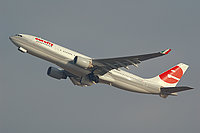
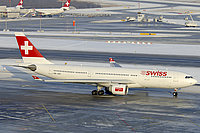
| The A330-200 is the newest member
of Airbus' widebody twinjet family and is a long range, shortened
development of the standard A330, developed in part as a replacement
for the A300-600R and a competitor to the 767-300ER.
Airbus launched development of the A330-200 in November 1995,
followed by the first customer order, for 13 from ILFC, placed
in February 1996. First flight was on August 13 1997, with certification
and first customer deliveries,to ILFC/Canada 3000, in April 1998.
The A330-200 is based on the A330-300 and shares near identical
systems, airframe, flightdeck and wings, the only major difference
being the fuselage length. Compared with the 300 the A330-200
is 10 frames shorter, and so has an overall length of 59.00m (193ft
7in), compared with 63.70m (209ft 0in) for the standard length
aircraft. This allows the A330-200 to seat 256 passengers in a
three class configuration, or alternatively 293 in two classes.
Because of its decreased length the A330-200 features enlarged
horizontal and vertical tail services (to compensate for the loss
of moment arm with the shorter fuselage). Another important change
is the addition of a centre fuel tank, which increases the A330-200's
fuel capacity over the 300's, and results in the 200's 11,850km
(6400nm) range.
Like the A330, engine options are the GE CF6-80, Pratt & Whitney
4000 series and the RollsRoyce Trent 700.
The A330-200 has sold quite strongly since its launch. Among the
initial A330-200 customers are, apart from ILFC, Canada 3000,
Korean Air, Austrian, Air Transat, Emirates, Swissair, Sabena,
Monarch, Asiana, TAM, and Air Lanka.
|