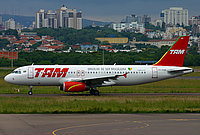
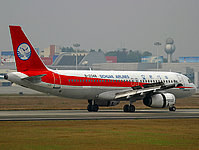
| Perhaps the most important contributor
to Airbus Industrie's success as an airliner manufacturer, the four
member A320 family is a significant sales success and a technological
trailblazer. The 150 seat A320 is the foundation and best selling
member of the family.
The A320 is perhaps best known as the first airliner to introduce
a fly-by-wire flight control system - where control inputs from
the pilot are transmitted to the flying surfaces by electronic
signals rather than mechanical means. Apart from a small weight
saving, the advantage of Airbus' fly-by-wire is that as it is
computer controlled, an inbuilt flight envelope protection makes
it virtually impossible to exceed certain flight parameters such
as G limits and the aircraft's maximum and minimum operating speeds
and angle of attack limits.
Also integral to the A320 is the advanced electronic flightdeck,
with six fully integrated EFIS colour displays and innovative
sidestick controllers rather than conventional control columns.
The A320 also employs a relatively high percentage of composite
materials compared to earlier designs. Two engines are offered,
the CFM56 and IAE V2500.
The A320 program was launched in March 1982, first flight occurred
on February 22 1987, while certification was awarded on February
26 1988. Launch customer Air France took delivery of its first
A320 in March that year. The first V2500 engined A320 was delivered
to Adria Airways in May 1989.
The initial production version was the A320-100, which was built
in only small numbers before being replaced by the definitive
A320-200 (certificated in November 1988) with increased max takeoff
weight, greater range and winglets. The stretched A321 and shortened
A319 and A318 are described separately. All four share a common
pilot type rating. Mid 2000 A320 family production was at a monthly
rate of 22, to be increased to 30 units a month by the end of
2002.
|