MICK THE MILLER
British
Greyhound Sensation of the 1920s
By
Michael Maguire
Mick The Miller
No
greyhound in the history of British dog racing has ever managed to achieve
immortality… except perhaps Mick The Miller. Sixty years have passed since his
death but his name and his fairy story career still lives on. His racing life
was the stuff of legend that few champions in any field of endeavour have
matched – and he will always remain the most famous and best-loved greyhound
throughout the land.
Fast
dogs will come and go, track records will continue to be broken, and Mick’s
clocked times (now) seem absurdly slow. But for some reason Mick was blessed
with a ‘touch of magic’ and will always remain a household name - such was
his popularity in the Depression-hit days of the 1920s.
In
this article I have been very careful to separate fact from fantasy. Inevitably,
over the years, many myths and fables have built up about the legendary Mick but
as far as possible I have tried to either validate or dismiss these stories
depending on their source.
First
let me start with the three biggest blunders that occur time and time again
whenever a biographic article about the late, great Miller is penned. It is
usually stated that Mick was an English greyhound… he wasn’t. He was whelped
in Ireland so, depending on your preference, this either makes him Irish or
British. Of course, he won most of his classic races on English soil, but by no
stretch of the imagination does this make him English.
Next comes the old chestnut: “Mick
died aged thirteen.” No he didn’t. Granted he was in the thirteenth year of his life, but the fact remains that he was aged twelve, not
thirteen when he died.
And
finally the silliest error of them all: “When Mick passed away he was embalmed
and put on show in a museum.” Apart from this making him sound like an
Egyptian mummy the whole idea of ‘embalming’ a dog for display purposes is
ludicrous. Needless to say he wasn’t embalmed.
Okay,
so maybe you think I’m being ‘picky’ or ‘splitting hairs’, but when
the above so-called ‘facts’ get copied-on by researchers then the story of
this great dog gets twisted and even rumour becomes trusted information.
So as a dyed-in-the-wool Mick The Miller enthusiast, I promise to be as
honest and accurate as I can in the following pages of this great dog’s
history.
The amazing Miller was without doubt
a trailblazer and there is no question this helped establish him as the
‘punters darling’. Mick’s career coincided with the first years of oval
track racing in Britain and therefore he was idolised by the man in the street
who could now watch him run in a proper stadium. He dominated and popularised
the then infant sport and ensured its continued success. Mick drew thousands of
people to the tracks and Joe Public would risk their last shilling to have a
wager on the greyhound that had endeared himself to the hearts of millions.
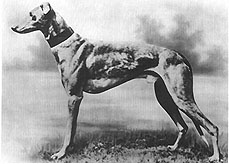
Born last of a litter of twelve in
June 1926 (Sire: Glorious Event, Dam: Na Boc Lei) he fought bravely to survive
distemper at the age of 10 months and this iron-will was perhaps a portent for
his forthcoming courage to win on a racetrack. In a decade without vaccines he
battled against the deadly illness, helped by his Irish breeder and owner Father
Martin Brophy.
The priest, with the assistance of
the track manager at Shelbourne Park, nursed the young Mick through the critical
stages of the viral disease. Both worked tirelessly and after a period of
convalescence the greyhound was his usual ebullient self, and back to maximum
fitness.
There are two versions of how Mick
got his name and both, on the face of it, sound plausible. It has been suggested
that the old miller’s wheel outside Brophy’s vicarage inspired the sporting
Father when titling his dogs, and all had associated names with the wheel. It
has also been suggested that Mick was named after a member of Brophy’s staff.
If the first version is to be believed then why was the only
litter-brother I’ve been able to track down called Macoma. This was a very
fast dog that did extremely well over hurdles… but does the name have a
connection with a miller’s wheel? I don’t think so.
The second version is far more likely when you consider parish records
show that Brophy did employ a young handyman-cum-gardener at the vicarage in the
village of Killeigh, Co. Offaly, Ireland. His name was Michael Miller and the
teenager had been given the task, as part of his duties, to care for the litter
of pups, and had formed a very close bond with the (as yet) unnamed young
brindle survivor.
It is reported that Brophy, on seeing the obvious affection between the
greyhound and Michael, immediately suggested using the young handyman’s name
for the dog but inserted the word
‘The’ between forename and surname. Thus, Mick The Miller was
registered, and the rest... as they say... is racing history.
A romantic story (that surfaced only after
Mick became famous) was the young greyhound once being caught drinking water
from the Holy font. Father Brophy supposedly witnessed this sacrilegious act,
with the priest immediately asking forgiveness from the Lord above. Presumably
this myth is trying to convince us that Mick received ‘god given’ powers
from the holy water… but I suggest this was merely Irish blarney on Martin
Brophy’s part. By all accounts the priest was known to be a bit of a
‘joker’ and I suspect the story was an invention of Brophy’s imagination
which made good copy for the newspapers of the day.
Under the guidance of Dublin trainer Paddy Horan an illustrious track
career was to follow with Mick The Miller (aged two) winning fifteen of twenty
races in Ireland. The brindled superstar was improving as every month passed and
Horan decided the dog had to be a major contender for the English Derby.
In May 1929 (with Mick not yet three) Paddy Horan and Father Brophy
arrived on English soil and immediately set to work on getting the dog fit for
the July trials which lay ahead. The priest (still playing the joker, and
dabbling in a little subterfuge) had travelled using the pseudonym, ‘Mr D.
Murphy’.
Mick’s Irish supporters weren’t fooled by this and on learning that
the dog was a late Derby entry managed to get ante-post odds of 25-1. English
greyhound followers (mostly unaware of Mr D. Murphy and Mick’s Irish history)
didn’t give the dog a second glance until the odds were slashed to 100-8.
Mick was not to disappoint either Father Martin Brophy or Paddy Horan. He
cruised to victory in the 1929 first round Derby qualifier, conquering the
525-yard stretch in 29.82 seconds - an achievement never before accomplished.
The dog was an immediate favourite with English greyhound race-goers, and
Mick (always the showman) thrived on the adulation. Reportedly a dog of great
intelligence he would weigh up the opposition during the parade, always insist
on walking into his trap unaided, and would never extend himself more than
necessary in order to pull off a victory. Mick was never shy, loved being around
people, and had charisma in abundance.
Father Brophy was now inundated with offers for the brilliant Mick. It is
reported that Brophy was reluctant to part with the dog and a lot of
soul-searching and prayers for guidance followed. Finally, with pound notes
being waved at him from every direction, Martin Brophy decided to capitalise on
Mick’s current English success and not push his, or the greyhound’s luck any
further. So the dog was duly auctioned at White City and sold for 800 guineas to
Albert Williams, a Wimbledon bookmaker. In the 1920s this was an enormous sum to
pay for a greyhound - but as history was to prove, Mick would recoup this money
ten times over.
Bookmaker Williams decided the dog should stay with Paddy Horan and the
second round and semi-finals of the Derby trials followed with Mick The Miller
winning his heats in impressive style. He won his second heat with eight lengths
to spare, and his semi-final by two lengths. The Derby final and the £700 pay
out seemed a mere formality and he was now the hot favourite to collect the
prize.
This turned out to be a far rockier ride than anyone had imagined and a
very tense moment in Mick’s career. In the final he was beaten into second
place, but because of an infringement (three dogs, including Mick collided on
the first bend) the Stewards declared it a no-race and the 1929 English Derby
was re-run. This time, the brindled star (now 7-4 on favourite) had Lady Luck on
his side, and he won in his usual never-give-an-inch way, passing the post three
lengths clear of his rivals in a time of 29.96 seconds.
The 50,000 race-going crowd were jubilant. A delirious roar of “Well
done Mick!” crashed around the stands and terraces as an adoring public
surged to the winner’s rostrum to catch a glimpse of their favourite
greyhound. The ‘peoples’ champion had done his job brilliantly and Mick, as
always, loved the attention as he flirted with his admirers. His English record
for the year was to read: 17 races, 15 wins, and 2 seconds. From humble
beginnings, the sickly young Mick The Miller, born at an Irish vicarage, had
come a long way - and he bathed unashamedly in the glory.
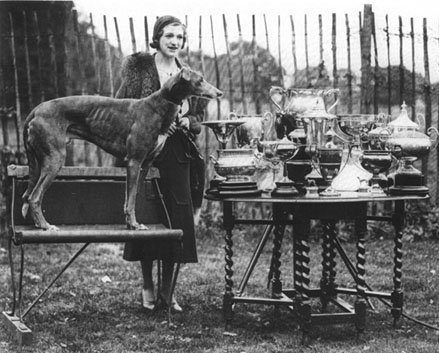
Mick was undeniably a class act and in December 1929 he was sold yet
again to Mr A.H. Kempton (Vice-Chairman of South London Greyhound Racecourses,
Ltd) who bought the superstar for his wife Phyllis, laying out the phenomenal
sum of 2,000 guineas. His racing career now progressed under the guidance of top
Wimbledon trainer Sidney Orton. Mick (now racing out of Burhill Kennels) was
certainly living a charmed life as he set up time records in England, Ireland
and Wales and landed the decider in the Wembley Spring Cup in March.
Trainer Orton claimed that Mick never ran two races alike and at odds of
9-4 on, the brilliant greyhound won the English Derby again that year. Showing
his usual track craft, he avoided the crowding at the first bend and went on to
win the classic by three lengths. King Alfonso of Spain attended the race - and
indeed he presented the trophy to a delighted Mr and Mrs Kempton.
Mick’s trainer, Sidney Orton, writing in The
Greyhound Express gives us an insight into one of the great dog’s
idiosyncrasies. Orton says, “Mick would never wear a coat in the kennels at
Burhill, not even in the depth of winter. Whenever I tried to put one on he
would bite through the securing tapes, and toss the coat into the corner of his
box.
“Even when kennelled with a female companion it was the same story. One
evening I put coats on both greyhounds and returned the following morning to
find that Mick had chewed his way through both sets of tapes. The coats were
flung into the corner of the box and the little bitch was curled snugly between
Mick’s paws!”
As any greyhound owner will know – the majority of the breed has its
quirky little ways, and even the great Miller was no exception. Mick would
tremble with fear if he heard the sound of thunder during an approaching storm,
yet he enjoyed nothing better than a good gallop with the rain stinging his
face. All who met him would remark on his gentleness and were somewhat surprised
to find he had a personality as big as a house.
The grandson of
Head Kennel-man Joe Ollis gives us a further insight into Mick’s extraordinary
character. He says, “When I was a kid, grandad used to talk about the great
Miller a lot. Sidney Orton had many fast dogs at Burhill, but Mick was always
Joe’s favourite.
“Some dogs can have a dark
side but Mick didn’t have a vicious bone in his body. Even when in pain with a
‘knocked-up’ toe or inflamed claw, Joe could handle him single-handed and
treat the condition with ease. The Miller would never attempt to bite or snap…
It just wasn’t in his nature.”
Argue
with the future King of England?
Sidney ‘Clare’ Orton (Sidney Senior’s son, who acquired his middle
name from his French Canadian godfather) recalled to me, “I was only a
twelve-year-old schoolboy when I was ‘smuggled’ into West Ham stadium to
watch Mick compete in the final of the 1930 Cesarewitch. The dog ran the race of
his life and won in magnificent style. It was an evening I will never forget.”
The Welsh Derby quickly followed and
Mick went unbeaten through the heats and secured victory in the 525-yard final
in 29.55 seconds. This was yet another national record. Eleven days later he won
a two-dog Grand Challenge Match at Wimbledon, bringing his winning sequence to
19 – a feat that was to remain unequalled for forty-four years.
The first round of The Laurels now
beckoned and trainer Orton had only two days to get Mick rested and fit in his
bid for a fourth classic. This was perhaps a ‘bridge too far’ for the great
dog and his challenge came to an abrupt end when he was knocked badly at the
second bend and pushed into the outside fence. He finished last, struggling home
with a bruised shoulder.
After such a hectic racing schedule it was now decided that Mick The
Miller would benefit from a long rest. The champion greyhound was therefore laid
off for seven months until March of 1931 when once again he was to delight his
legion of fans by winning the Spring Cup at Wembley. He went through the
competition unbeaten and equalled the track record in the decider.
The English Derby once again beckoned and trainer Sidney Orton prepared
his charge carefully for the difficult challenge that lay ahead. Could Mick the
Miller win this most prestigious race three times in succession? The British
public thought so and once again the name that was to become a legend was on
everyone’s lips.
Mick duly flew through the heats and on the night of the final
annihilated the opposition to win his third Derby in a row... almost.
In what seemed a repeat of the 1929 race there was a breach of the rules (in
which Mick was not concerned) and the Stewards once again gave a no-race
decision.
As Sidney Clare Orton confided, “It
was a terrible moment when the no-race klaxon sounded and everyone was stunned
by the ruling. The booing from the spectators was long and loud when the
judgement was announced. Mrs Phyllis Kempton was distressed and in tears and she
told my father there was absolutely no way she would risk an overtired Mick
competing in the re-run.”
Sidney Senior agreed, knowing Mick’s age was against him... but none
had bargained on the intervention of HRH Edward, Prince of Wales, who was
present at the track that day.
The Prince (a great Mick The Miller
enthusiast) insisted that the
greyhound should run again, and as Sidney Clare Orton told me with a chuckle,
“Who would dare argue with the future King of England? It wasn’t a
request - It amounted to a royal command, and one that Mrs Kempton couldn’t
ignore.
“It was a terrible dilemma for the
poor lady but after prolonged pleading by the Stewards she reluctantly gave her
consent.”
The re-run quickly followed (with Mick’s loyal fans making him evens
favourite) but this time Lady Luck had deserted the old warrior. Mick’s heart
was as big as ever but, as expected, the no-race final had taken its physical
toll. It was a crowd of 80,000 who watched an exhausted Mick cross the line that
night, cruelly beaten by six lengths into fourth position.
So Mick was never destined to win his
third successive English Derby... and, as history was to dictate, Edward, Prince
of Wales would never wear the English crown.
The Derby disappointment was a setback for Burhill Kennels but trainer
Orton kept his charge in training and Mick raced on and off, finishing second in
the final of the 1931 Cesarewitch. It was usual, in these early days, for a
racing greyhound to retire at around three or four but the legendary Mick, now
well over five-years-old was entered for the stayers classic - the St Leger at
Wembley.
As Sidney Clare Orton explained, “Everyone loved Mick so it wasn’t
difficult for my father to get permission to exercise the dog at Burhill Golf
Club. They had a wonderful 700 yard stretch and my father would gallop Mick
there on a regular basis.”
This was to be the last time the British public was to see their
illustrious hero in action on a racetrack... and Mick didn’t let them down.
The ‘Golf Club’ training had paid off and although the veteran had never
tackled 700 yards with other competitors before, he sailed unbeaten through the
heats and won the classic final in commendable style. He received a standing
ovation from the spectators, reminiscent of his Derby days.
An era was
at an end.
Mick The Miller had competed in 61
British races. He’d won 46, come second ten times and clocked up a sequence of
19 consecutive wins. He’d collected over £10,000 in prize money, set up four
world records in six weeks and won the first International Derby and the Welsh
Derby. He was, without doubt, unique - a real ‘character’ who loved pleasing
his fans and giving his all.
Twenty years ago, Archie Newhouse of
the Sporting Life wrote, “Mick had
that indefinable ‘IT’ that places him head and shoulders above his
contemporaries.” Those few words are an excellent summing up of Britain’s
favourite greyhound and I certainly could not have put it better.
With Mick’s racing days over, Sidney Orton decided to send the dog to
Jack Masters, a farming friend in Norfolk, to stand at stud. He was with Masters
for a couple of years, earned £20,000 in fees, but was not destined to produce
a string of winners in the ‘progeny’ stakes. His best effort was siring a
daughter, Gallant Ruth, who won the English Oaks in1934.
Still followed closely by the newspapers of the day, Mick was brought
home and once again took up residence at Burhill Kennels, Wimbledon, England.
He’d been given the starring role in the 1934 British film ‘Wild Boy’ and
was to play a greyhound captured by a bunch of crooks trying to stop him racing
in the Greyhound Derby. In true ‘cinema tradition’ Mick makes his escape,
runs to White City racetrack and (breaking every regulation in the rulebook)
enters the race and duly wins the classic. Of course the story was nothing more
than heroic hokum but the movie was patronised by (his still) horde of fans who
were thrilled to see the veteran greyhound in action.
He spent the remainder of his years in retirement and sadly died in his
sleep at Burhill Kennels on May 5th, 1939... just a few weeks short of his
thirteenth birthday. Sidney Clare Orton informed me, “Mick passed away in
exactly the same kennel box from which he raced all those years earlier.”
And so the legendary greyhound was stuffed and mounted and presented to
the Natural History Museum in South Kensington, London by Mr A.H. Kempton. Mick
was on display for many years before being moved (early 1995) to the Walter
Rothschild Zoological Museum in Tring, Hertfordshire. He now stands proudly in a
glass case alongside two other classic winners, Fullerton and Ballyregan Bob. He
is there for the world to see, and well worth a visit.
As
Sidney Clare Orton recalled, “Even in retirement he was never short of
well-wishers. Foreign tourists dropping into Burhill Kennels would always ask if
they could see the fabled Mick The Miller - and never one to disappoint an
audience he would trot out in true champion fashion and befriend the visitors.
He would stand contentedly as he was petted, and enjoyed nothing better than
being photographed with the guests.”
Racing sensation, movie star,
punter’s darling, and greyhound legend. He was just being his usual flamboyant
self... keeping up the game of being Mick The Magnificent Miller.
*
* * *
Copyright
© 1999 by Michael Maguire
My sincere thanks to Sidney Clare Orton for his generous co-operation in unravelling fact from fable and for the loan of Mick’s photograph with Mrs Phyllis Kempton.