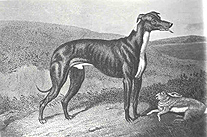
MASTER
MCGRATH
Ireland's Famous Greyhound
by
Joan Dillon ©
Throughout history Irishmen have had a
reputation for being scrappy fellows always ready to take on any challenge.
Master McGrath certainly lived up to that reputation.
Although long gone, his memory lives on, perhaps more so than any other
Irish greyhound -- in poetry, song, paintings, a monument in Ireland and, even
in this country "the
United States", with a New Hampshire restaurant and pub named in his honor -- a
most impressive legacy for an undersized, unimpressive pup that was very nearly
put down! Like most legends,
however, certain aspects of Master McGrath's life have been embellished over
time until sometimes it is hard to distinguish fact from fiction.
According to one such
account, in 1867, a ne-er-do-well Irish tenant suffering the effects of too much
imbibing, heard a strange sound. Upon
investigation, he found a bag half in and half out of the water which had caught
on the root of a tree. Opening the
bag he discovered a nearly drowned greyhound pup -- Master McGrath.
This pup then came under the care of Lord Lurgan and rewarded his
benefactor by excelling against all comers on the coursing field.
Another account -- one
which sounds much closer to the truth -- states that Master McGrath was whelped
in Waterloo Cup week, 1866, having been bred by Lord Lurgan's partner, James
Galway, who raised greyhounds in County Waterford.
His sire was Dervock, a top coursing dog who had been edged out of a win
in the first running of the Brownlaw Cup (Ireland's equivalent to England's
Waterloo Cup). His dam was a bitch
by the name of Lady Sarah. Apparently
Galway felt that this small 54 lb. black and white greyhound lacked potential
and was going to put him down but, due to a plea by the orphan boy who exercised
him -- a young lad by the name of Master McGrath -- the young dog's life was
spared. Named after the boy, Master
McGrath then went on to best the most famous coursing greyhounds of his day both
in Ireland and England.
In 1868, Master McGrath
was entered in coursing's premier event -- England's Waterloo Cup -- and, at
just two years of age, surprised his detractors by bringing the blue riband home
to Ireland. The following year,
over 12,000 people are reported to have gathered at Altcar to see if this Irish
interloper could repeat. In his
final course, Master McGrath drew in against Bab-at-the-Bowster, a Scottish
bitch who was also considered virtually unbeatable.
In what many consider to be history's greatest coursing match, the two
ran neck and neck until Master McGrath proved he wasn't a fluke and pulled ahead
to record his second Waterloo Cup win.
In 1870, when trying to
win the Waterloo Cup for a third consecutive year, Master McGrath suffered the
only defeat of his coursing career. The
event was held that year despite a controversy over course conditions.
Many felt that a February freeze had caused the course to be unfit and
this was indeed the case as Master McGrath fell through some ice and almost
drowned in the River Alt. As he struggled in the icy water, an Irish slipper by the
name of Wilson jumped in and saved him. After
this mishap, Lord Lurgan vowed never to race Master McGrath again and took him
home to Ireland to recover from his ordeal.
The following year,
however, with Master McGrath back in racing condition, Lord Lurgan just could
not resist the challenge of trying for a third Waterloo Cup victory. To the utter disbelief of some, this amazing greyhound came
through and won the event for a third time.
Proclaimed a public
hero, Master McGrath received the ultimate accolade of his time by receiving a
summons to appear before Queen Victoria at Windsor Castle. Queen Victoria was not only a dog lover; she and her husband
Prince Albert had also owned a black and white pet greyhound by the name of Eos.
Just two short years after his presentation to the Queen, Master McGrath
died of heart failure and, although he didn't live long enough to have a very
productive stud career, one of his grandsons -- a white greyhound with blue
markings named Tippecanoe -- was reportedly owned by General George Armstrong
Custer.
So great was Master
McGrath's fame in Ireland that he was often referred to as "Mighty
McGrath". After his death, a
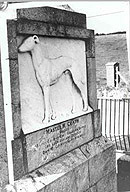
monument commemorating his accomplishments was erected near his birthplace in
County Waterford and he was also memorialized on the Irish sixpence coin. A poem written in his honor commemorating his triumph in his
second and most famous Waterloo Cup victory was later put to music and became a
popular Irish ballad.
Author's Note: While researching this article I came across two different
spellings of Master McGrath's name - the modern "McGrath" and the older spelling "M'Grath" where an apostrophe is substituted for the letter "c" which is silent. I have chosen to use the more modern spelling for this article but you should be aware that "M'Grath" was the more common usage back in the 1800s when the Master was alive.
Copyright
1997 by Joan Dillon ([email protected])
How
Coursing Matches Were Judged
In a coursing match,
points were awarded for 6 different degrees of skill as follows:
1.
Speed: This was estimated at
1, 2 or 3 points depending on the degree of superiority shown;
2.
The Go-bye: This is where a
greyhound starts a full length behind his opponent, passes him, and then clears
him by a full length -- 2 points awarded or, if gained on the outside, 3 points;
3.
The Turn: This is where the
hare is brought round at not less than a right angle from its previous line -- 1
point;
4.
The Wrench: This is where
the hare is turned from its line at less than a right angle -- 1/2 a point;
5.
The Kill: 2 points or less
depending on the skill shown by the greyhound;
6.
The Trip: This is where the
hare is thrown of its legs but the greyhound cannot hold it -- 1 point.