 |
| Komodo Dragon |
|
| Submit Animal Information |
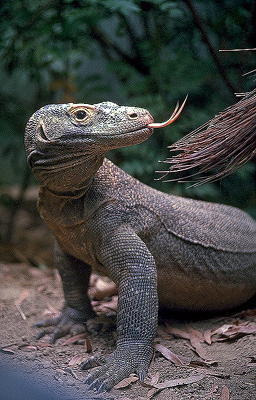
| Komodo dragons are the largest of all living lizards, growing up to 11 feet in length and weighing as much as 400 pounds. These dragons live on 4 small islands in Indonesia, Komodo, Flores, Pintja, and Pada. The main island they live on is called Komodo. Komodo is a small island, only 22 miles long and 12 miles wide. Komodo dragons belong to the family of monitor lizards, the group of largest living lizards. Dragons are carnivores and cannibals, but they will also eat carrion. If the dragon does not kill it�s prey on the first try, it will not be discouraged, because the animal will soon die. Komodo dragons mouths are home to four types of bacteria that are deadly when combined. One of the bacteria eats away at the flesh and causes the animal�s skin to rot. This bacteria also creates a horrible stench, and this is what the dragons follow to find their dead prey. Another type of bacteria stops the blood from clotting, so that the animal will bleed to death from the bite. It is not know what the other two types of bacteria do, but it is believed that they carry deadly viruses. Any one of these bacteria can cause blood poisoning. Komodo dragon scales are made of keratin, the same type of material that your fingernails are made of. These scales have special spots that are sensitive to touch. The face, neck, throat, and feet have the most �touch sensors�. Dragons are one of the smartest lizards. They can track prey, figure out how and where to ambush, and they have their own form of advanced communication. Old and strong dragons expect and demand respect. If they feel as if there is a dragon around that is not being respectful, he my attack him, and the winner gets to eat the other dragon. Young dragons keep their heads down and mouths closed to signal humbleness. Young and small dragons must wait their turn to eat. A sort of stiff-legged walk indicates that one dragon is respecting the other, and that it knows that the other dragon is stronger and holds a higher position in society. Komodo dragons have the nastiest �hair balls� of the animal kingdom. These cylinders, called gastric pellets, are created when there is something indigestible in the dragon�s food. When the dragon regurgitates the pellet, it is coated in a vile-smelling mucus. Even dragons can�t stand the smell, and they will rub their nose in the dirt to get the mucus off their face. Afterward, they try to get as far away from the gastric pellet as possible. Komodo dragons have a good sense of smell. They can smell prey from up to six miles away. Once they pick up the scent, the dragon won�t stop following it until it has found the animal. The dragon�s sight is almost as good as a human�s, and they can see in color. Komodo dragons have very large ear openings, and they hear quite well. However, if you make loud noises and wait to see a response, you may well be disappointed. Komodo dragons hardly ever react to sound. Perhaps they just aren�t interested in it. Komodos are diurnal, which means they are active during the day. Komodos are good climbers, but only the young tend to live in the trees, adults dig dens in the ground using their claws. Komodos are excellent swimmers, and it is not uncommon for a dragon to swim to one island and back again in the same day. Komodo dragons can�t sweat; they pant like a dog in order to keep cool. About a month after a successful mating, the female lays about 15 eggs under ground, and then packs the earth down, sealing the eggs into the ground. The eggs take about 8 months to hatch. Scientific Classification: Varanus Komodensis Status: Endangered; less than 500 living in the wild Habitat: Grasslands Size: Estimated 10 feet (3 meters) If you have interest in Komodo Dragons, you can check out these sources of information: Macmillan Illustrated Animal Encyclopedia�.. Dr. Philip Whitfield Komodo Dragon on Location�. Kathy Darling |