 McCoy Spring Creeks
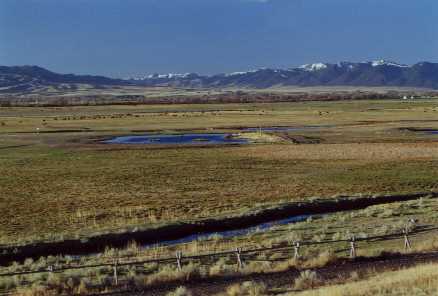
McCoy Spring Creeks Valley
Nestled in the Beaverhead River valley near Dillon in southwestern Montana is one of the finest, and hottest-fishing, spring creeks in the west. And it all came about simply because cattle needed a convenient place to drink. Today nine ponds and almost three miles of stream harbor healthy populations of big rainbow, brown and brook trout. And for those of us flyfishers fortunate enough to fish these private, rod-fee waters, we owe a huge debt of gratitude to those thirsty cattle.
For, in only a few short years, the McCoy Spring Creeks, have been changed from a marginal small brook trout fishery into some of the west’s most interesting and challenging trout water. When Poncho and Bev McCoy bought this property in the early ‘80’s as home to their developing Red Angus cattle operation, they acquired several springs and small creeks with year-round water flow, a prime attraction for a cattle ranch. Small brookies thrived in the upper reaches of the largest creek, and big browns and a few rainbows ran up from the Beaverhead River each season seeking spawning beds. A few stayed, particularly in a backwater slough off one of the creeks. However, for the most part, the creeks were uniformly shallow with virtually no rocks, runs, holes or undercut banks to provide cover and shelter for trout.
The first changes on the property were a series of cattle watering ponds made by dredging, deepening and widening the streams. Waterfowl began to use these ponds extensively, both for nesting in the spring and for winter watering and resting. The hunting became so good that the McCoys formed a duck hunting club on the property. And, as aquatic vegetation and insect life developed in the ponds, so did the trout fishery. Holdover spawners, natural brookies and stocked rainbows flourished. Those invited or allowed to fish the ponds found it challenging, particularly when midges were the main fare, and very rewarding.
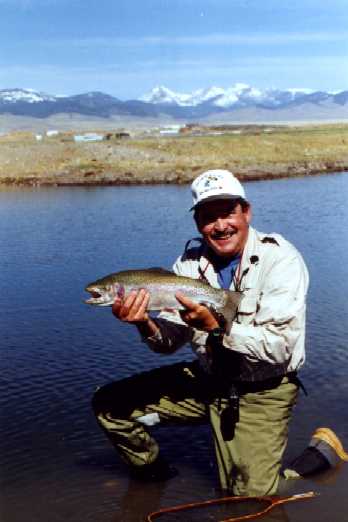
Sam Broberg with McCoy Rainbow from the ponds
However, the pond fishing was fairly limiting, and in the mid ‘90’s,
the McCoys began development work on one of the main creeks itself.
Deepening many parts of the stream, placing rocks at strategic points and
creating runs along and under some of the small bluffs created well over
a mile of prime habitat. And the fish loved it. They moved
in from both the Beaverhead and from the ponds. Natural reproduction
from both rainbows and browns, in addition to the brookies, started occurring
in the gravel stretches between the ponds and between the stream pools.
Public fishing started in 1996, and was limited to one party per day, thereby
ensuring uncrowded fishing for all McCoy guests.
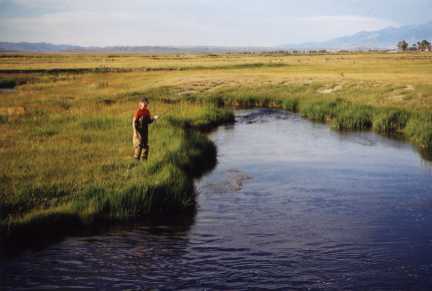
Peggy Vineyard playing a fish on Big Meadow Reach
Buoyed by the fishing success and public acclaim of their earlier stream improvement efforts, Poncho and Bev McCoy began another major development effort on their ranch’s second spring creek in December, 2000. Three weeks of intensive work by a large track-hoe and three dump trucks resulted in an additional mile and a half of stream being converted from shallow, silted riffles into prime trout habitat. Many of these new runs are 10 to 12 feet deep, and are particularly suited to holding and sheltering large fish. Undercut banks below streamside willows, large mid-stream rocks, shelving flats and deep runs around bends are features of this new stretch named Fox Island Reach. Fishing will open in these new waters in the summer of 2001, allowing two parties per day access to the ranch’s waters.
The McCoys took advantage of the equipment working on Fox Island Reach to also make significant additions and improvements to the original waters, now known as the Big Meadow Reach. And, not too surprising, the ranch also now has the finest and most extensive gravel roads in the west!
Food sources at McCoy’s are varied. Trico’s and summer PMD’s are the main stream mayflies, callibaetis and damselflies are found in the ponds, midges are present in all the waters, and there is great late summer terrestrial action with grasshoppers and beetles. Scuds, primarily olive-colored ones, are present in all waters, as are black leeches.
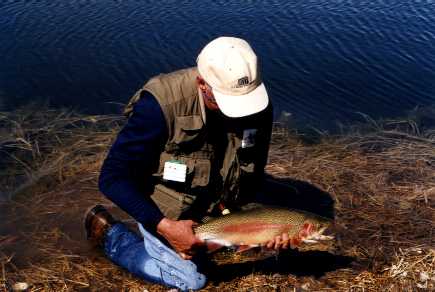
Jim Cook with big Kamloops rainbow that took a leech pattern
Fish the water types of your choice, and tie on the flies to match your mood. Like to fish large flies? Strip a size 10 olive or black beadhead woolly bugger through the ponds or deep runs. Or come during summer and fish large grasshopper patterns or Chernobyl Ants to big slashing rainbows and browns. Want to get technical? Fish a #20 Griffith’s Gnat or parachute Adams to sipping fish in the ponds and runs. You may choose to hang a small nymph, #20 or #22 black pheasant tail or a #24 midge pupa, 18” below your dry fly to improve your chances. Want to nymph fish the streams? Hard to beat a size 14 beadhead Prince Nymph with a San Juan or Bighorn Worm tied on below it. Spring brings exciting size 12 Callibaetis dries in many of the ponds. Scuds catch fish all year. And did I mention how effective foam ants and beetles are?
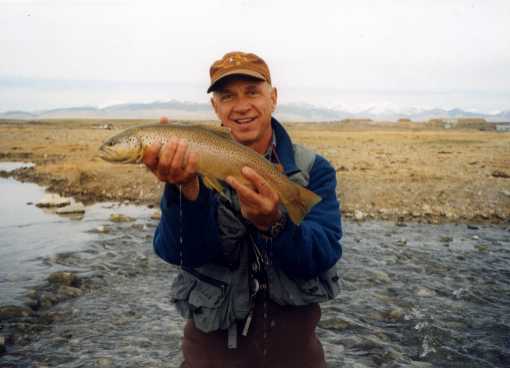
Mike Vineyard with a large brown taken on a #24 midge pupa
You can sum up McCoy’s simply by mentioning beautiful scenery, big fish,
easy access, willing fish, easy walking, lots of fish, easy wading, lots
of fun, and great hosts. You can also book a stay at the very nice
two-bedroom “Duck Shack” located on the bluff overlooking the ponds and
creeks. Sitting on the house’s deck on a crisp, clear morning with
a cup of hot coffee with your days fishing spread out below you is about
as good as it gets!
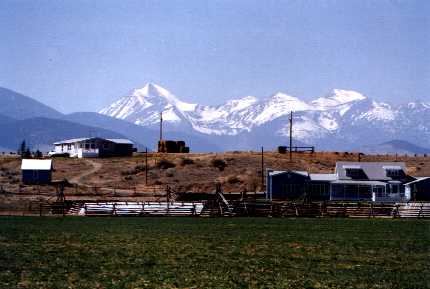
Duck Shack on the left, McCoy ranch house on the right.
Want to book a rod or find out more? Check out the McCoy website at www.mccoycattlecompany.com. And good fishing.