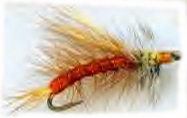
Hook- Curved shank nymph hook sz. 8-16
Tail- Elk hair
Rib- Copper wire
Body- Orange antron or dubbing
Body hackle- Brown 2 sizes smaller then hook
Wing- Elk hair
Front hackle- Grizzly
Head- Yellow dubbing
1- Start thread on hook and wrap to butt
2- Clip a small bunch of elk hair and use a hair stacker to even tips, tie in a slightly shortened tail
3- Tie in a copper wire rib running parallel to the hook shank and facing back
4- Tie in and wrap body material forward, covering about 2/3�s of the shank
5- Tie in the body hackle with the shiny side facing out and the tip of the hackle facing towards the rear
6- Now wrap body hackle backwards to the tail, use a hackle pliers clipped to the tip to hold the hackle in place for step 7
7- Wrap the copper wire rib forward laying it over the spine of the hackle while being careful not to catch hackle barbs under the wire tie off wire at the front of fly.
8- Again clip a small bunch of elk hair for the wings, using a stacker to even tips, tie in the wing facing towards the back and extending to the end of the body
9- Tie in the front hackle. Again, shiny side out and tip facing back
10- Dub a tapered head from the base of the wing forward to the eye of the hook
11- Wrap front hackle over the head with 3-4 turns, tie off and trim excess
12- Build up a small head of thread and whip finish, apply a light coat of head cement.
Eric Staswick
Fly tying and warm water editor Fly Fish the West
The stimulator has many uses. First, it can be used to imitate a grasshopper, a stonefly or other large bodied winged flys. The fish like the big meal and go and take it. Second, it can be used as an indicator for a smaller dry fly because of it's high visability. It works on many rivers here in the west, but sometimes it might not work. It would work well on th South Fork of the South Platte River right now because it is murky from recent flooding. The fish can see the fly easily because it is big and bright, and they take it. It can also be fished with a dropper fly attached instead of just an indicator. Try flicking the fly right up along shore on windy days when grasshoppers are being blowen into the water. This is a great fly that everyone sohuld ahve on hand.
Jeff Goncalves
Trout Fishing editor of Fly Fish the West