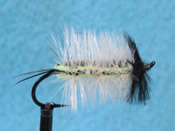
Tying Instructions
This is a woven/crocheted
fly. Start by tying in the goose biots for the tail. To get them to
flair correctly, I tie a little knot just before the bend that allows
the biots to flare into a V. Next cut a strip of Ultra Chenille 8”
long of the black and the chartreuse ultra chenille. Tie this in just
above the pint of the goose biot tie in. Next Cut a strip of craft
foam, black or gray and tie in at the point of the ultra chenille.
Finally tie in the cream saddle hackle. I personally prefer the Hoffman/Whiting
Farms saddle hackle for this fly because it is uniform in width and
they are extremely long. You will need a very long saddle hackle for
this fly, roughly 10 – 12” long. Once all of the materials are tied
in, wrap the craft foam forward, rather tightly, toward the hook eye.
Stop approximately 1/8” from the eye and wrap backwards to the point
of beginning. This will make a sleek underbody and help give substance
to the fly. It also keeps the fly afloat. If you prefer for the fly
to sink, you can use any other type of foam for the body. This will
enable the fly to float for a while and eventually sink as a drowned
caterpillar would do. After tying off the foam, trim and wrap the
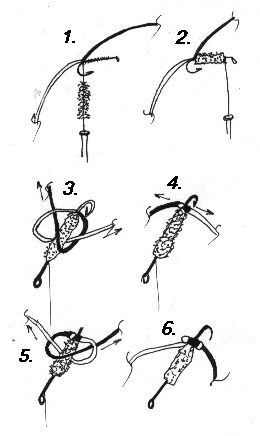
thread forward out of the way. Now you begin to weave/crochet the
fly. This is done by taking the black chenille and bringing it over
the top of the hook and down the side. The chartreuse chenille will
go in front of the black chenille on the side, underneath the body
of the fly and through the loop of the black chenille on the opposite
side. Tighten the weave and snug down onto body. A picture is worth
a thousand words, so the following diagram should help.
Repeat this process making sure the weaves are snugged up against
each other tightly so as not to leave any gaps. Also, always make
sure the black chenille is on top and the chartreuse chenille is on
bottom. This ensures the constant color on the top and the bottom,
as well as the stripe on the side.
Continue the weaving process until you get to the end of the foam
body. Tie off the ends with the thread. Tightly palmer the cream hackle
forward to 1/8” from the hook eye and tie off. Make a dubbing loop.
Cut 1/2” of black rabbit fur from skin (I usually use zonker strips
simply because it is easier and I have too many dead animal parts
lying around the house already J).
Place the rabbit fur in the dubbing loop and spin forming a hair hackle.
Wrap the rabbit hackle around the tied off ends to hide the ends and
give the fly a head. Tie off, snip and whip finish. Viola! You are
done. The whole process takes me about 15 minutes to complete which
is a rather long time because I can easily tie 15 dries in an hour.
Nevertheless, weaving/crocheting flies produces great looking bodies.