Tying Instructions
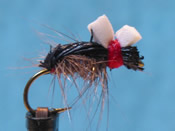
The Little Tuxedo is
essentially an ant pattern, but will work as a beetle as well. The
name comes from the bowtie and cumber bund look imparted by the white
foam wing and bright red collar. This fly incorporates a body and
head style derived from Dave Hughes’ cricket pattern but on a smaller
scale (with formal attire!)
After laying down a thread foundation, cut and stack an appropriately
sized bunch of black deer hair twice the length of the distance between
the hook eye and the bend. tie in the hair with the front end extending
a little beyond the hook eye. Pinch the hair and tie in with two lose
loops of thread pulling upward tightly on the third round. This will
spin/flare the hair to make the first layer of the head. Tie a few
more loops to stabilize the flared hair then pinch gather the back
hair and tie it in as the body, leaving the front flare as the first
layer of the head. You will have a generous length of hair extending
beyond the hook bend. Be sure to pinch the hair body so it lies on
top of the hook. This will allow the red thread to show as the underbelly.
At the hook’s bend, tie in the leg hackle tip first and palmer it
toward the front. Tie off behind the eye. Be sure that the hackle
is big enough to serve as the terrestrial’s extended legs. Clip the
top and bottom hackles leaving the horizontal legs extended. Gather
the rest of the deer hair and bring it over the top of the palmered
hackle (as you would if tying a humpy). Spin this hair directly behind
your fist spun hair to create a full head. Trim the flared hair into
a well-shaped head. Attach the sliver of white foam “bowtie” style
to the red collar behind the head. Wrap a few turns of the red thread
to create the cumber bund effect. Tie off and add a drop of cement
to your knot. For the sake of durability and looks, I paint the back
of the fly with Dave’s Flexament.
How to Fish
This
is a great fly for late season fishing on the spring creeks in my
home stomping grounds in the southwestern Wisconsin coulee region.
The grasshoppers can’t always be counted on, but ants and beetles
are a fairly consistent. I like to bounce this fly off the vegetation
of the opposite bank, let it sit a while then skitter it out into
the current. It also works well fished over late summer aquatic vegetation
in low current areas. The Little Tuxedo is also a good prospector
fly and has produced well alongside similar sized Humpies and Stimulators.
All in all a good, practical (and well dressed) fly.