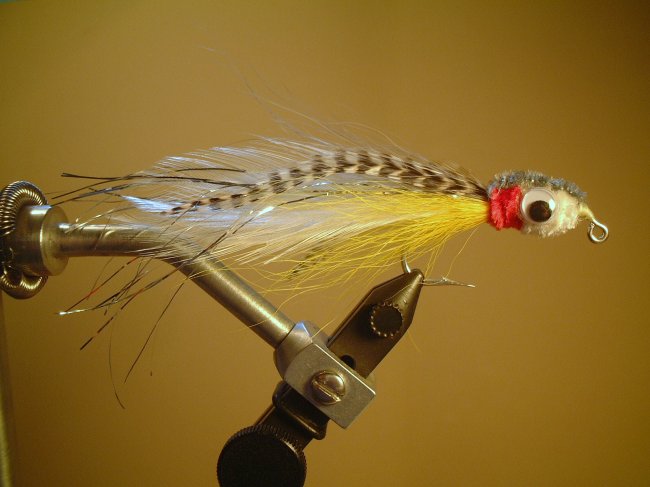
Tying Instructions
This is a relatively
complicated tie for a simple streamer but it can pay off.
1. Start thread halfway
down the shank and add three saddle hackles on either side, cups out.
2. Add flashtail above,
leave ends 1/2" longer than wing.
3. Tie on a clump of
gray deer hair extending halfway to the end of the feathers or so.
4. Rotate fly and add
underwing of white deer hair, splitting on hook shank.
5. Tie on an overwing
of saddle hackles. For a different look, these can go under the gray
overwing.
6. Wind .035 lead from
halfway point to hook eye, or to the beginning of the bend on the
EHC413.
7. Start a doubled over
band of gray chenille just behind the lead wrap on the top of the
shank.
8. Start and wrap 3 turns
of red chenille.
9. Start and wrap white
chenille to the eye/bend.
10. Pull gray loop over
the top of the wraps and tie off. Whip finish and cut.
11. Get a dollop of Goop
on a doll's eye and apply it low enough that it doesn't flip the hook
a la a Clouser. Press firmly into the chenille and use your bodkin
to roll away the excess. It will not be the slightest bit sticky yet.
12. Wait for fly to dry.
By tomorrow, those eyes won't come off before the plastic breaks.
How to Fish
This is Dan Blanton's
fly and I take no credit for it. He developed it for the West Coast
striper fishery and offshore expeditions. The Sar-Mul-Mac means 'Sardine/Mullet/Mackerel'
and it can be varied to imitate any of these and a whole lot more.
The color pattern you have is approximately threadfin shad. Threadfins
have a lot of yellow in them where I'm from so consider a yellow middle
wing. Blanton also uses a lot of pink.
This pattern should be
tied as blade-shaped as possible and given sharp tugs to send it skipping
back and forth through the water. Nothing that would hit this is going
to be convinced by a Wooly Bugger strip.
I have landed Largemouth
bass, ladyfish, trout, and perch on this fly. It is a versatile performer
and suffers only from a tendency to grow bulkier on the hook than
intended and from the tying time. Surprisingly, durability is not
an issue.
One more word. Some patterns
have a length of heavy monofilament with the end burnt buried in the
tailfeathers. Wrap .035 lead around the mono for rear weighting. Combined
with an inverted hook style, this can greatly increase the fly's weedlessness
and action. This fly works well with heavy sinking lines down deep.
Use bigger eyes the deeper you go. Can be tied to 5/0 if you can afford
the feathers.