|
|
"Screwball
Looks, Lonely Places" Many
websites and even books have been written on the subject of flyfishing
for carp. Although some of these articles and books are very good, carp
have still managed to slip under the radar of the American angling public.
In Europe, carp fishing is an established and expanding sport. Magazines
are dedicated to the species and anglers routinely make the local newspapers
gripping-and-grinning these fish like maniacs. Here in the United States,
the average angler would rather be photographed knee-deep in his sinking
driftboat than discovered to have hooked a carp, much less caught it and
looked proud about doing so. After all, carp are widely known to be the
nastiest, slimiest, plug-ugliest, bottom-dwelling-est fish on the continent.
Before I get into why I not only respect the species, but actively seek
to embarrass myself by catching them, maybe a brief review of the carp’s
less than noble history in the United States is in order. |
|
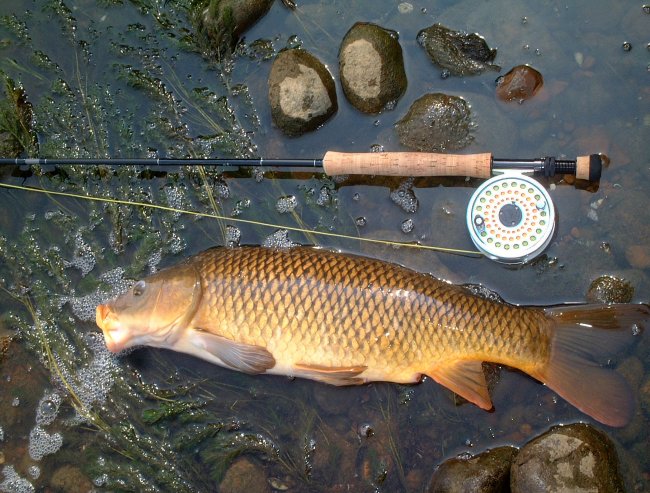
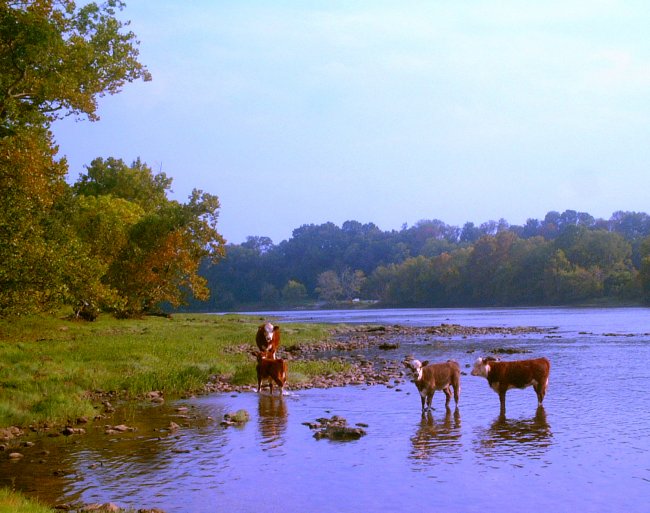
A typical entry from the author's home water, with tackle. |
|
| Ok,
assuming I might want to catch them, how do I do it? The most common misconception about carp fishing is that it is easy. It isn’t. People assume that carp are easy to catch for the same reason they assume all carp are diseased: nothing that ugly could be difficult to trick. Fortunately, this belief is just as flawed as the first one. Carp are, in all likelihood, the spookiest, trickiest, smartest fish found in the waters of the United States. They have phenomenally sensitive mouths equipped with chemically sensitive receptor cells which allow the carp to distinguish food from foe in an instant. In addition, carp actually have nostrils, small holes near the eye sockets which flush in water and allow the carp to sample its surroundings like a lizard testing the air with its tongue. Once spooked, a carp emits an alarm pheromone which alerts other carp to the danger. Thus, one shot is often all you get, even in waters where the carp experience no fishing pressure. The great beauty of carp fishing in the United States is that the time to seize the moment is now. Europe, as mentioned, has organized carp angling which selects for educated fish, mimicking the arms race that has already occurred between North American anglers and salmonids. Carp, with such an impressive biological arsenal already at their command, are certain to quickly reach new levels of uncatchability once angling pressure begins in earnest. Just as saltwater fishing opened up in the previous decades, so too will carp fishing in the coming years. The tools for catching carp now were largely developed in the great saltwater laboratories of the past decade or so. Although blind fishing is an option, the thrill of catching carp is in the stalk, just as it is with redfish and bonefish, so this article will focus on sight-fishing alone. Carp in common conditions can easily cross twenty pounds, so be prepared with strong tackle appropriate to the situation. Eight weights with strong drag reels are appropriate for river situations, but consider scaling up to a ten weight if you target carp in waters where they can sound for the bottom. Horsing a carp out from under a dock is particularly difficult. Pay close attention to the terminal tackle. Most modern saltwater lines are adequate for carp fishing. Avoid bass bugs and other tapers which might turn a fly over too aggressively. Use tapered leaders at least as long as the rod, but use the strongest pound test you can get away with. Ten pound Climax saltwater is my usual tippet. Flies range from my personal favorite, the Crazy Charlie in whatever color matches the stream bottom, to orange-headed wooly buggers in white and olive, and egg-patterns colored to resemble mulberries, corn, or trout eggs. Choose patterns based on the vegetable as well as animal sides of the menu, because carp are omnivorous. Hooking up Carp are at their trickiest, and most rewarding, when the sun is high and the water is slick. Although I am not above chumming up some lake carp for a quick evening of bulldogging some fish, I find the early afternoon carp stalk to be among the most entertaining forms of fly-fishing I have experienced. Wear polarized sunglasses and locate a section of your local carp water, whether river or lake, which allows for shallow wading. Even granddaddy carp will tail in less than six inches of water. Begin your stalk upriver (or upwind in still water), with the sun wherever you can see ahead of you best. I find it helps to use the reflections of trees or nearby hills to cut some of the glare off the water. Again, polaroids are absolutely not optional. Carp will skim across the flats seemingly at random, sometimes holding in predictable patterns and sometimes meandering about. Usually they are looking for food, which they attack by hoovering up the sediment and filtering out crustaceans, plant matter, and bugs. Just as a bonefish puffs away at the bottom, so will a carp root for his dinner. Approach the carp from “over his shoulder,” and carefully wade as close as necessary for a really clean cast. For the best results with a ten pound carp you will want to be able to hit a 3” target at at least 30’. That 3” strike zone is usually immediately “behind his ear,” or in the slot just between his pectoral fin and his eye, approximately 6” away from the fish. Cast for distance first as the fish are not line shy, then lay the fly in with an audible plop (but not a splash). If you are lucky, the carp will turn to see a potential food source drifting down and will grab before the adage about being too good to be true finishes flashing before his eyes. This cast usually gets me about 50-50 results when I nail it. Some carp will blow out of the pool the minute the fly makes contact. Because of those chemical signals, the best bet is to wade to the bank and start over a couple hundred feet away. Another approach makes use of the carp’s feeding proclivities. Like a bonefish, carp often spot prey by the puffs of sediment the critters send up when scurrying away from danger. When you see a carp prowling for food, lead your fishy receiver like a quarterback by just a few yards and give your fly time to sink. I particularly enjoy this method with a Crazy Charlie or similar hook-upwards pattern. Let the fly settle, then when the carp comes in range, twitch it just enough to stir up some dust. Usually, the carp will be on you like a duck on a June bug. |
|
|
The peanut gallery
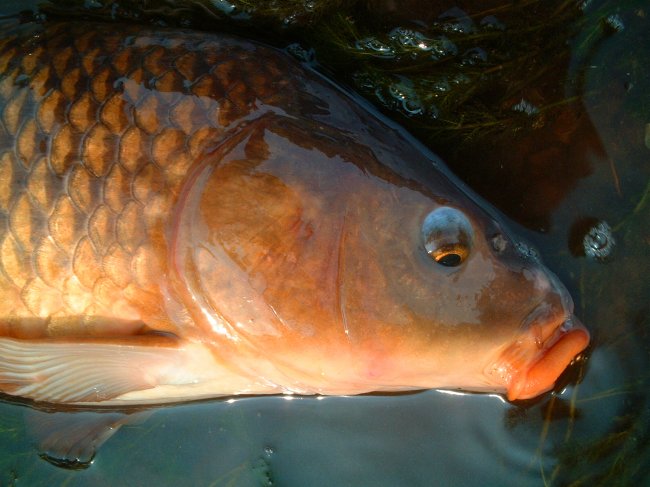
Plug-ugly? |
|
| Eating
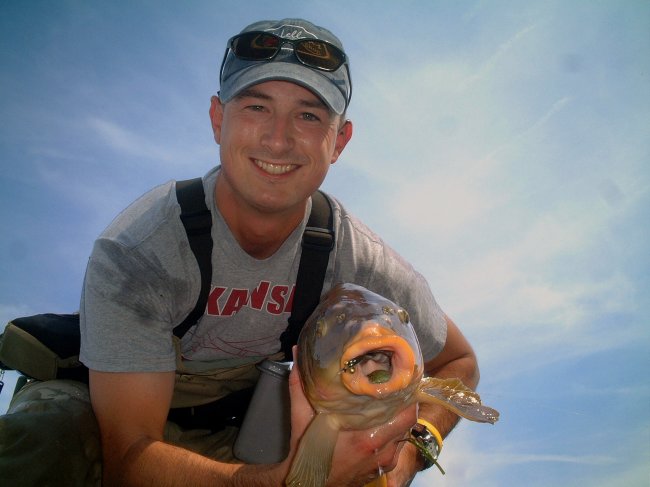
the Wind out of His Sails |
|
|
|
|
 |