|
2.
Who wrote the famous treatise whose title has entered our flyfishing vocabulary,
"Matching the Hatch"?
Answer: The classic, “Matching the Hatch: A
Practical Guide to Imitation of Insects Found on Eastern and Western
Trout Rivers,” was written by Ernest G. Schwiebert, Jr. and first
published by Macmillan Press, NY in 1955. With this book, Schwiebert
coined the phrase, “matching the hatch.” When published
in 1955, Schwiebert’s book was perhaps the first popular and simple
explanation of matching imitations to the natural insects, principally
covering mayflies, stoneflies and caddis flies, dividing the hatches
by seasons.
3. Who was the Ross Reels company
named for (first and last name)?
Answer: Ross Reels were named after Ross Hauck. Hauck
founded ROSS REELS in 1973 with the goal of creating a fully machined,
highly durable, saltwater approved fly reel.
4. What
is the only line manufacturer which primarily uses polyethylene rather
than polyvinyl chloride (PVC) as the main material in its fly lines?
Answer: MONIC, in Boulder, Colorado, is the only fly
line manufacturer that uses gel-spun polyethylene as the core material
in their flylines. According to MONIC, “this core exhibits no
elongation, and possesses a breaking strength of 90 pounds.” MONIC
is a registered trademark of Flow Tek, Inc., Boulder, Colorado
5. What do you have to cross to get a Tiger Muskie?
Answer: Introduced in 1978, a Tiger Muskie is a sterile
hybrid cross between a Muskellunge and a Northern Pike. The hybrid gets
its name from the distinct, dark vertical bars on its body, although
some larger individuals may display very little barring. Whereas the
hybrid can occur in the wild where both species coexist, the vast majority
of hybrids are produced in the hatchery. The female Muskie is usually
preferred due to its greater egg production than the female Northern
Pike. However, the female Northern Pike and male Muskellunge cross is
often used when suitable numbers of female Muskies are not available.
6. What company manufactured the
first commercial fiberglass fly rod?
Answer: The first commercial fiberglass flyrod, known
as the “Wonderod,” was manufactured by Shakespeare in 1947.
The first production "Wonderods" fly rods were model #1390,
an 8-1/2 ft. three piece weighing under five ounces, and model #1290,
a 7'9" two piece weighing three and one-half ounces. (See the full
story below)
The Story Of The
First Fiberglass Fly Rod
In 1944, Dr. Arthur M.
Howald, Technical Director for the Plaskon Division of Libbey-Owens-Ford
Glass Company, was on a trout fishing trip in northern Michigan
when he broke the tip of his pet bamboo rod. Because replacement
tips were impossible to obtain during the war, he used his knowledge
of glass fibre/Plaskon resin fabrication to attempt a replacement
tip of fiberglass.
Although it proved to be
satisfactory, he continued to experiment with rods made entirely
of fiberglass. Dissatisfied with these results, he revealed his
experiments to Mr. Shakespeare's son, Henry Shakespeare, the Company's
new Vice President and General Manager.
Dr. Howald asked Henry what
the ideal rod should cast like, and Henry told him that no one had
yet made an ideal rod, since each fisherman and each fishing situation
would require a different rod action in order to be considered "ideal".
Dr. Howald then wanted to meet with the foremost authorities on
fly rod casting and rod design. He met with Paul H. Young, the famous
bamboo rod maker from Detroit, on the North Branch of the Au Sable
river, and later with Henry's friend Charles Ritz of France. Howald
returned from these meetings with the impression that there was
room for two more fly rod authorities, namely Henry and himself.
Patent rights were secured
to produce the world's first fiberglass fishing rod, the "Howald
Glastik Wonderod," and Henry Shakespeare put the Shakespeare
Company back into the rod making business.
At the Tackle Manufacturer
Association meeting that year, the president of the Montague Rod
Company asked Henry if he was not making a big mistake in thinking
that the American angler would abandon split-bamboo for a fiberglass
rod costing nearly sixty dollars, and speculated that perhaps they
might sell fifteen or twenty rods in the first year. "We already
have orders for that many thousand!" Henry replied.
The first "Wonderod"
test rods were made as fly rods, made up from natural gray colored
fiberglass blanks and had bright nickel silver ferrules. The first
"Wonderods" to appear on the market in 1947 were bait-casting
rods, since casting rod tapers were easily designed, and fly-rod
tapers were more complex. Fly rod Wonderods were available to the
public later that same year. These first production "Wonderods"
fly rods were model #1390, a 8-1/2 ft. three piece weighing under
five ounces, and model #1290 7'9" two piece weighing three
and one-half ounces. Both sported the now familiar milky-white colored
fiberglass shaft with the spiral markings of the cellophane wrap,
and featured a genuine agate stripping guide, serrated nickel-silver
ferrules finished in black, and a ring hook keeper.
And for what it’s worth… **The first glass used in the manufacture
of fly rods was named E glass. Hexcel made E glass fabric in three weights:
H Rod material was the heaviest; L Rod material was lighter than H,
and XL Rod material was the lightest weight material and was generally
used to make fly rods (**from the book, “Fiberglass Fly Rods –The
Evolution of the Modern Fly rod from Bamboo to Graphite” by Victor
R. Johnson and V. R. Johnson, Jr.).
Incidently, the oldest rod I own (next to an old bamboo fly rod I aquired
last year) is a stout Shakespeare “Howald” wound fiberglass
spinning rod that I bought decades ago for striper fishing.
7. Who patented the perforated face and spool type of reel which has become
so standard today?
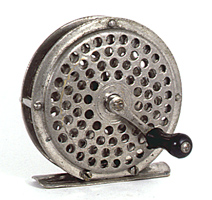
Answer: On May 12, *1874, Charles
F. Orvis, founder of The Orvis Company, was granted a patent on his
new perforated Trout Reel. That reel had a large overall diameter and
a very narrow spool. The perforations, or porting, enabled a quicker
drying time for the silk lines that were used at the time. Virtually
all fly reels since have been based upon the principles that set this
reel apart from all others. While materials used to make the first reels
(nickel silver and nickel-plated brass) have changed (to aluminum),
it is still very evident that Mr. Orvis’s perforated fly reel
represented a milestone in the evolution of the fly reel. *(A
side note here: While two sources gave the patent
year as 1874, a third source reported the patent year as being 1877)
|