|
|
"Siblings
of the White"
By Zach Matthews
October 20, 2003
| Travel
This is not a giveaway article. Quite rightly,
many anglers become upset when some online or published magazine starts
selling out the secrets locals spent years developing and shared with
only a few. The streams I am about to dissect are known, even well known.
Many hundreds of anglers fish them each week of the year, with marginal
to excellent success. However, somehow these streams have managed to be
passed over as “last years’ water.” There’s a
prevailing myth here that these streams are overfished, that the fish
are undersized, and that attempting an outing means wrangling with Bubba.
This doesn’t have to be true.
Little Red River
 Right off the bat, I know you are going to say, “Wait a minute!
The Little Red is what he considers passed-over water? Isn’t that
where they caught the world record brown?!” If you are saying this,
let me explain. Yes, it is true that the world record brown trout, a 40
lb., 4 oz. behemoth caught by the late Rip Collins in 1992, came out of
the Little Red. The river enjoyed an instantaneous flash of popularity
as anglers pummeled its depths in search of something, anything comparable.
The mighty White River was for once passed over by the hordes of out of
state anglers who paraded their way to the Little Red. Yet slowly, that
torrent diminished to a trickle, and the Little Red went back to what
it always was, a trout stream convenient to Little Rock and not much more.
Electroshocking boats still dredge up the silent monsters between the
moss, and occasionally an angler will land a 20 pounder night fishing
off a dock, but the media frenzy has died.
Right off the bat, I know you are going to say, “Wait a minute!
The Little Red is what he considers passed-over water? Isn’t that
where they caught the world record brown?!” If you are saying this,
let me explain. Yes, it is true that the world record brown trout, a 40
lb., 4 oz. behemoth caught by the late Rip Collins in 1992, came out of
the Little Red. The river enjoyed an instantaneous flash of popularity
as anglers pummeled its depths in search of something, anything comparable.
The mighty White River was for once passed over by the hordes of out of
state anglers who paraded their way to the Little Red. Yet slowly, that
torrent diminished to a trickle, and the Little Red went back to what
it always was, a trout stream convenient to Little Rock and not much more.
Electroshocking boats still dredge up the silent monsters between the
moss, and occasionally an angler will land a 20 pounder night fishing
off a dock, but the media frenzy has died.
In the fall the Little Red yields up some of its biggest secrets, but
there’s a catch here. In order to fish to some of the true monsters,
you are going to have to interfere with the spawn. No matter your fishing
ethic, you must consider that the Little Red is not stocked with brown
trout. Every trout in the river was born in the river. Fish the spawn
now and you will take home some incredible pictures and memories. But
you will pay the price down the road. Some anglers argue that the spawn
can be fished safely, that the fish are not really harmed by being dragged
off the redd. I refuse to accept this. I have watched the browns spawn
carefully and the rainbows are right there with them, eating the eggs.
Pull away the protection of the mother’s body and it’s a free
for all. The other thing to consider during the spawn is that the trout
do not actively feed. In order to hook one you are going to have to trigger
its attack response, or hook it foul. Flyfishing is about accepting limitations,
and one of those limitations is attempting to fool the fish into taking
“natural” food. Fishing the spawn entirely misses the point.
|
| Enough
about that. This is not an article for spawn fishermen. Plenty of the
horde in lawnchairs that line the river each November can tell you about
that. The problem is the rest of the year. The majority of the rest of
the year fishermen are content to take 11” rainbows thirty yards
from their stocking point. They complain that they journeyed 11 hours
to catch something special, only to find the same trout they could buy
at Kroger back home.
Many anglers, particularly out of state
but some locals too, never leave the known locations. On the Little Red
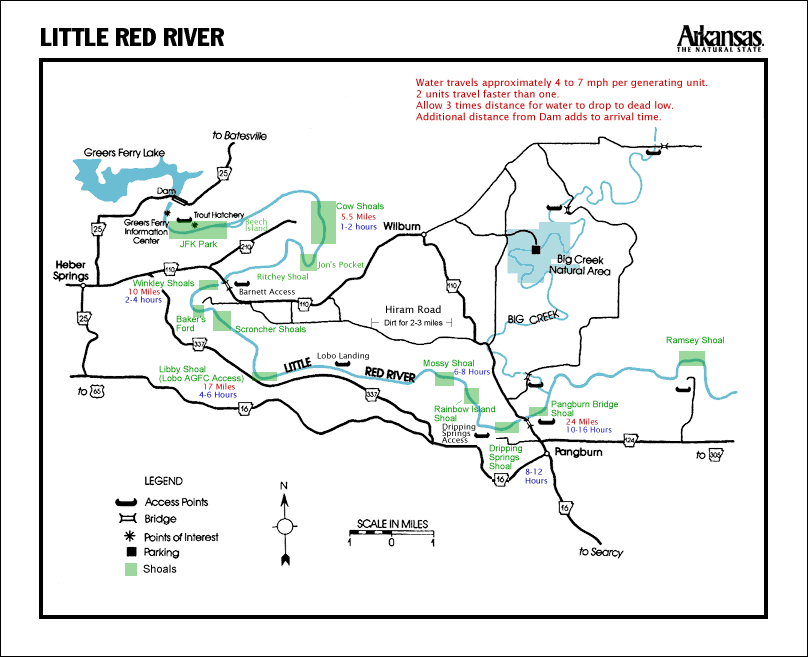
the most popular destinations are JFK Park, Winkley Shoal, and Cow Shoals.
Cow Shoals is where the browns spawn and is famous for that. Winkley and
the Park are simply easy to access.
These locations get pounded. The average
fish there in the bulk of the year is 11” long, the stocking size.
If fooling trout that have been in the river 36 hours is your thing, check
these shoals out. You will miss out on the translucence of a natural born
brown and the fight of a feral rainbow, but you’ll catch fish. Keep
working the same pod and you can rack up dozens and dozens of the same
trout. Impress your friends and scare your enemies.
If you are interested in the wilder side of the apparently tame Red, read
on. There are other shoals on the river too. Shoals not accessible by
paved roads and public access points. For some, to legally reach them
you will need a boat. Others are only as far away as water conditions
and your endurance allows. Fortunately boat shuttles are cheap at any
of the trout docks in the area. Abe’s Lobo Landing rents jonboats
for $50 a day, which will hold three anglers, or they will shuttle you
anywhere in range for $10.
If you don’t want to settle for supermarket fish, you have other
options. Worthwhile experiences will take a little more effort, but then
worthwhile things usually do. You can start by exploring the lower river.
Lobo Access, Mossy Shoal, Dripping Springs Shoal near Pangburn, and Pangburn
Bridge Shoal are all elegant, frequently empty places to ply the water.
Or, try the lower reaches of the known areas. If you fancy a hike and
a wade, try walking all the way out the back door of Winkley Shoal; there
are islands and eddies there where monsters lurk.
Fly selection on the Little Red is fairly
simple. The standard of choice is the Little Red Sowbug, one of the simplest
of all flies. Drop a sowbug or a humpback scud beneath an indicator and
search the pools, runs, and riffles of the lower river. You might be surprised
at what you find. If you go the boat route, rig deep and fish slow, and
watch your indicator like a hawk. Eight feet down is a long way to pull
slack, and your yarn may only twitch.
When the day ends, don’t pack it in. Stay on until 9 or 10 o’clock.
If nothing else the ominous weight of the river at night by yourself is
worth the 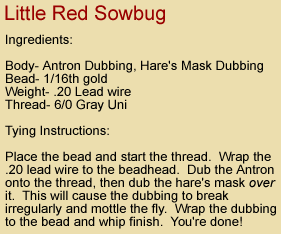 experience.
You are much smaller than you think. Trout leap clear at night for bugs
so small you couldn’t spot them with the light on. The sound of
their bodies hitting the water like lead footballs, over and over and
over, will drive you into a frenzy that makes your worst case of buck
fever feel like you drank one too many espressos at Starbucks on a Tuesday
morning. Do be careful, however, and always check generation tables before
heading out. I like to stick to the lower river at night because then
I know what water’s coming and when. Mind the docks as well, I have
been threatened with bodily harm just for being near one at night. Some
of the locals are a mite jumpy. experience.
You are much smaller than you think. Trout leap clear at night for bugs
so small you couldn’t spot them with the light on. The sound of
their bodies hitting the water like lead footballs, over and over and
over, will drive you into a frenzy that makes your worst case of buck
fever feel like you drank one too many espressos at Starbucks on a Tuesday
morning. Do be careful, however, and always check generation tables before
heading out. I like to stick to the lower river at night because then
I know what water’s coming and when. Mind the docks as well, I have
been threatened with bodily harm just for being near one at night. Some
of the locals are a mite jumpy.
Crisp mornings in the fall are wonderful times to fish away from the spawning
shoals. These hotspots act like magnets, drawing the flotsam of the rest
of the river and leaving the watery lanes open and unobstructed. I have
been face to face with deer flushed from the forest, their brick dust
fur blending into the autumn backdrop. A deer’s hooves on the slippery
rocks of a dry shoal in the fog is something to hear. Herons will ignore
you like housecats who have done something foolish, and occasionally you
may spot an eagle or a horned owl. The Little Red is worth far more than
its trophy potential. The first time you hold a Little Red brown in your
hands, you will know what trout are meant to look like. A natural brown
bleeds color like a Van Gogh beside the harsh, Wal-Mart-ish light dulling
the scales of a hatchery rainbow. Six inches or thirty, trout fishing
is rarely better.
Beaver Tailwater
“Now,” you are saying, “he’s moving on to Beaver!?”
That’s right, Beaver Tailwater, the red headed stepchild of the
White River system. In 1990 Beaver Lake saw one of its worst floods ever,
with all the overflow gates open for days on end. The river bottom ecosystem
was scoured away like sandpaper on a fine work of art. All that remained
was rock, and stripers. Beaver now sports scars from its wounds. But Beaver
has fought back.
Thanks in large part to the work and dedication of the Trout Unlimited
chapters of North Arkansas, Beaver Tailwater is fishable again. The riverbank
was largely destroyed, so the Corps of Engineers and TU replaced it with
iron-and-wood bandages 8 feet high, walls which hold back the water and
protect the canyon’s flanks. The bottom was ripped clean down to
the bare limestone, but gravel and moss pods have reemerged. Plans are
on hold for a fish hatchery beneath Beaver Dam, and the effluent from
that hatchery could do much to aid the future development of this small
stretch of trout water. Triage is complete and the river is going to make
it, but it may be a long time to a complete recovery.

That does not mean, however, that Beaver isn’t worth a visit. When
you go to a place like this, you have to keep in mind why you started
flyfishing in the first place. Beaver Tailwater yields up maybe one eight
pound trout a year, usually to a local. The average size of the fish is
small, and holdovers are few and far between. Nonetheless there is magic
here. Crane Roost Bluff is an eyrie for a wide variety of birds, from
scissortailed swallows to Great Blue Herons, which live here in abundance.
Two great horned owls have recently made it their home, and they will
watch you from the branches of the sycamores towering high over the clifftop.
This stretch of river is your best chance for seeing the national bird
while fishing, and in the fall squadrons of geese dive bomb so low you
have to avoid hitting them in your backcast. (A hat is definitely recommended
when fishing during the migration.) Fields of wildflowers melt into the
river opposite the bluff, and aside from the occasional canoe hatch, the
catch-and-release is all yours for the taking any day except Saturday.
Local favorite patterns on Beaver Tailwater include a vast array of tiny
midges, a sprinkling of sowbugs and other crustaceans, and the ubiquitous
Y2K bug, a Frankenstein creation blended from beadhead nymphs and egg
patterns that resembles a Harlem Globetrotters basketball in yellow and
orange. This is the only serious candidate fly in recent years for banning
from the water. It is so effective some anglers, including myself, have
given up using it. Midge fishing in winter is excellent, though tricky,
as at low water Beaver has effectively no flow.
This is a river that is worth the trip for more than the fishing. It is
beginner water, a place where the trout are easy to spot and easy to fool,
and it deserves its place as the minor league ballpark of the White River
association.
Nonetheless it is beautiful, and in the evenings elegant, like an old
woman dressed in the fashions of her youth.
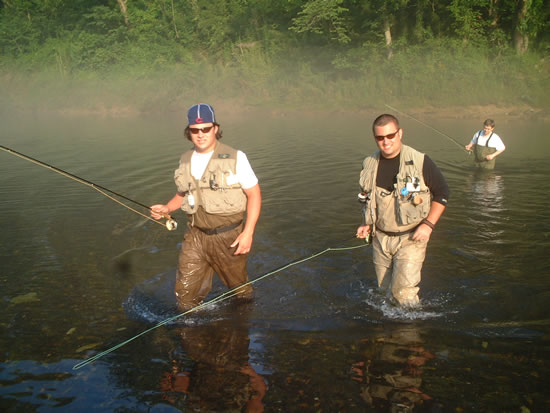
The author's wedding party on the morning of his
wedding,
fording the White River below Beaver Dam
(Beaver Tailwater) in the mist.
|