 |
 |
 |
 |
 |
| Arrival in Manali - June 23, 2000 |
| The stiflying heat, dust and chaos of Delhi were now a 15 hour bus ride behind me. I had come to Manali at the invitation of Domi, who had taken a years leave of absence from her job in Paris to live in this rarified atmosphere. So what would possess an intelligent, talented, independent, worldly French woman to give up a well paying job in Paris to immerse herself in a culture diametrically opposed to her own with all the concomitant challenges presented by langauge, customs, religion, etc.? In just 3 words; il...est...beau. She got to know him (yes, in the biblical sense) the year previously on a Himalayan trek where he served as guide. After meeting him, I could understand why she was here. If he hadn't chosen to be a guide he certainly could have had a brilliant career as a leading man in the Indian cinema. |
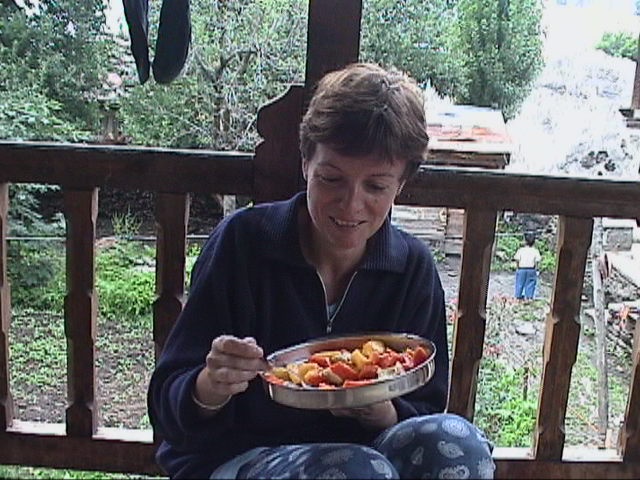
| Voila, Domi on the terrace of her little pad in Dhungri, which is a lively, seven minute, serpentine, get-out-o'-my-way ride in a motorized rickshaw up the hill above Manali. |
| Domi had all the comforts; silty water she pumped from the well below to be lugged upstairs, a propane stove for cooking and heating water for showers (cup in one hand, soap in the other), drinking water from a spring a quarter mile away, two homemade beds, small wood burning stove, and a built-in, organic alarm clock - four screaming kids who went off prompty every morning at 5 am. The first morning I was awakened by such piercing screams and shouts that I sincerely expected to find the gory, scattered remains of at least two of the little imps at the foot of the stairs when I went down to get water. But alas, no, they were still all alive and kickin'...and punching and biting. They were great kids but there appeared to be no limits to their unrestrained enthusiasm. |
| While living in Manali, Domi began to learn Hindi and worked part-time for a couple of agencies who booked Himalayan treks for French groups. She talked to Chhape at Himalayan Frontiers who put me in contact with my "horseman" Chher, and after looking at several different routes I decided that the trek to Baralacha was the most appealing because it followed the Chandra river for part of the way then passed by a lake (Chandratal). |
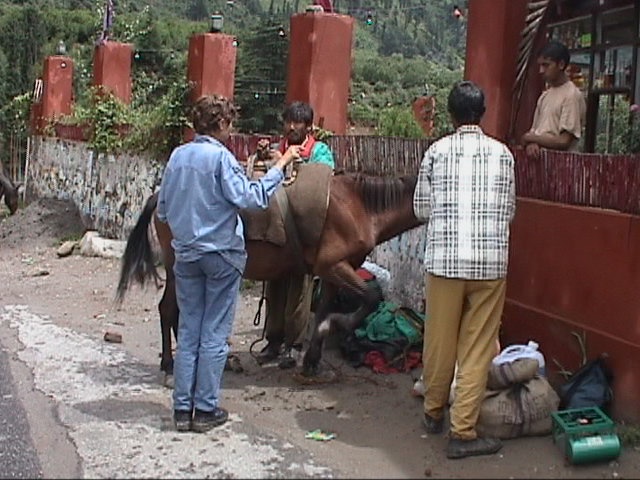
| Since this wasn't a trek organized by an agency I was responsible for providing my own gear and provisions; Chher would take care of cooking utensiles and horses. Domi accompanied me downtown to guide me during my shopping excursion, then on the morning of June 28th we were up early to take a rickshaw to meet Chher at the rendez-vous location in front of the restaurant at Prini (seen to the right) at the appointed time, only to wait almost four hours until he arrived. He excused his tardiness explaining he had trouble getting the horses down the muddy hillside due to the heavy rain that had fallen during the night. Before leaving, Domi asks Chher a few basic questions, like; "You do know where you're going, right?" |
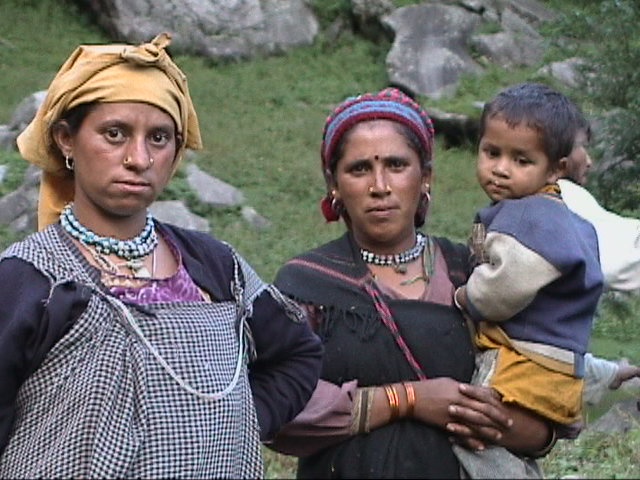
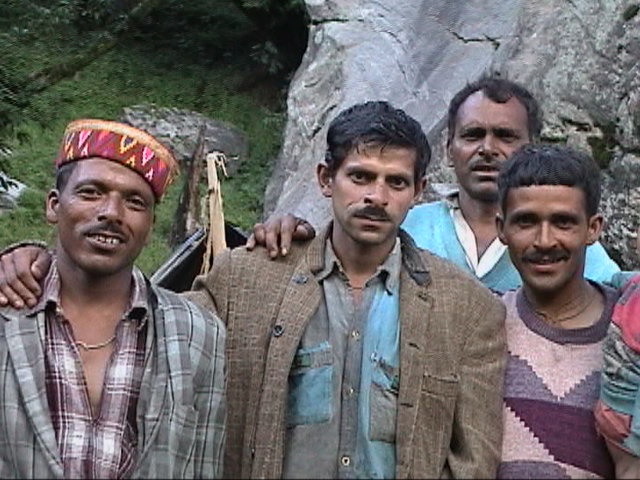
| Despite the muddy conditions it only took Chher and I about three hours to reach our first campsite at Pandro Rupa. There were about twelve people camped there who appeared to all be living together in a large communal shelter. Upon arrival, I was a bit hesitant to break out the video camera because I thought they might be a bit timid about being filmed, so I began taping some of the surroundings. It wasn't long before I had a crowd around me curious about my camera. So I took some video of them, then showed it to everyone on the small, built-in video monitor, to their general delight, amusement and amazement. I had never seen so many interesting faces all together in one place at one time. Later, Chher and friends invited me to try some of the "local whisky". However, after a couple of ounces ("Whoa, hold it, stop, stop you guys!") I politely excused myself as Chher and company continued to liberally sample the local brew. But what is drink without song. As I lay in my tent, marveling at the incredible resiliency of the human vocal chords, Chher and company sang verse after verse of what I determined to be ancient, traditional folk songs passed down from one generation to the next for hundreds of years, because I didn't want to consider the alternative; that what they were really singing was the Hindu equivalent of..."Now there's 99 bottles of beer on the wall, 99 bottles of beer...". |
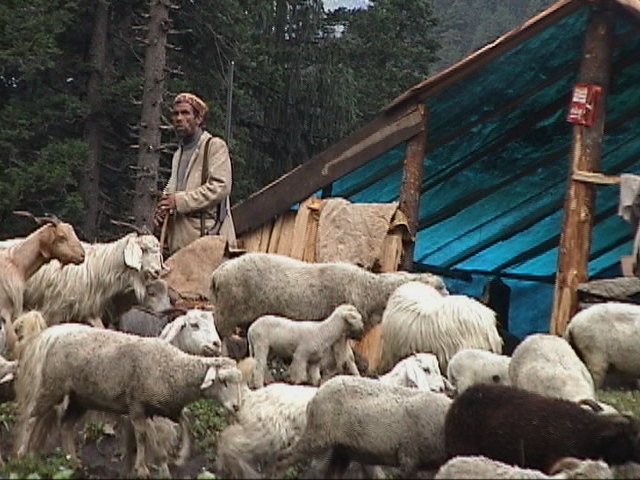
| Back at the ranch, somebody has to watch the sheep. When I saw the big gun he was toting I wondered just what we were in for that night. This was the first and only time during the entire trek that I saw a shepherd with a rifle. Most of the other sheepmen we came across had something that smoked, but it definitely wasn't a gun. One blast of the stuff they were carrying and the last thing on your mind would be rustling a bunch of sheep. |