Doc and Katy (right) have been writing their syndicated gardening column, "The Green Thumb," since the end of World War II. They garden, landscape, and write from their home in upstate New York. If it lives in a garden, they know about it. Here is some of their best advice.
LOOK AROUND YOUR KITCHEN.
You have vinegar, baking soda, garlic, and many other products-even a can or two of fruit cocktail-that can help keep house and garden plants healthy. The following remedies for plant problems are safe, inexpensive, and reliable.
 ALCOHOL
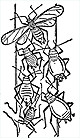
Alcohol kills mealybugs, scales, aphids, spider mites, whiteflies, slugs, and earwigs by acting as a surfactant, or wetting agent, that can penetrate an insect's waxy coat of armor and kill on contact with the body. Methanol (wood alcohol) evaporates a bit too fast. Isopropanol (rubbing alcohol) works fine and is easy to find, but be sure it doesn't have additives. Ethanol (grain alcohol) seems to work best. Alcohol usually comes in 70 percent strength in stores (or 95 percent strength purchased commercially). To make an insecticidal spray, mix equal parts 70 percent alcohol and water (or if using 95 percent alcohol, mix 1 part alcohol to 1-1/2 parts water). To kill mealybugs, dip a cotton swab or cotton ball into alcohol and wipe off the infestation.
BAKING SODA
Black spot disease causes the leaves of roses to wilt, turn yellow, and drop off. To combat this, mix 3 tablespoons of baking soda into 1 gallon of water and spray the roses. Pick up any fallen rose leaves and burn them or take them to the dump.
 BEER
BEER
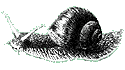
Placed in shallow pans with the top edges flush with the ground, beer is a safe, inexpensive killer of snails and slugs. The pests crawl into the pans and drown. In a report to the Entomological Society of America a few years ago, Floyd F. Smith of the U.S. Department of Agriculture said that in a series of four-day greenhouse tests, beer attracted more than 300 slugs, and metaldehyde, a standard bait, attracted only 28.
 BORAX
BORAX
Blisters on geranium leaves, a condition called edema, may be caused by a boron deficiency. If the blisters do not clear up as spring advances, mix 1/8 teaspoon of borax into 1 gallon of water and use it to water the plants two or three times. (For another use of borax, see Epsom Salts.)
BUTTERMILK
Mites are the scourge of many outdoor ornamental plants, as well as some indoor plants. So tiny that it takes 50 of them to cover the head of a pin, mites cause yellowed and stippled foliage and twisted leaf tips. For a simple home cure that works on ornamental plants and fruit trees, mix 1/2 cup of buttermilk, 4 cups of wheat flour, and 5 gallons of water, and strain the mixture through cheesecloth. Spray it onto affected plants to kill the mites and their eggs.
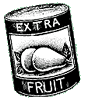 CANNED FRUIT
You can buy Japanese beetle traps of all sorts, but most are no more effective than a can of fruit cocktail. Open the can and let it sit in the sun for a week to ferment. Then place it on top of bricks or wood blocks in a light-colored pail, and fill the pail with water to just below the top of the can. Place the pail about 25 feet from the plants you want to protect. The beetles will head for the sweet bait, fall into the water, and drown. If rain dilutes the bait, start over.
DETERGENTS AND SOAPS
Here is the best control for Japanese beetles:Put 1 tablespoon of liquid dishwashing detergent into a widemouthed jar. Add 2 inches of water. Pick or knock the beetles into the jar and they will die in minutes. Many people use Safer's Insecticidal Soap (as directed) or Murphy's Oil Soap (diluted at a rate of 1/4 cup of soap to 1 gallon of warm water) as all-purpose bug sprays for indoors and out. Here's another safe bug killer: Mix 1 teaspoon of liquid dishwashing detergent with 1 cup of vegetable oil and shake well; then add it to 1 quart of water. Add 1 cup of rubbing alcohol and shake vigorously to emulsify. Pour this mixture into a spray bottle and use it at ten-day intervals on pests.
DISINFECTANT CLEANER
A tiny pest called thrips causes gladiolus flowers to turn brown and shrivel up.
Prevent this by soaking corms in a solution of 1 tablespoon of Lysol and 1 gallon of water. Plant corms while still wet.
EPSOM SALTS
If your muskmelons taste flat, the trouble could be a lack of magnesium in sandy soil. Sweeten the fruit by spraying the vines with this solution: Dissolve 6-1/2 tablespoons of Epsom salts and 3-1/3 tablespoons of borax in 5 gallons of water. Spray the foliage when the vines begin to "run" and
again when the fruit is about two inches in diameter.
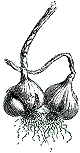 GARLIC
To keep dogs and cats out of the garden, steep 1 chopped garlic bulb and 1 tablespoon of cayenne pepper in 1 quart of water for 1 hour. Add 1 teaspoon of liquid dishwashing soap to help the mixture stick to the plants. Strain the portion you need into a watering can and sprinkle it onto plant leaves. The rest will remain potent for several weeks if kept refrigerated in a covered jar.
MOUTHWASH
An agriculture professor in Texas recommends adding about 2 ounces of Listerine to 1 gallon of water to extend the life of cut flowers, including roses. Listerine contains, among other things, sucrose (food for flowers) and a bactericide, and its acidity promotes quicker uptake of water by the stems.
 OLIVE OIL
Prevent mosquitoes from breeding in rain barrels by floating 1 tablespoon of olive oil on the water's surface.
PETROLEUM JELLY
Whiteflies ("flying dandruff") can be the most difficult plant pest, indoors or out. Trap them with yellow index cards coated with petroleum jelly. To whiteflies (also aphids, scale, and some other insects), the color yellow looks like a mass of new foliage. The bugs are attracted to the cards, get stuck in the jelly, and die.
TALCUM POWDER
To discourage pesky rabbits, try dusting your plants with plain talcum powder. It also repels flea beetles on tomatoes, potatoes, peppers, and other plants.
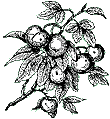 VINEGAR
To keep insects away from apple trees, make a solution of 1 cup of vinegar, 1 cup of sugar, and 1 quart of water. Pour this mixture into a widemouthed plastic jug. Hang the jug, uncovered, in your apple tree. This really works on our 'Northern Spy'.
WOOD ASHES
Slugs and snails hate wood ashes. Sprinkle ashes around flower and vegetable plants. The ashes are a good source of potassium, unlocking nutrients so that plants can take them up. Ashes also check radish maggots: Sprinkle ashes over seeds before covering with soil.
For more information
on summer gardening for all regions,
please visit my sister-in-laws page,
"Seasonal gardening and birding idea's"
click on the bluebird below
Click here
for August to do list