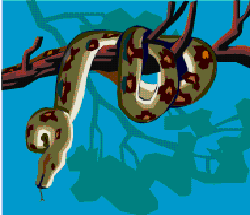
How did you do on the little quiz we took? Are you a snake herpetologist? Or a snake novice? Does anyone know what a herpetologist is? Let's take a look at the following definitions of snakes.
Easier - Snakes are long, thin reptiles. They do not have legs and they slither along the ground. In the United States, only copperheads, coral snakes, rattlesnakes, and water moccasins have poisonous bites.
Harder - Snakes have a long, legless, flexible body that is covered with dry scales. When snakes move about on land, they usually slide on their belly. Snake's eyes are covered by clear scales rather than movable eyelids; therefore, their eyes are always open. They repeatedly flick out their narrow, forked tongue, using it to bring odors to a special sense organ in the mouth.
Snakes belong to the order of animals called reptiles. This group also include crocodiles, lizards, and turtles. As with the other reptiles, snakes maintain a fairly steady body temperature by their behavior. They raise their temperature by lying in the sun or lower it by crawling into the shade.
There are about 2,400 species of snakes in the world. They live almost everywhere, in deserts, forests, oceans, streams, and lakes. Some are ground dwellers, others live in trees, and other snakes spend most of their lives in water. There are a few areas where snakes do not live. They cannot survive in places where the ground stays frozen the year around, so they are missing in the polar regions or at high mountain elevations. Several islands, including Ireland and New Zealand, do not have snakes.
Return to the top.
This week you will:
Some tools we will use include:
Return to the top.
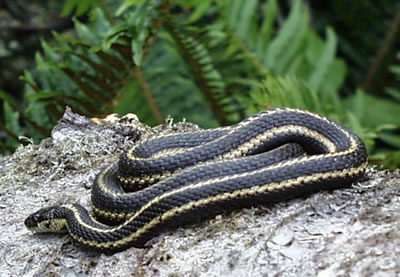
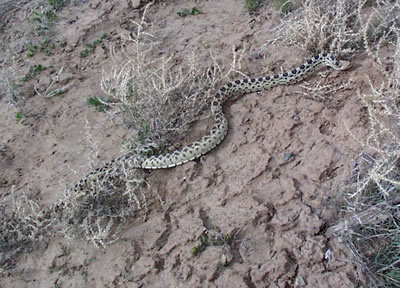
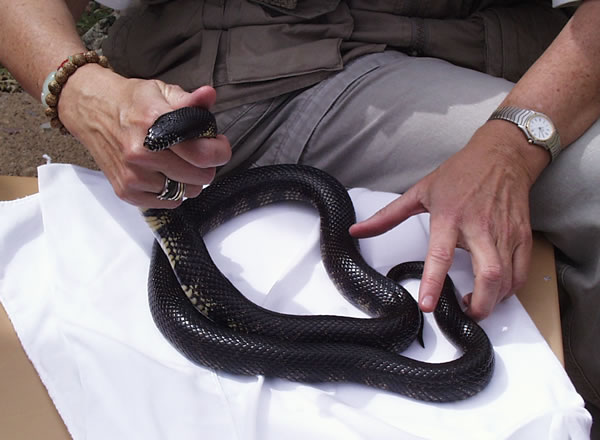
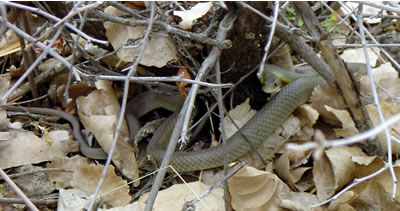
Before we read our story, take a look at some pictures of snakes and view a short movie showing how a snake moves. Click the thumbnails to see full-size images.
|
|
|
|
|
| a gartersnake | glossysnake | a kingsnake | a racersnake |
*Lamb, A. and Johnson, L. (2004). Glossysnake.jpg. Naturescapes Starters. http://tipt3.utoledo.edu/starters
*Lamb, A. and Johnson, L. (2004). Kingsnake.jpg. Naturescapes Starters. http://tipt3.utoledo.edu/starters
*Lamb, A. and Johnson, L. (2004). Gartersnake.jpg. Naturescapes Starters. http://tipt3.utoledo.edu/starters
*Lamb, A. and Johnson, L. (2004). Racer01.jpg. Naturescapes Starters. http://tipt3.utoledo.edu/starters
When we want to get from one place to another, we just get up and walk, run, skip, hop, twirl, etc. How do snakes move? Watch this movie of a snake moving across some rocks on the western edge of Yellowstone National Park. Click here to view the movie.
You'll need a player that can handle QuickTime videos to view the movie. Go to Apple QuickTime Player to download a free player.
Source:*Lamb, A. and Johnson, L. (2004). Snake.mov. Naturescapes Starters. http://tipt3.utoledo.edu/starters
Read Annette Lamb's definition of a snake by clicking here. Before we read our story, take a few minutes and write down your own definition of a snake. If you have time, draw a picture of a snake.
Let's popcorn read the story, The Day Jimmy's Boa Ate the Wash.
You will be working with your assigned partner to learn about snakes. What kind of things would you like to learn? Before you begin, take a few minutes to write down five questions you have about snakes. Each partner should have a list of five different questions. Do you have your list of questions? Great!
Now it's time to search for the answers to your questions. We will use some of the following sources to find information to answer your questions.
Today, we will focus on using books to find information about snakes. On our Computer Lab, day we will visit the following Internet sites:
Now that you've gathered information, we will use it to write a descriptive paragraph about snakes. Let's review some vocabulary you may want to use in your paragraph. See table below.
| anaconda | rattlesnake | forked tongue | carnivore | shedding |
| reptile | slither | pits | poisonous | constrictors |
| swallow | sidewinding | viper | vertebrae | scales |
| Jacobson's organ | prey | cobra | python | venom |
| coral snake | garter snake | fangs | copperhead | scales |
When you've finished your parargraph, we will publish it by posting it on the student work section of our class website.
Return to the top.
| Beginning | Developing | Accomplished | Exemplary | |
|---|---|---|---|---|
| Correct Usage of Topic Sentence/Title | 1 | 2 | 3 | 4 |
| Topic Sentence | 1 | 2 | 3 | 4 |
| 3-5 Detail sentences | 1 | 2 | 3 | 4 |
| Conclusion Sentence | 1 | 2 | 3 | 4 |
Return to the top.
Yeah! You've completed the project and learned a lot about our slithery friend, the snake. Click the snake to find a fun word search. You may work with a friend to complete the puzzle.

Return to the top.
Click here to visit Janette's L571 homepage.
 Send comments to Janette Fluharty, website developer and IUPUI MLS student. Page created in 9/04.

This site is "Bobby Approved."
