The universe is like a safe to which there is a combination,
but the combination is locked up in the safe.
- Peter de Vries
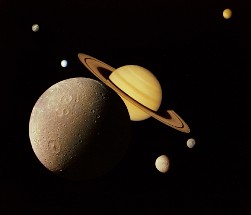
People have enjoyed Saturn since prehistoric times. Saturn was known as the god of agriculture in Roman mythology. Galileo observed Saturn with a telescope in 1610. However it wasn't until 1659 that Saturn's rings were identified. In the summer of 2004, Cassini began orbiting Saturn and taking wonderful photographs. Lightning and a new radiation belt have been found.
Saturn is the second largest planet and the sixth planet from the Sun.

It is the least dense of the planets with a specific gravity less than water.

It is made of 75% hydrogen and 25% helium with traced of water, methane, ammonia, and rock.

Saturn contains a rocky core with a layer or liquid metallic hydrogen and a layer of molecular hydrogen.

The interior is very hot.
Thirty-one satellites have been found orbiting Saturn.
The most recent moon was discovered in 2003.
Some of the moons have relationships and rotate together.
Titan is by far the largest moon at a radius of 2575 kilometers.
Click here for information about Saturn's rings.
Click here to return to Janette's L571 homepage.
