 |
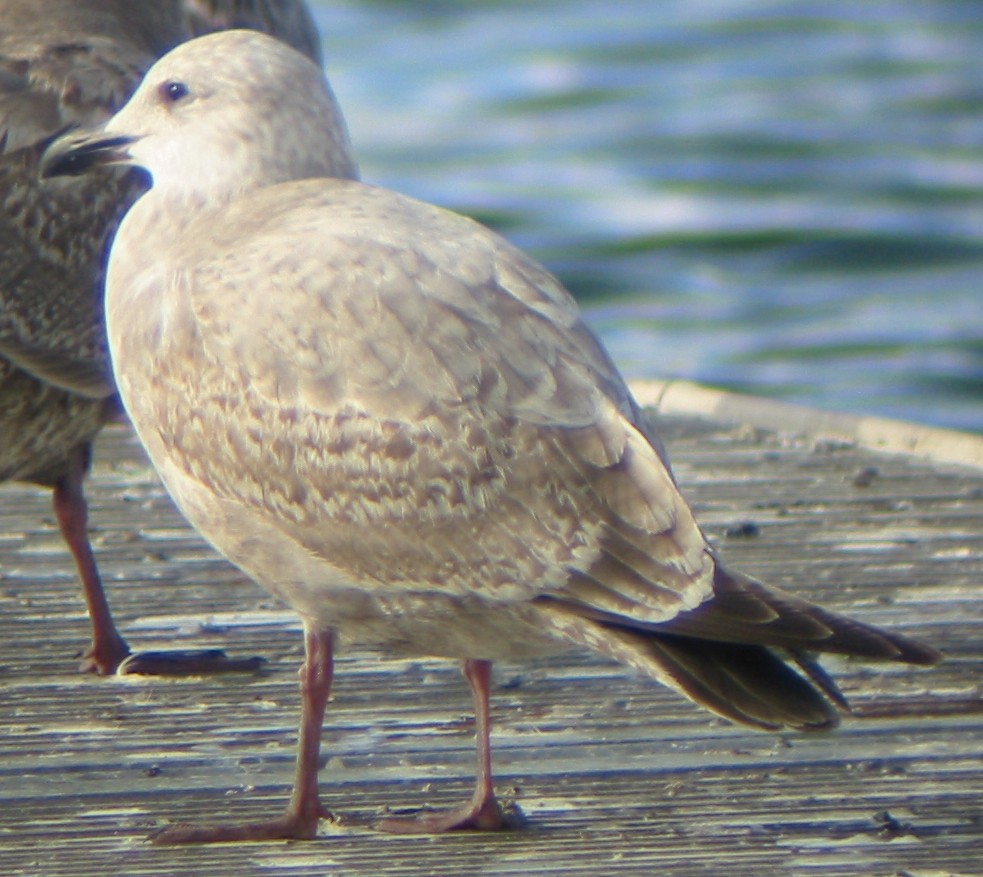
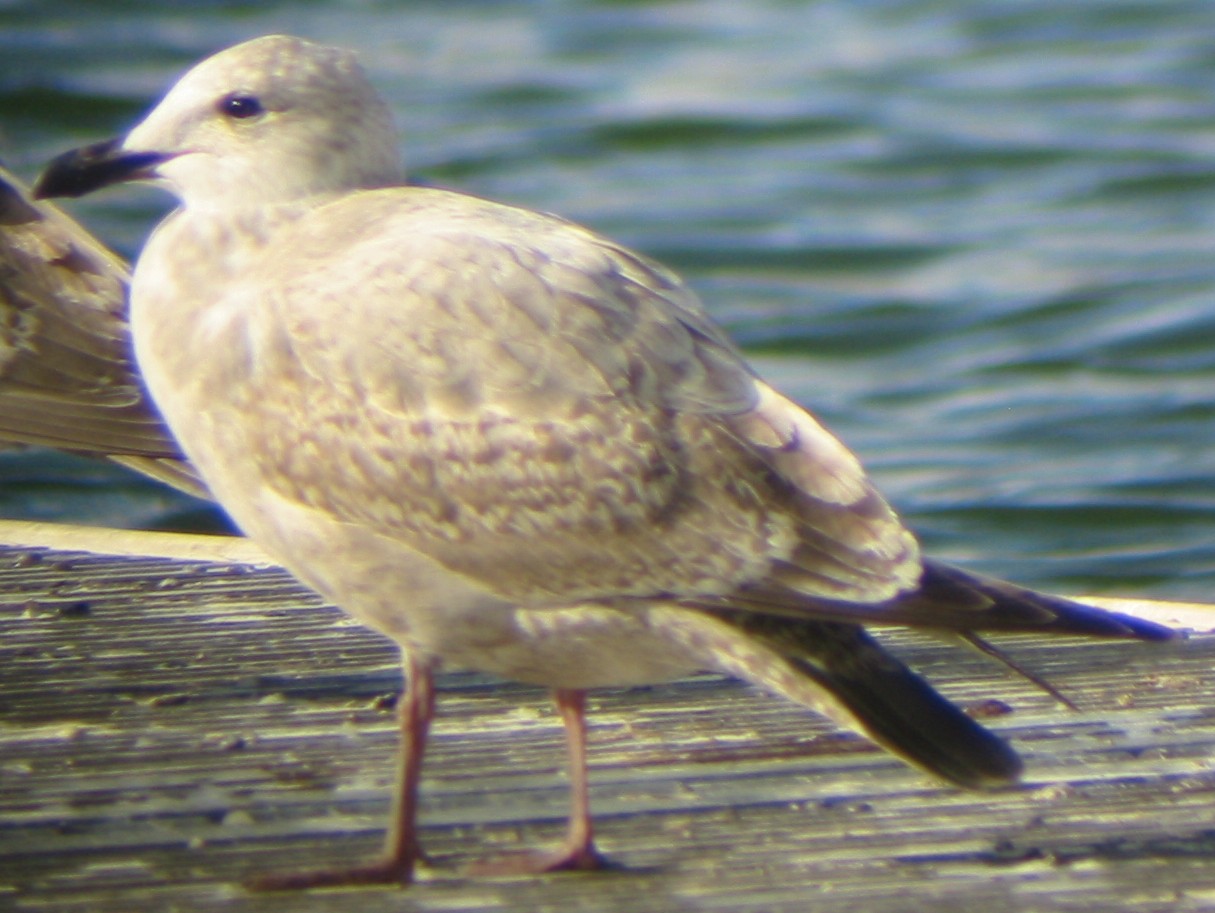
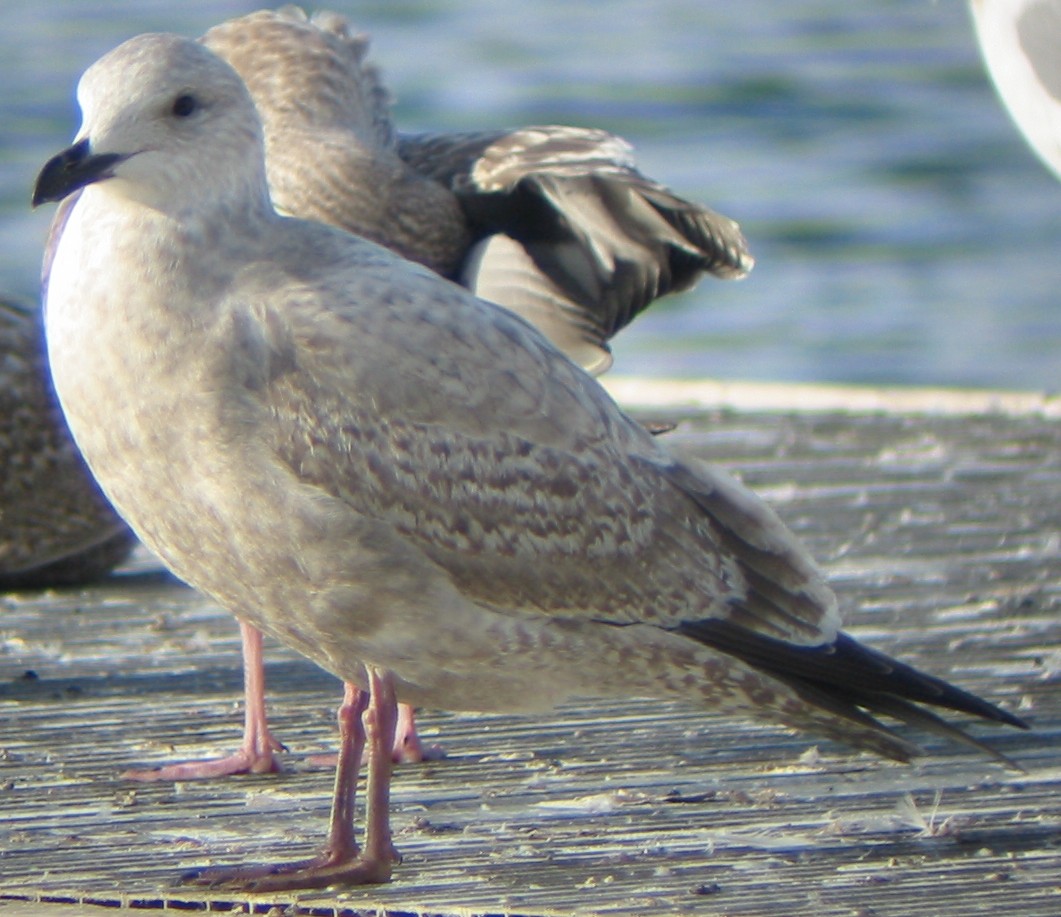
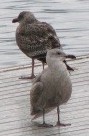
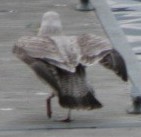
| Possible 1st-cycle Slaty-backed Gull (Larus schistisagus) at Redbud Park, Clearlake, Lake County, CA, 15 December 2007. First found by Jerry White during the Clear Lake Christmas Bird Count. Fortunately I was only 5 minutes away! For comments from others on the identity of this bird, click here. |
 |
 |
 |
 |
 |
 |
 |
 |
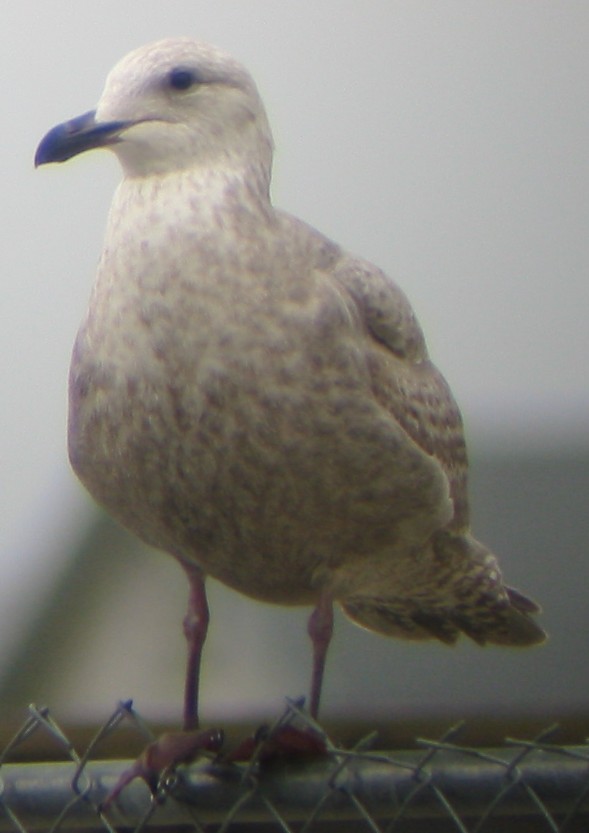
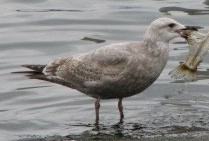
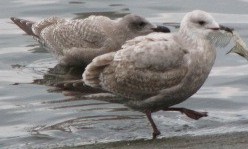
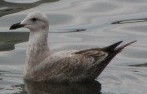
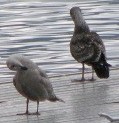
| This is a relatively large, bulky, short-winged, pot-bellied and short-legged gull similar in size and shape to nearby Glaucous-winged Gulls, but shorter legged. The bill is fairly short and stout, lacking the bulbous tip typical of Western and Glaucous-winged Gulls, appearing shorter and stouter than typical of "Vega" and "American" Herring Gulls, and too stout for a Thayer's Gull. The head, neck and body are very pale and washed out for a Western Gull or "American" Herring Gull in December, but could be matched by Glaucous-winged, Thayer's and "Vega" Herring Gulls, although the latter two typically are more boldly patterned. The messy wing coverts and white-tipped, unnotched tertials are relatively unpatterned and plainer than typical of either Herring Gull. The wingtips and tail are very dark brown, nearly black, too dark for Glaucous-winged Gull and perhaps too pale for either Herring Gull. The tail is uniformly dark, too dark for a Glaucous-winged or "Vega" Herring Gull but similar to "American" Herring Gull (which often has white barring on the edges of the tail). The wings appear too short for either Herring or Thayer's Gull. The short legs are bright pink. All of these features appear consistent with a Slaty-backed Gull, which is notorious for bleaching during the first winter, but they might also be matched by a hybrid Glaucous-winged � Herring Gull, which typically would have paler wingtips and tail, especially on a bird as pale as this one (assuming a correlation between head/neck/body and wingtip coloration, which is readily observed in Glaucous-winged � Western Gull hybrids). The following day, 16 December, I relocated the bird a few miles away on the roof of a Wal Mart (conveniently viewed above from a hill). Here are a few photos of the bird on the roof: |
 |
 |
 |
 |
 |
 |
 |
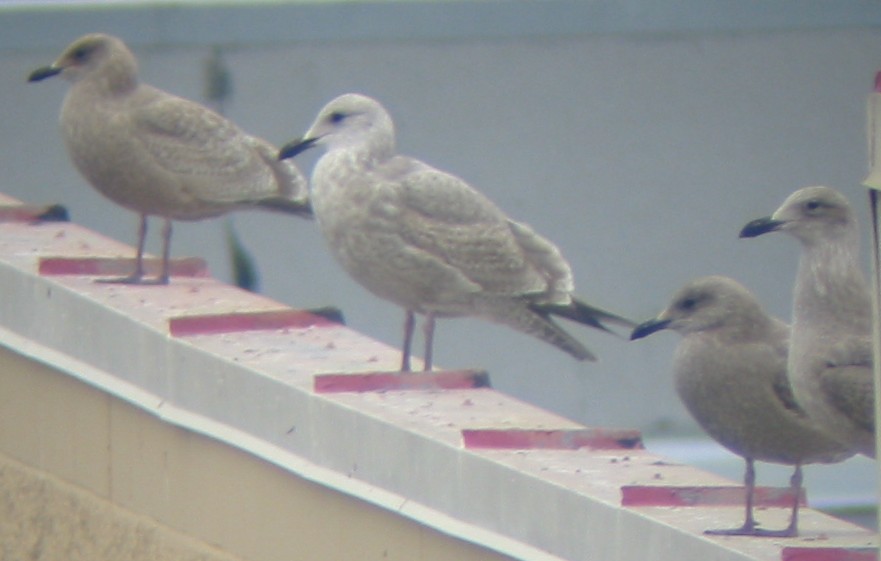 |
| Flanked by a 1st-cycle Thayer's Gull on each side with a 1st-cycle Glaucous-winged Gull on the right. Note the intermediate bill size. |
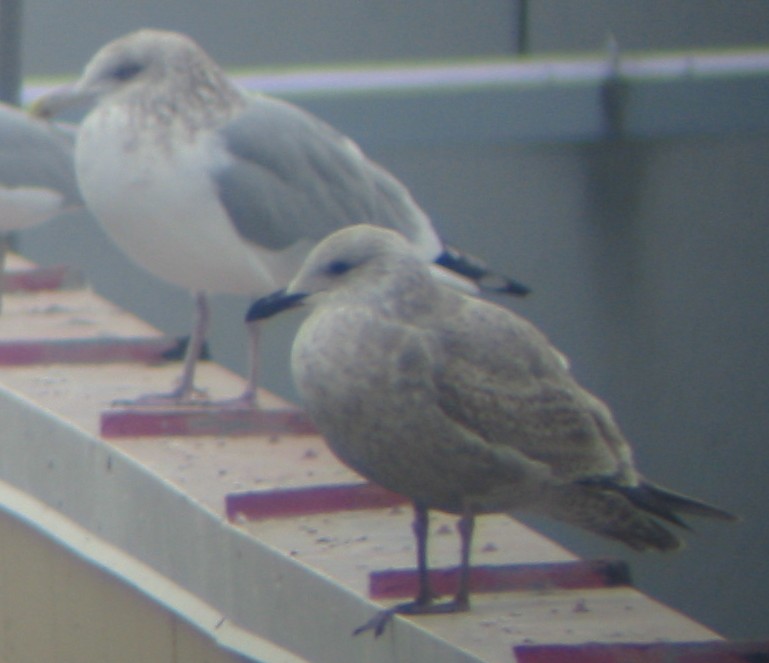 |
| With an adult Herring Gull. Note the shorter legs and slightly shorter, smaller bill. The bird and its legs (and pink strips toward the right) appear darker due to vignetting (a well known problem with digiscoping). |
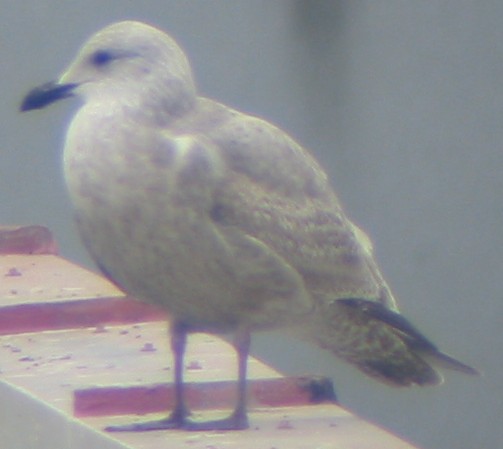 |
| Here the gull appears paler with brighter legs than in the photo above. |
| After the bird flew away it was later relocated by Jerry White, David Woodward, Darlene Hecomovich and myself at Redbud Park. The bird was highly active and often too close for digiscoping, so I got only a few photos: |
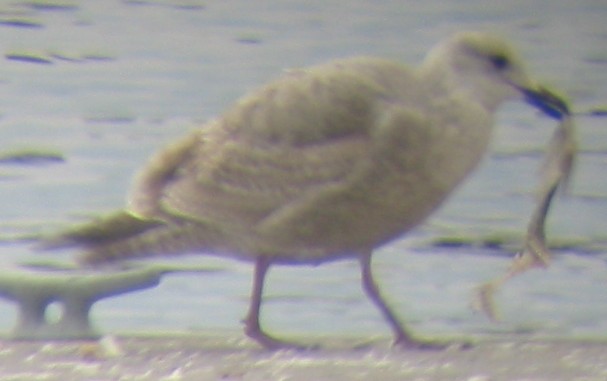 |
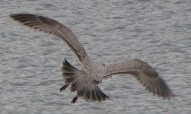
| Although blurry, this photo best illustrates relative wing length. |
| In some light conditions the underparts appear much darker. |
| The following photos were taken by David Woodward: |
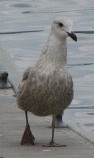
| Note the shorter legs compared to a 1st-cycle Western Gull in photos 14 and 15, and the long, outstretched neck in photos 11 and 16. |
| Note the bicolored primaries, with dark outer and pale inner webs, and the paler window on the inner primaries. Note the broken dark bars (speckling effect) on the white rump contrasting with the dark tail (inner webs of rectrices appear paler). |
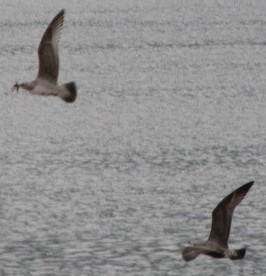
| Note the broader wing of this gull in the upper left compared with the gull (species uncertain) in the lower right of photo 19. There is very little back-rump contrast. All primaries, including the innermost, are dark tipped. The bicolored primary pattern is typical of 1st-cycle Slaty-backed Gull and Thayer's Gull, but may also be matched by hybrid Glaucous-winged � Herring Gull. |
| Conclusions: All features, except perhaps the pale 2nd-generation mantle feathers, appear consistent with a 1st-cycle female Slaty-backed Gull. For comparative photos of similarly pale individuals from Japan, click here (1 November), here (21 October and 6 November), here (14 December), here (13 January), here (3 February), here (16 February) and here (15 March). However, distinguishing 1st-cycle Slaty-backed Gulls from Glaucous-winged � Herring Gulls is a larophile's nightmare. The wingtips and tail of this bird are dark for a classic hybrid, especially on a bird as pale as this one (assuming a correlation between head/neck/body and wingtip coloration), and the legs appear to be shorter than both Glaucous-winged and Herring Gulls, but there is an unknown amount of variation as well as backcrosses. For comparative photos of presumed Glaucous-winged � Herring Gulls (none of which even remotely match this bird), click here. Slaty-backed � Vega Gull is yet another potentially confounding hybrid combination. To give an example of the confusion, Fig. H2-19 on page 283 of Howell and Dunn's Gulls of the Americas depicts a possible Glaucous-winged � American Herring Gull hybrid in flight, and states "Matches Slaty-backed Gull in most features and might be that species, thus highlighting an unresolved identification conundrum." Hopefully one day we'll have better information on the range of variation among hybrids. Anybody want to band these odd 1st-cycle birds for a research project? It would be interesting to see what they look like when they mature into adults. |
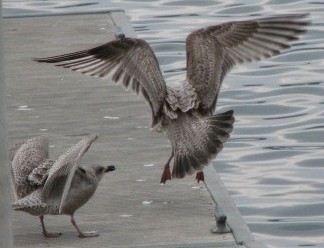
| The legs are notably shorter than those of the presumed 1st-cycle Glaucous-winged > Western Gull hybrid to the left (visible in uncropped image). |
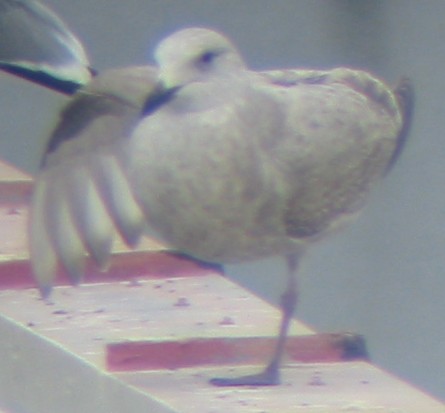 |
| Note the strikingly whitish undersides of the outer primaries contrasting with the darker underwing lining, and the bicolored pattern produced by darker outer webs contrasting with paler inner webs. |
| The new 2nd-generation mantle feathers are relatively pale, but some have a narrow dark shaft streak in the center. |
| 1 |
| 2 |
| 3 |
| 5 |
| 6 |
| 7 |
| 8 |
| 9 |
| 10 |
| 11 |
| 12 |
| 13 |
| 14 |
| 15 |
| 16 |
| 17 |
| 18 |
| 19 |
| 20 |
| 21 |
| The round-headed appearance in this and many other photos suggest this is a female. |
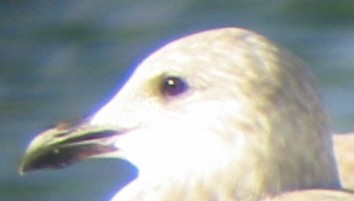 |
| In good light, the iris appears brown rather than black, suggesting that this gull might develop a pale iris as it matures. This might be expected in a 1st-cycle Slaty-backed Gull or in any 1st-cycle hybrid involving "American" Herring Gull. |
| 4 |