| RESEARCH PROJECTS |
| FLOYD HAYES |
 |
 |
 |
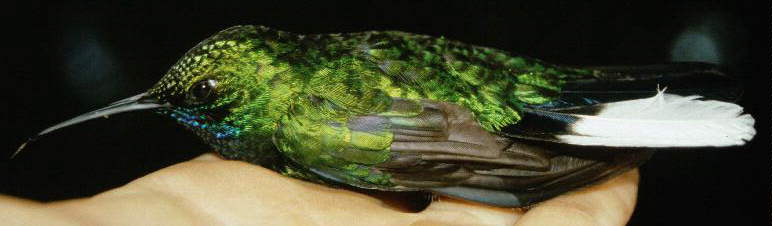
| White-tailed Sabrewing (Campylopterus ensipennis) Photo by William L. Murphy |
 |
| Sabre Rattling at the Lek: Status, Ecology and Behavior of the Endangered White-tailed Sabrewing (Campylopterus ensipennis) |
 |
 |
 |
 |
 |
| The White-tailed Sabrewing (Campylopterus ensipennis) is an endangered species of hummingbird whose distribution is restricted to two coastal ranges in Venezuela and the Main Ridge of Tobago. In 1963 Hurricane Flora destroyed most of its rain forest habitat on Tobago; afterward it was feared extinct until its rediscovery in 1974. Subsequently the population has gradually recovered. In 1995 I initiated "Project Sabrewing," whose goal was to study the status and biology of the White-tailed Sabrewing on Tobago and, to a lesser extent, in the Paria Peninsula of Venezuela. Since then I have led 18 expeditions to Tobago and one to the Paria Peninsula of Venezuela in which 100 students representing 17 countries and four continents have participated. With the assistance of these |
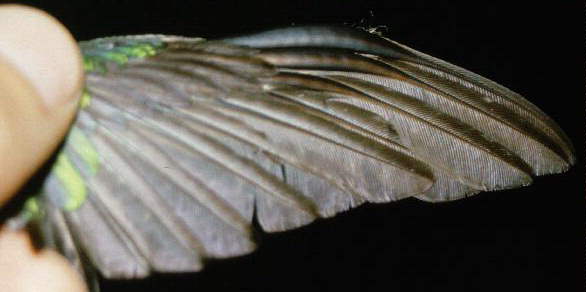
| students I have amassed a large data base on the status, ecology and behavior of this lekking species of hummingbird. We initially conducted trail surveys in an attempt to document their current distribution and status. We spent many days obtaining behavioral data on territorial males at two active leks. Using mistnets we captured and banded sabrewings as well as other forest species of birds at four active sites; thus far we have captured and banded 81 individual sabrewings and hundreds of other birds. I have also measured museum specimens to assess sexual dimorphism, geographic variation and population age structure. Current status.--Trail surveys revealed sabrewings to be widely scattered from Mt. Dillon in the west to Hermitage Hill in the east, but absent (perhaps rare) in parts of their former range including Hillsborough Reservoir in the southwest and in Pigeon Peak in the east, suggesting that the population is still in the process of expanding to these areas. Sexual dimorphism.--The sexes are dichromatic. Body weight, wing length and tail length are greater for males, bill length greater for females. Immatures <1 yr have striations (tiny grooves) on the bill. Adult males have widened 'sabres' (shafts of outermost primaries) that are acquired abruptly, presumably during their second |
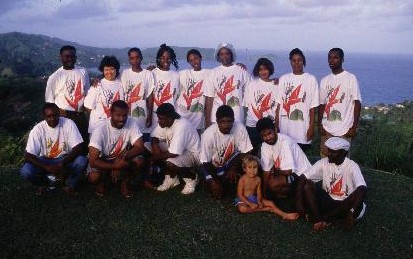
| Participants of Project Sabrewing expeditions in March 1995 (above) and July 1996 (below). |
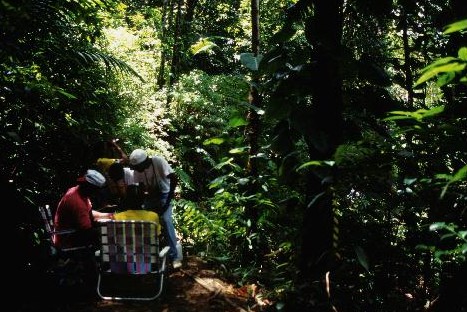
| Students studying the behavior of a lekking male White-tailed Sabrewing. |
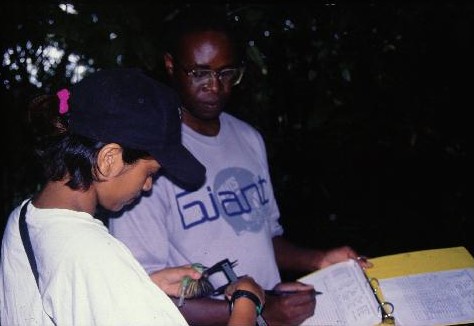
| Student Crystline Persad measures a bird while student Victor Joseph records the data. |
| Male White-tailed Sabrewing. Note the blue throat and solid green upperparts and underparts. |
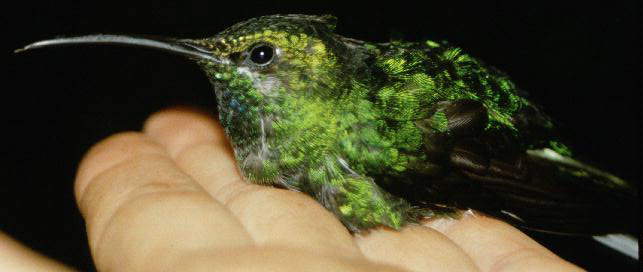
| Female White-tailed Sabrewing. Note the white malar stripe and grayer throat and underparts. |
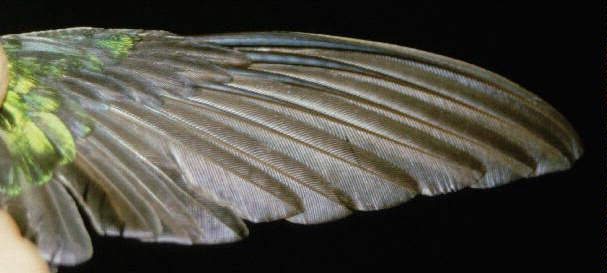
| Outstretched wing of adult female (left) and adult male (right), illustrating widened and bent shafts or "sabres" of outermost primaries in adult male. |
| year. Geographic variation.--Based on specimen data, no marked geographic variation occurs. However, bill length averages longer in the Paria Peninsula population and tail length averages shorter in the Cordillera de Caripe population. Population age structure.--The current proportion of immatures in Tobago is higher than it was before the hurricane, suggesting that the population in the study sites is still growing. Seasonal cycles.--Breeding occurs during the dry season, from January to April. Molt occurs after breeding, during the late dry to early wet season, from March to July. Mating system.--Groups of 2-4 males display year-round at traditional leks. Evidence of lekking occurs in 7 of 11 species of sabrewings. Males sing throughout day while perched on midstory twigs. Rates of male vocalization |
| peak in early morning and late afternoon. Up to 4 females visit lek per day. Parental care is maternal. Foraging behavior.--Within a lek, males forage on arthropods >90% of the time. Nectar is obtained from uniformly dispersed flowers. Males tend to hawk for insects. Females tend to glean insects from vegetation. |
| Sabre function.--I hypothesize three potential functions for the widened sabres of sabrewings. For the "sabre-rattling hypothesis," I postulate that wide sabres confer a competitive advantage over less endowed males during male-male conflicts. For the "sabre-flashing hypothesis," I postulate that females prefer to mate with males possessing widest sabres. For the sabre-sickling hypothesis, I postulate that wide sabres enhance aerial foraging on |
| arthropods. Because males of most if not all sabrewing species display at leks, I suspect the widened sabres play a role in sexual selection. But though I suspect the sabre-rattling hypothesis may be the best explanation, testing between these hypotheses is difficult. Population genetic structure.--University of Wisconsin geneticist Mark Berres and I are collaborating to test whether the White-tailed Sabrewing population in Tobago has undergone a |
| genetic population bottleneck resulting from Hurricane Flora in 1963, based on DNA obtained from blood samples of banded birds. When compared with other species of lekking hummingbirds and manakins in the Neotropics, the genetic diversity of White-tailed Sabrewings in Tobago appears to be reduced, supporting the conventional hypothesis that a population bottleneck results in reduced genetic variation. In addition, we hope to study parentage and relatedness among individuals. Funding.--American Bird Conservancy (1996), Amoco Trinidad Oil Company (1995), Birdlife International (1995), British Petroleum (1995), Center for the Study of Tropical Birds (1995), Fauna and Flora International (1995), Guardian Life of the Caribbean Limited (1995), Lincoln Park Zoo (1997), Trinmar Limited (1995), Republic Bank Limited (1995), Trinidad and Tobago National Petroleum Marketing Company Limited (1995) and the University of the West Indies (1999). Additional funding was raised by selling T-shirts with a painting of White-tailed Sabrewings generously donated to the project by reknown artist Dr. John P. O'Neill. Refereed Technical Publications (supervised students indicated with bold letters) Ramjohn, C. L., F. B. Lucas, F. E. HAYES, S. Ballah, N. C. Johnson, and K. M. Garcia. 2003. Lek mating behavior of the Sooty-capped Hermit (Phaethornis augusti) in the Paria Peninsula of Venezuela. Journal of Field Ornithology 74:205-209. [abstract / resumen] HAYES, F. E., D. B. McNair, F. B. Lucas, C. L. Ramjohn, N. C. Johnson, S. T. Ballah, L. W. Doodnath, and K. M. Garcia. 2003. Noteworthy observations of birds, including two globally threatened species, in the eastern Paria Peninsula of Venezuela. Cotinga 20:101-102. HAYES, F. E. 2002. Sabre rattling at the lek: morphological variation and its significance in the White- tailed Sabrewing (Campylopterus ensipennis). Department of Life Sciences, University of the West Indies, St. Augustine, Occasional Paper 11:23-36. [abstract / resumen] HAYES, F. E., N. A. Trimm, B. Sanasie, and R. P. ffrench. 2000. Breeding biology of the White-tailed Sabrewing at Tobago, West Indies. Journal of Field Ornithology 71:597-605. [abstract / resumen] HAYES, F. E., W. K. Hayes, and T. O. Garnett. 1998. Rediscovery of the Gray-throated Leaftosser (Sclerurus albigularis) on Tobago, West Indies. Caribbean Journal of Science 34:166-168. HAYES, F. E., A. L. Bullard, D. R. Hardy, D-A. D. Wilson, D. J. Wilson, T. O. Garnett, M. V. Bernard, B. Y. Y. Wong, H. S. Gurley, V. L. Joseph, and M. M. Hayes. 1995. White-tailed Sabrewing population recovering on Tobago. Cotinga 4:7. Published Abstracts of Presentations at Scientific Meetings (supervised students indicated with bold letters) HAYES, F. E. 1999. Sabre rattling at the lek: morphological variation and its significance in the White- tailed Sabrewing (Campylopterus ensipennis). Pitirre 12:63. HAYES, F. E., T. O. Garnett, M. V. Bernard, and I. Samad. 1997. Update on the status of the threatened White-tailed Sabrewing (Campylopterus ensipennis) on Tobago, West Indies. Pitirre 10:28. HAYES, F. E., T. O. Garnett, M. V. Bernard, A. L. Bullard, D. R. Hardy, D-A. D. Wilson, D. J. Wilson, V. L. Joseph, and D. K. St. Louis. 1997. Behavioral ecology of territorial male White-tailed Sabrewings (Campylopterus ensipennis): evidence for lek polygny. Pitirre 10:27-28. HAYES, F. E., A. L. Bullard, D. R. Hardy, D-A. D. Wilson, D. J. Wilson, T. O. Garnett, M. V. Bernard, B. Y. Y. Wong, H. S. Gurley, V. L. Joseph, and M. F. Hayes. 1995. Status, ecology and behavior of the threatened White-tailed Sabrewing, Campylopterus ensipennis, on Tobago, West Indies: preliminary report. Pitirre 8:9. Non-technical Publications HAYES, F. E. 2002. A feathered gem: the white-tailed, sabrewing hummingbird. Ins and Outs of Trinidad & Tobago 2002:139. HAYES, F. E. 1997. Ornithological education and research at Caribbean Union College, Trinidad. Pitirre 10:17-18. HAYES, F. E. 1997. Project Sabrewing. NetLines 4(1):4. HAYES, F. E. 1996. Caribbean Union College students study Tobago's environment. Environment Tobago Newsletter 1(3):3-4. HAYES, F. E. 1996. Ornithology research at Caribbean Union College. Bellbird (Bulletin of the Asa Wright Nature Centre and Lodge), June, pg. 3. HAYES, F. 1996. Rediscovery of "extinct" bird in Tobago. Caribbean Union College Campus News 2(8):1. HAYES, F. 1995. Saving the sabrewing. Daily Express, Port of Spain, Oct. 10, pp. 19-20. HAYES, F. 1995. Natural Science Club wins prestigious award for "Project Sabrewing." Caribbean Union College Campus News 1(2):1-4. |
 |