| RESEARCH PROJECTS |
| FLOYD HAYES |
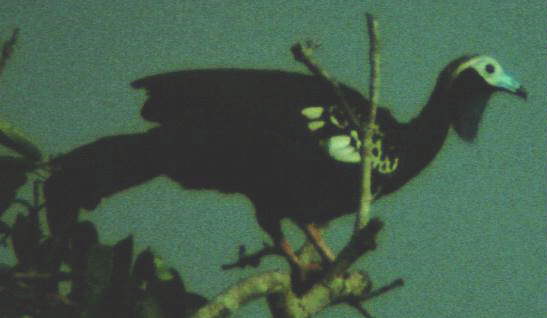 |
| The Trinidad Piping-Guan (Pipile pipile), known locally as the "Pawi," is morphologically distinct and geographically isolated from its mainland South American sister taxa; given current trends in species concepts, it probably represents an endemic species. It apparently once occurred in forests throughout Trinidad, from sea level to the highest mountains, but currently it is a critically endangered species with a viable population in northeastern Trinidad and a tiny, probably doomed population in southeastern Trinidad. With the assistance of Caribbean Union College student Bryan Sanasie, |
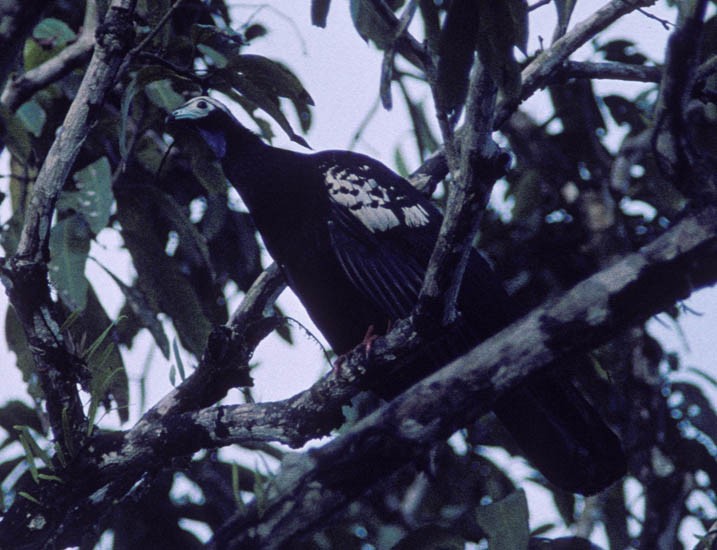 |
| Trinidad Piping-Guan (Pipile pipile) Grande Riviere, Trinidad, 13 July 2001 |
| Status, Ecology and Behavior of the Endangered Trinidad Piping-Guan (Pipile pipile) |
| Status.--Piping-guans were detected in only three of roughly 275 point counts within the currently known range, indicating that they are extremely rare. Social behavior.--The size of the group varied from year-to-year (4-10 individuals, according to a local land caretaker), but when we obtained most of our data in 1999, six birds were present. They readily split and fused into smaller or larger groups. Home range and habitat.--The individuals within the group occupied an overlapping home range of about 19 ha in secondary forest highly disturbed by subsistence farmers. The territory was not abandoned even when 4 hectares were deforested for small-scale farming. Habitat use and foraging.--As canopy frugivores, they spent 95.0% of the time > 5 m above ground, and only 0.2% of the time on the ground, based on 44.62 hrs of observation. They |
| local naturalist Ishmaelangelo Samad, University of the West Indies student Floyd Lucas, my son Brett, and a few others, I have been conducting variable-radius point counts (5 min duration) throughout northeastern Trinidad in an effort to quantitatively assess the current status of the Trinidad Piping-Guan within its dwindling range. With the assistance of Caribbean Union College students Bryan Sanasie and Clifmond Shameerudeen, and University of the West Indies students Carol Ramjohn and Floyd Lucas, we studied the ecology and behavior of a group of birds at Grande Riviere, along the north coast of Trinidad. We recorded group sizes, mapped out the group's movements to estimate home range, quantified the amount of time spent in different vertical strata of the forest, identified the food items consumed, obtained time budget data, and obtained data on vocalizations. |
| Trinidad Piping-Guan at Grande Riviere, Trinidad, 1 April 1999. Photo by Harry Lehto. |
| foraged mostly on fruits or or buds (occasionally leaves or flowers) of 14 species of plants, with Virola surinamensis (family Myristicaceae) constituting the primary item (37.0% of foraging bouts; n = 27). On a few occasions, one bird was seen feeding another. Behavioral time budgets.--In early morning (0545-0900), they spent 80.0% of their time perched alert, 9.8% preening, 4.0% walking, 3.9% flying, 1.7% feeding, 0.4% drinking (from bromeliads), and 0.1% perched flapping (16.34 hrs of data). In late afternoon (1500-1845) they spent 78.6% of their time perched alert, 12.8% preening, 3.7% walking, 3.0% feeding, 1.2% flying, and 0.7% drinking (8.17 hrs of data). At midday they eluded observation. Vocalizations and displays.--Vocalizations included a song of 3-7 plaintive whistles rising in pitch (up to 4 series/min), usually emitted by a solitary bird--presumably a male--perched near the top of a tree. |
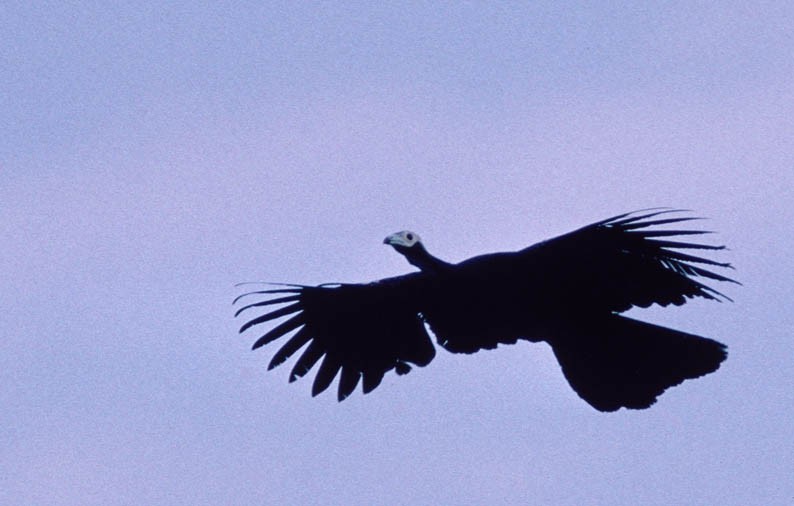 |
| Trinidad Piping-Guan in flight, illustrating the emarginated primaries used to produce "drumming" sounds. Grande Riviere, Trinidad, 1 April 1999. Photo by Harry Lehto. |
| Soft piping calls and raised crest feathers were typically given during social interactions. Loud "drumming" displays were often produced by the whirring of the wings when a bird flew from one tree to another. Breeding biology.--We were unable to find any nests or observe any young birds. Nothing is known about their breeding biology in Trinidad. Funding.--Saint Louis Zoo (1998). Publications: in preparation. |
 |