| RESEARCH PROJECTS |
| FLOYD HAYES |
| Tropical vs. Temperate Life History Traits: Breeding Biology and Mating Systems of the Tropical Mockingbird (Mimus gilvus) in Trinidad |
 |
 |
 |
 |
 |
 |
 |
 |
 |
| With the help of undergraduate biology student Tony Trimm, I commenced an extensive study on the natural history of the Tropical Mockingbird on the campus of Caribbean Union College (CUC), Maracas Valley, Trinidad, in April 1997. My primary purpose was to compare the life |
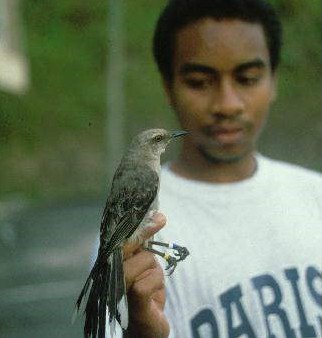
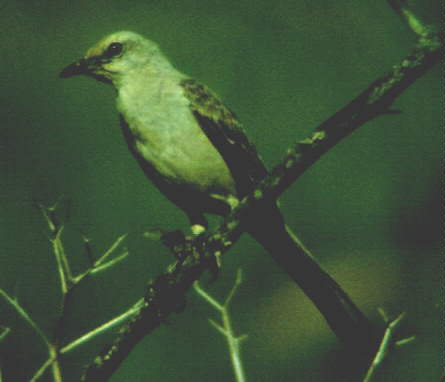
| Tropical Mockingbird (Mimus gilvus) |
| Student Tony Trimm holds a color-banded male mockingbird |
| history traits of the Tropical Mockingbird with that of the well studied Northern Mockingbird (M. polyglottos) of North America. Secondly, I wanted to provide an opportunity for CUC students to |
| participate in actual field research during their lab exercies in a few of my courses, including Ornithology and Animal Behavior. Our first objective was to capture territorial adults using mistnets. Each captured bird was measured, weighed and banded with a unique combination of colored plastic leg bands. A few feathers were plucked from the tail to obtain DNA for subsequent analyses of relationships. Sex was determined by measurements, presence of a brood patch and behavior (males sing more, only females incubate). |
| Student Bryan Sansie monitors a mockingbird nest in a mango tree. |
| We studied the breeding biology of the mockingbirds by monitoring nests. We measured variables for nest site selection and recorded the number of eggs (clutch size), nestlings or fledglings to evaluate reproductive success. To determine growth rates, we periodically measured and weighed nestlings and fledglings. We studied the parental investment of mockingbirds by studying time budgets of each sex during various phases of the breeding cycle (nest construction, incubation, nestlings, fledglings), by recording the number of trips to |
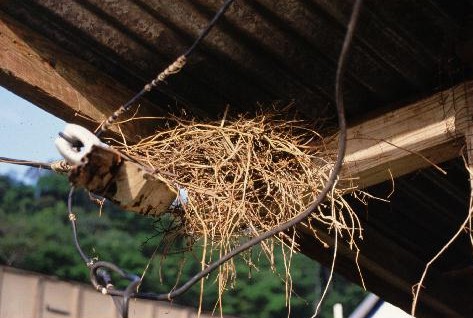
| Mockingbird nest in a building. |
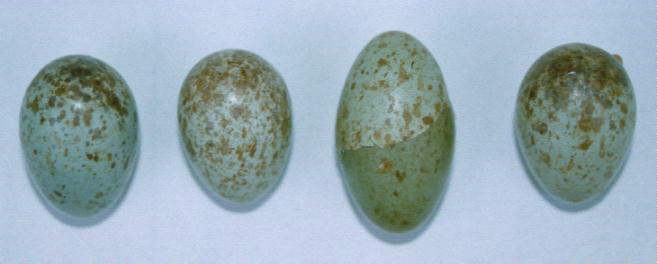
| Double-shelled mockingbird egg with normal eggs. |
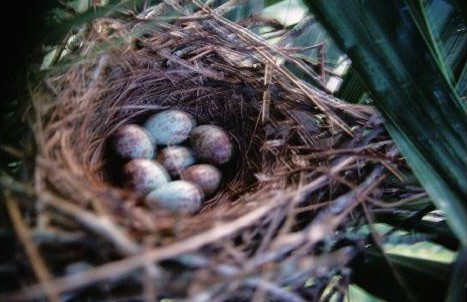
| Nest with 7 eggs laid by two females, which shared in incubating and provisioning. |
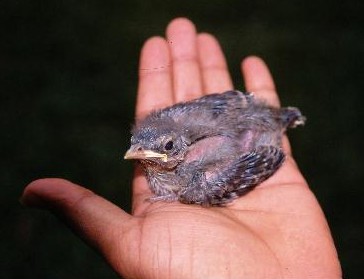
| Nestling mockingbird. |
| Students studying the parental care by a polygynous trio of mockingbirds feeding nestlings. |
| and the amount of time spent at the nest by each sex during each phase of the breeding cycle, and by recording the vocalizations and distance approached by each sex when an investigator visited the nest. Body size.--Tropical Mockingbirds average larger than Northern Mockingbirds, contrary to Bergmann's "rule" which predicts that temperate populations are larger than tropical populations. Survivorship.--Adult annual survivorship averages about 80% for each sex, considerably higher than typical values (about 53%) for temperate North American passerines. No such data are available for the Northern Mockingbird. Mating system.--Mating systems are extremely flexible. Monogamy is most common but occurs in less than half of the territories. Polygynous trios and polyandrous trios frequently occur as well as one documented polygynandrous quartet. Polygamous individuals breed cooperatively with all three or four adults participating in territorial defense, nest construction, provisioning of offspring and defense of offspring. However, cooperatively breeding mockingbirds do not achieve higher reproductive success than monogamous pairs. Northern Mockingbirds are almost exlusively monogamous and cooperative breeding does not occur. Breeding season.--Breeding occurs nearly year-round, with a peak during March-May (dry season) and a second peak during October-November. Breeding usually stops when molting commences in July. Northern Mockingbirds have a shorter breeding season. Clutch size.--Females typically lay three eggs but occasionally lay two or four; in once instance, a single, double-shelled egg was laid but subsequently abandoned. Occasional nests with five to seven eggs represent clutches laid by two females which take turns incubating the eggs (males never incubate). Mean clutch size is 2.9, considerably less than that of the Northern Mockingbird (studies ranging from 3.5-3.9). However, other mockingbird species in tropical Ecuador and the Galapagos Islands have larger clutch sizes and another species in temperate South America has a similar clutch size. Growth rate.--Growth is slower and nestlings are fed at a slower rate than in the Northern Mockingbird. Nestlings typically fledge after 15 days. Northern |
| Mockingbirds typically fledge after 12 days. Defense of eggs and nestlings.--Males are slightly more defensive than females. Tropical Mockingbirds are much less defensive than are Northern Mockingbirds, remaining 3-4 times more distant from human investigators at the nest, presumably because they live longer, have a longer breeding season and a smaller clutch size. Parental provisioning.--In monogamous pairs, males average slightly more trips to the nest (56%) than females. In polygynous trios, males contribute only 11% of the trips to the nest. In polyandrous trios, each male contributes about 30% of the trips to the nest. Nesting success.--The percentage of nests which fledge offspring and the number of fledglings per nest differs little among among mating systems. Nestlings are often infested by as many as 20 blowflies, but mortality appears to be insignificant. Percent nesting success (about 42%) is similar to Northern Mockingbirds in Maryland and Florida, but less than in Indiana. Nest site selection.--Higher nests are more successful than lower nests. After a nesting failure, the subsequent nest is constructed farther away than it is after a nesting success. Nest reuse often occurs, nearly always after a nesting success. In the Northern Mockingbird, lower nests are more successful and nest reuse is rare. Funding: Linnean Society of London (1999) Publications: in preparation. |
 |