| FLOYD HAYES |
| RELIGION |
 |
| DOES GOD EXIST? For I know that my redeemer liveth, and that he shall stand at the latter day upon the earth. -Job, who never doubted despite losing his family, wealth and health (Job 19:25) |
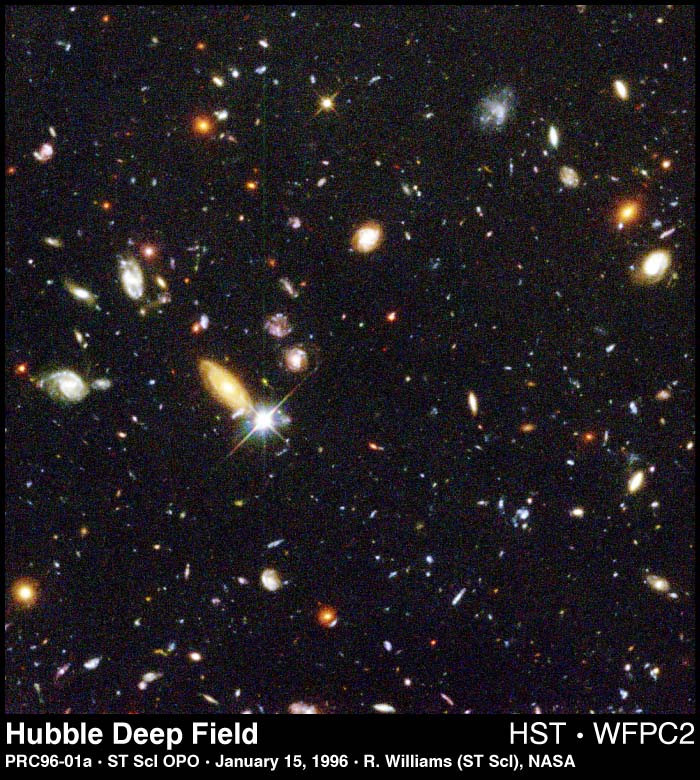
| Hubble Deep Field photograph by Hubble Space Telescope, December 1995. Photo not copyrighted. For further information, click here. |
| This question vexes many humans, but not all. Some never doubt that God exists. Others never doubt that God doesn't exist. Some claim that they could care less. But many of us never cease to wonder. How vast is the universe? In the 1920s, astronomer Edwin Hubble discovered that the heavenly constellations were moving away from each other, indicating that the universe was expanding. Subsequent calculations of the rate of expansion revealed that the universe apparently began with the so-called "big bang," roughly 15 billion years ago. In December 1995, astronomers attempted to view the most distant fringes of the universe --when the universe was in its infancy--by aiming the Hubble Space Telescope toward a dark corner of the sky with relatively few bright, nearby stars. During a 10-day period the telescope took more than 200 exposures to obtain enough light for a photograph. When this "Deep Field" photograph was examined, astronomers were astonished by what it revealed: at least 1,500 galaxies--more than were thought to have existed in the entire universe--appeared as they were roughly 11.7 to 10.4 billion years ago. Each galaxy is comprised of billions of |
| stars. Each star, like our own Sun, potentially captures the orbit of one or more planets, although these are difficult to detect because they do not emit light. Each planet may potentially provide the conditions required to support life. Epitomizing tunnel vision to the extreme, the Deep Field snapshot depicts only a minute fraction of the universe. Obviously the universe comprises billions of galaxies, each with billions of stars and who knows how many planets potentially capable of supporting life. Are we alone? Now that we can better appreciate the enormity of the universe, our ignorance of what exists beyond our own solar system is appalling. Basically the only clues available are light and radiation, from which what little we know can be inferred. Given the potential existence of enormous numbers of planets, what is the probability that our planet is the only one supporting life? And if life indeed occurs elsewhere, what is the probability that we are the most intelligent form of life? Many scientists believe that we will eventually create life within a laboratory by simulating the postulated chemical composition of our atmosphere and planet when life supposedly evolved spontaneously roughly 3.9 billion years ago. However, the prospect of creating such life has become increasingly challenging as one experiment after another fails to produce tangible results and one potentially promising line of research after another is abandoned. If we are indeed the most intelligent form of life, we have a unique opportunity to play God if we can succeed in creating life. But if we are not the most intelligent form of life in the universe, could it be that somebody, somewhere, somehow, actually knows how to create life? When individuals claim that there is no God, how could they possibly be certain? Given our limitations of discovering whether life--or somebody who knows how to create it--occurs beyond our planet, obviously they cannot be certain. Others claim that there is proof that God exists, but if so, what is the proof? Do we have direct evidence, available for all to see and verify, proving beyond doubt that there is a God? Obviously we don't--at least from a scientific perspective. A leap of faith. In my opinion, a leap of faith is required to believe in either position that God exists or does not exist. Even the scientist who believes in organic evolution or abiogenesis--the spontaneous generation of life on Earth--is professing faith in a process that cannot be explained or demonstrated. The only alternative to faith is being agnostic--essentially indifferent to whether or not God exists. But how can anybody be truly indifferent? If faith is required to believe in God, what kind of faith does it take? I suspect that the faith of many is blind. They believe in God merely because their parents or somebody else told them about God. Or because of some esoteric experience that convinced them of God's existence. But blind faith, in my opinion, is sheer folly. And easily abandoned when confronted with persecution. True faith, in my opinion, should be based on evidence. But upon what kind of evidence? I have never been to Japan, but I believe Japan exists. Why? Because I have seen evidence that Japan exists: people who claim to have been there, objects allegedly manufactured there, history books relating past events there, etc. Similarly, there is evidence that a creator God actually exists and has attempted to communicate and interact with us. But although I can personally verify the existence of Japan by going there, unfortunately I cannot personally verify the existence of God. My personal faith in God is based on evidence, though admittedly not the kind of evidence that can be observed, studied and verified by the scientific method. Science is limited in studying only that which can be observed. Karl Popper's criterion for distinguishing true science from pseudoscience was testability or falsifiability. Because no experiment can be performed to falsify God's existence, the postulated existence of God is beyond the realm of scientific inquiry. Believing that God exists is no less scientific than believing there is no God. I choose to belief in God in part because I find the available evidence difficult to reject, and in part because I simply want to. A belief in God provides meaning and hope in life, something to strive for. If I am right, what do I have to gain? The blissful promises of eternal life, free of sorrow or pain, in heaven and a new earth. I concede that I could be wrong, but if so, what do I have to lose? Absolutely nothing! Except, perhaps, the respect of those--including many scientific colleagues--who choose not to believe in God. Faith based on evidence. But what sort of evidence is there that God exists? Well, there are different kinds of evidence supporting the notion of God. One is the improbability of abiogenesis. However, this represents negative evidence for the existence of God. I will later post a separate essay on this issue. Another line of evidence is the existence of a conscience. From an evolutionary perspective, I'm dubious that natural selection would ever favor a conscience that was pricked each time we cheated in order to benefit ourselves at the expense of others, especially when such selfishness is required for survival. A religion professor once received an essay written by a student who argued that there was no absolute right or wrong. On the title page the professor wrote "Your essay is well written and well documented, but I don't like it, therefore your grade is F." But on the last page, the professor wrote: "Actually your grade is an A, but if your thesis is correct, you would have no justification for being upset if I chose to give you an F." Further lines of evidence come from holy books that claim to be inspired by one or more divine beings. The Bible, with which I am most familiar, provides what I consider to be four lines of evidence that I find difficult to ignore. First, an amazing amount of historical data in the Bible can be independently verified by archaeological records and historical documents. Even scholars who disagree with the Bible's interpretations of the significance of events generally concede that the people, places and events mentioned in the Bible are historically accurate. Second, the Bible relates accounts of many who spoke directly with God or personally experienced events under God's control. Of course these accounts could well be fabricated or imagined, but perhaps not. There were many witnesses, for example, who claimed to have seen Jesus after He allegedly arose from the dead, and many more who actually watched Him die on the cross. Similarly, there have been many--including me--whose personal experiences in life provide sufficient evidence that God cares. Third, the Jewish health laws written by Moses are totally different from those of other ancient cultures, including the Egyptians who mentored Moses. Yet these laws are unique among all but modern cultures in being hygienically correct. Only since the widespread acceptance of the germ theory as a cause of disease have we been able to verify the hygienically correct rituals prescribed in the Old Testament. Where did Moses get his information from? The most convincing evidence. Fourth, the most convincing biblical evidence for me is prophecy. The Old Testament is peppered with persistent predictions of a "messiah"--or "anointed one"--who would eventually live among us and die for our sins. Although there are many biblical texts predicting the circumstances regarding the mission and fate of the long-awaited messiah, the most amazing is found in the fifty-third chapter of Isaiah. I'm still waiting for an adequate explanation as to how such a text, coinciding so closely with biblical and historical accounts of Jesus of Nazareth, found its way into ancient Hebrew scriptures venerated and safeguarded by religious leaders who completely rejected Jesus as their messiah. Could it be mere coincidence, or were these prophecies actually fulfilled? For a compilation of these messianic prophecies, click here. In addition to these messianic prophecies, two biblical books of prophecy, Daniel and Revelation, make some stunning predictions about world events well before they actually took place. However, the nature of these predictions requires an understanding of how prophecy is to be interpreted. For further information, click here. |
 |