 |
 |
 |
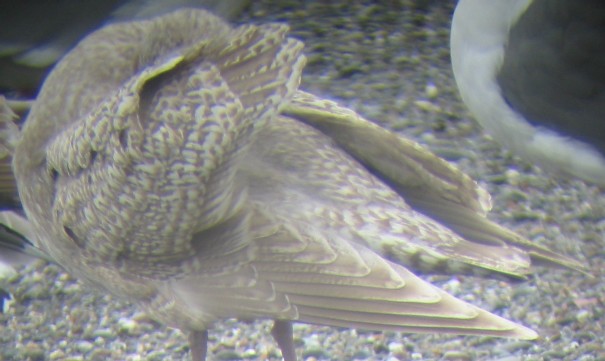
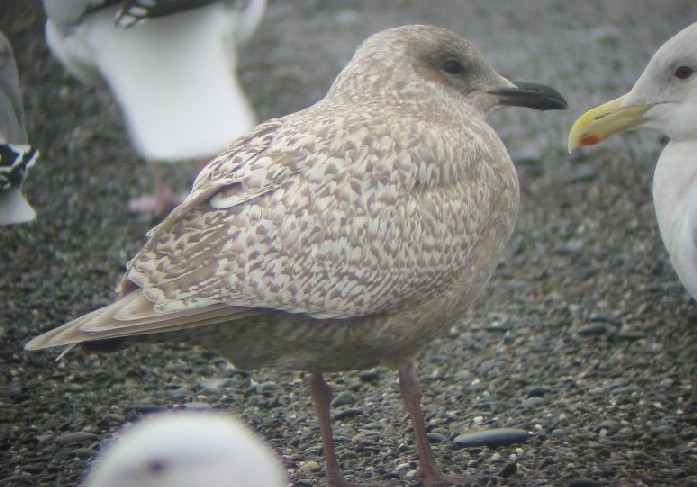
| Presumed 1st-cycle "KUMLIEN'S" ICELAND GULL (Larus glaucoides kumlieni) at a small beach in Carmet and also 6 miles to the north at the mouth of the Russian River, Goat Rock State Beach, Sonoma County, CA, 13 January 2008. Photos � Floyd Hayes. For photos of a similar bird (4th accepted record for California) at Clearlake Park, Lake County, CA, click here. |
| I initially found this gull among perhaps 25 gulls on a small beach at Carmet (photo 1 above). About an hour later I was astonished to see it again among perhaps 1000 gulls at the mouth of the Russian River, about 6 miles to the north (photo 2 below). Note the relatively crisp and coarsely marked juvenal plumage, relatively dainty bill (much smaller than the bill of a Western Gull below), and rounded head. This bird is not deficient in melanin; it is neither pale nor strongly bleached. |
 |
| 6 |
| 5 |
 |
| 1 |
 |
 |
| 4 |
| 3 |
 |
| 8 |
| 2 |
 |
| 7 |
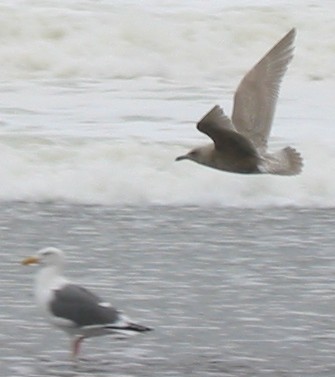 |
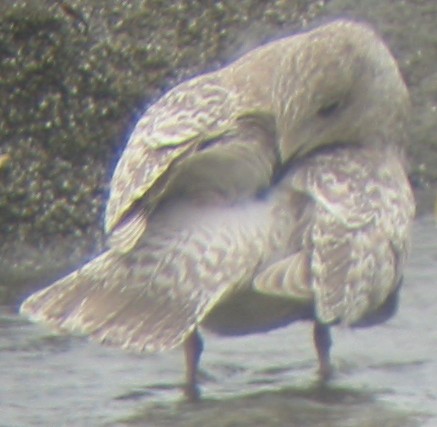
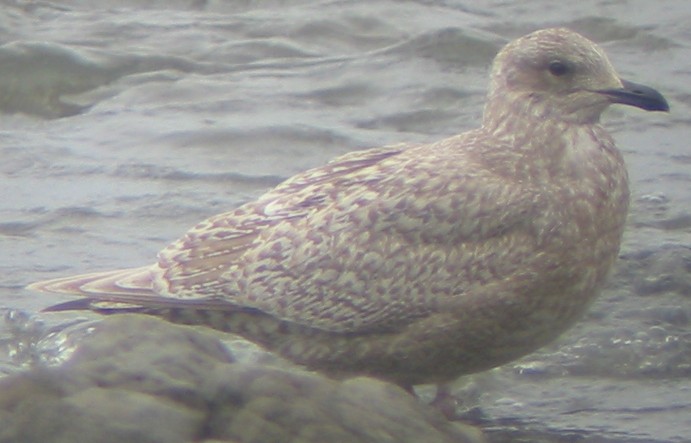
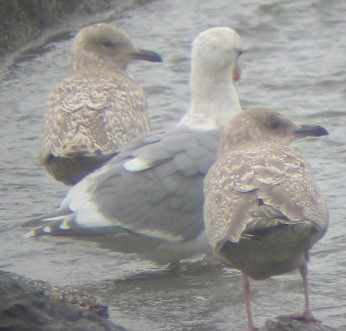
| The body was smaller, the bill much smaller and the legs shorter than all Glaucous-winged, Western and Herring Gulls present (confirmed by additional photos not posted here). The body was larger than that of California Gulls but the bill was similar in size. In photo 3 the bill of the presumed Kumlien's Gull in the background appears similar in size or perhaps slightly smaller than that of a 1st-cycle Thayer's Gull in the foreground (which resembles a Glaucous-winged in this photo, but it resembles a typical Thayer's Gull in a few other photos not posted here). Photos 3 and 6 were taken at Carmet and the remaining photos were taken at Goat Rock State Beach. |
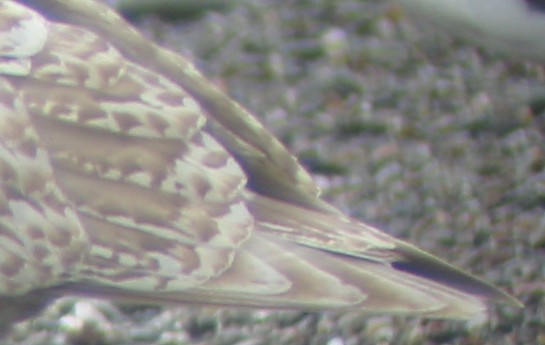
| The tertials are speckled along the margins and tips, but appear to have broad dark centers, which is typical of a Thayer's Gull, and is perhaps the strongest argument against this bird being a "pure" Kumlien's Gull, but some dark Kumlien's Gulls have similar markings (e.g., Figs. 35A.9 and 35A.12 of Howell and Dunn's Gulls of the Americas, 2006). The slightly worn primaries are paler than the tertials, with a pale brown wash and fairly broad white tips to the outermost primaries. Thayer's Gull typically has darker primaries with narrower pale tips, and the primaries are typically darker than the tertials. Primary 10 can barely be seen just behind primary 9 in the photo above; they appear to be about the same length (primary 10 is often longer in Thayer's). Primaries 1-9 are visible in the photo below. There is a hint of a dark subapical spot on primaries 4-8; quite possibly all the outer primaries had a pronounced subapical spot a month ago. The pale brown wash near the wingtips is likely to fade to white within the next month, producing a "white-winged" gull. Dark stippling is visible on primaries 1-6 and on the white tips and edges of the exposed secondaries. Dark internal markings on the flight feathers are more typical of Kumlien's Gull than Thayer's Gull. In Thayer's Gull the outer webs of the primaries are typically darker than the inner webs, producing a two-toned "venetian blind" effect (shared by some Kumlien's Gulls), but in this gull the brown is distributed evenly on both webs, a pattern more typical of Kumlien's Gull. |
| The tail has a fairly solid dark area in the inner rectrices but white occurs at the tips and margins of all rectrices, especially the outer ones. Some dark spots are visible within the dark tail band, even in the inner rectrices. Thayer's Gull typically has a more uniformly dark tail. Spotting is more typical of Kumlien's Gull. |
| 9 |
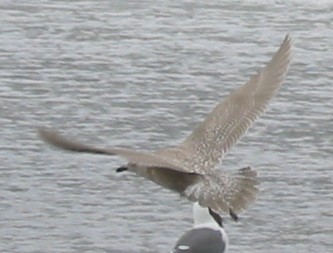
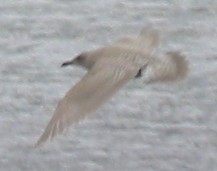
| Multiple photos of the extended wing consistently reveal very little contrast between the secondaries, inner primaries, outer primaries and coverts. Thayer's Gull typically has a contrastingly dark secondary bar, paler inner primaries, and bicolored outer primaries (dark outer webs contrasting with paler inner webs). The relatively uniform appearance of the wings is perhaps the strongest evidence that this bird is a Kumlien's Gull. Such a uniform appearance is typical of both Kumlien's Gull and Glaucous-winged Gull, but note the much thinner bill and much smaller size of this gull compared with the Western Gull in Photo 10. The tail band is the darkest part of the dorsal surface and is present in most Kumlien's Gulls. |