|


Everlastings
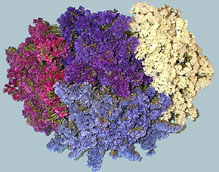
English Statice
November is here and the leaves are still falling in New England. This is a good autumn month to start making your dried everlastings into Christmas gifts for your loved ones. Meowmie's daughter Nancy has made her several wreaths with everlastings.
Everlasting flowers are not the perennial flowers or weeds in your garden that you just can't seem to get rid of. They are flowers that retain their color and form when dried. Many everlasting flowers are composed of colorful, papery petals called bracts that are stiff and dry while still attached to the living plant. The French call them "immortelles." Flowers of this type are popular to grow and save for winter arrangements. The most important thing to know about everlasting flowers is when to harvest the flowers so they best retain their color and form. Picking them too early or too late causes them to become misshapen or darken as they dry. Each type has its own best time for picking which a gardener learns through experience. It is important to make daily trips through the garden. It may mean picking just a few stems at their optimum stage for drying and waiting a day or so to harvest a few more.Before drying, carefully remove the foliage from the stems, unless you are specifically drying it for its foliage. Below is a list of everlasting flowers and the optimum time to harvest the flowers.
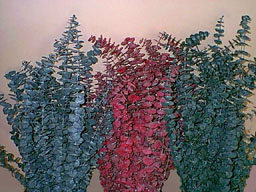
Eucalyptus
Annuals
Celosia (cockscomb) - Both plumed and crested types can be dried. Harvest plumed celosia when the blooms are bright and nearly fully opened. Harvest crested celosia when the seeds begin to form just below the comb.
Helichrysum (strawflower) - Harvest only the flower, with little or no stem attached. Pick when only a row or two of outside bracts are opened and before the center opens. Insert a #22 gauge wire up the bottom of the flower (where the stem was) and store wired flowers upright in styrofoam.
Limonium (statice) - Annual statice is the most used of all everlastings. Pick as buds begin to open because they open further while drying. Tie stems together and hang upside down.
Blue Salvia - Pick the spikes when the florets are fully open and the calyx is bright blue. Tie stems together and hang upside down to dry.
Scabosia - The ornamental part of the plant is the pod that remains after the flowers fade. Pick the pod just as the last petals fall off.
Gomphrena (globe amaranth) - Cut the stems when the flower heads are in the peak of color. Tie the stems together and hang upside down to dry.
Xeranthemum - The blossoms and buds dry in the stage in which they are picked. Pick just as flowers are fully open. Tie stems together and hang upside down.
Perennials
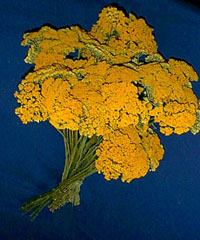
Yarrow
Achillea (yarrow) - Cut the stems as soon as every umbel on the head is fully developed and firm to the touch. Dry upright or upside down.
Artemesia (wormwood) Typically the taller species are best for drying. It is used as a filler in bouquets or as the base of wreaths. Harvest the stems when the pebbly seed head is fully developed.
Globe Thistle - Pick as soon as the central globes are grey-blue and before the tiny flowers appear. Dry upside down.
Gypsophilia (baby's breath) - Pick when about half the florets are open on a flowering stem. Hang upside down to dry.
Liatris (blazing star) - Pick when 1/2 to 2/3 of the flowers are open. Hang upside down to dry.
Lavender - Pick stems when the florets on the spike are opening. Hang upside down to dry.
The flowers and herbs listed were selected for hardiness, ease in growing and productivity. All air-dry easily and some double as cut flowers or ornamentals in the landscape. Most herbs dry well and are attractive as well. Those listed were found most useful in design. As your interest grows, you will find others.In harvesting these flowers, timing is crucial. Most must be picked before fully opened. Never pick when damp with dew or after a rain.Always find time to enjoy their particular beauty.
Here are more selections for everlastings.
FLOWERS FOR DRYING
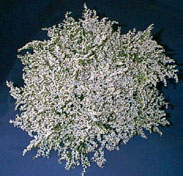
German Statice
ANNUALS
Amaranthus caudatus Love-lies-Bleeding
Ammobium alatum Winged Everlasting
Carthamus tinctorius Safflower
Celosia cristata Crested cockscomb
Celosia plumosa Plumed Cockscomb
Delphinium ajacis (Consolida ambigua) Larkspur
Gomphrena globosa Globe Amaranth
Helichrysum roseum bracteatum Strawflower
Helipterum roseum (Acrolinium roseum) Acrolinium
Limonium sinuatum Annual Statice
Limonium Suworowii Rat-Tail Statice
Lonas indora (Lonas annua) Yellow Ageratum
Molluccella laevis Bells of Ireland
Nigella damascera Love-In-A-Mist
Salvia farinacea Perennial Salvia, Victoria
Scabiosa stellata Starflower
Xeranthemum annuum Immortelle
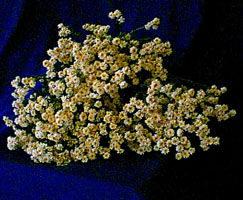
Feverfew
PERENNIALS
Anaphalis sp. Pearly Everlasting
Catanache caerulea Cupid's Dart
Ecninops ritro Globe Thistle
Eryngium bourgatii Blue Sea Holly
Gypsophila paniculata Baby's Breath
Hydrangea paniculata cv. 'Grandiflora' Nikko Blue, Peegee Hydrangea
Liatris spicata Gay Feathers
Lunaria biennis (Lunaria annua) Money Plant (Biennial)
Physalis alkekengi Chinese Lantern
HERBS FOR DRYING
Achillea sp. Yarrow
Achillea filipendulina Coronation Gold
Achillea millefolium Cerise Queen
Achillea ptarmica The Pearl, Sneezewort
Achillea taygatea Moonshine
Alchemilla mollis (Alchemilla vulgaris) Lady's Mantle
Artemisia absinthium Common Wormwood
Artemisia ludoviciana Silver King, Silver Queen
Hyssouspus offinalis Hyssop
Lavandula angustifolia English Lavender
Origanum vulgare Wild Marjoram
Tanacetum vulgare Tansy
Your activity for this month is to mew about everlastings and what you do to make gifts for your loved ones. Our fur sister Nancy is a very gifted craftsperson. Usually as she crafts her arrangements, she has her Yankee Candles burning. The everlastings have wonderful smells as do her candles.
Please send in your biograhies and pictures for our "Getting to Know You" pages.
Remember all of the previous gardens are available to garden in. Mew to us, Shirley and Sophie. Enjoy the falling leaves.


http://www.tendermoon.com/TenderMoon.htm


|