"There is a garden in every childhood,
an enchanted place where colors are brighter,
the air softer, and the morning more fragnant
than ever again."
~Elizabeth Lawrence~

It's April! Spring is truly here! We have seen Meowmie's favorite
Birdscaping
Birds are naturally drawn to trees and shrubs. Trees and shrubs
Shelter
Birds need to hide from their enemies. At night this cover keeps
Food
Birds have favorite foods at our feeders. Some like thistle,
Types of Birds
What types of birds winter in your region? What birds spend the
If you live in an area in the path of migrating birds, be sure
robin return. A robin is a harbinger of Spring. In New England it
is time to think about planting flowers, shrubs and trees to attract
birds, butterflies and insects. April 7th is the day to spring
forward one hour and April 27th is Earth Day or National Arbor
Day! Time to plant a tree in memory of a loved one. Birds love
trees for several reasons. Meowmie has been working on "birdscaping"
her yard for the past few years.
provide birds with a place to hide from their enemies, a place to
nest and roost, a place to get a meal, and a place to rest.
Take an inventory of your property. What types of trees and shrubs
do you have? How many different types are there? If you live in
a colder climate, do you have any evergreens? Do any bear fruit,
nuts, berries, seeds or cones? How dense are your trees and shrubs?
A variety of trees and shrubs will attract a greater variety of
birds to your yard.
them safe as well as in wintery or stormy weather. In cold
regions, dense evergreens shelter birds and insulate them from
frigid temperatures and icy winds. In hot areas, birds get
protection from sun and heat. In the spring, this shelter will
also provide nesting places for them.
some like sunflower seeds, others like safflower, fruits or nuts
or suet. Others like the robin make a meal out of insects or
worms. Providing a variety of food sources will entice birds to
visit or live in your yards. Birds that visit your yard all have
different food preferences, shelter and nesting needs. Try to
have a variety of heights, leaf types, food types and densities
in your yard.
spring and fall there? Select all of the birds on the chart
provided by the link.
Here's a link to help you determine this.
to consider their food needs on their long journeys to their
winter or summer homes. Consider if the bird species has a
favorite native food or type of nesting place.
Now that you have figured out your list of birds that you may
attract to your yard, find out your planting zone and soil type.
You need to plant a shrub or a tree that is adapted to your
area and soil. Consider natives when possible. Native trees
and shrubs require less water, have fewer insect and disease
problems, and grow better.
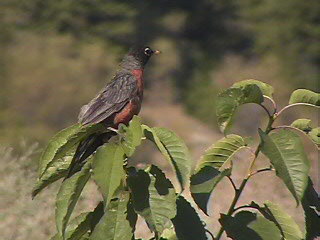
Meowmie has several young maple trees surrounding her yard.
She has a large maple beside the deck where she hangs
several feeders with thistle seed and songbird mix.
We two gals love to sit at the sunporch windows on the
tintop table to watch the birds. Down back in the rear
shade garden Meowmie has planted some viburnum
shrubs. She calls them her "snowball bushes".
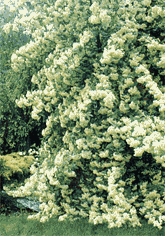
Viburnum
Viburnum are the most versatile and gardenworthy genus of shrubs.
They have attractive foliage and growth habits. They offer lovely,
sometimes, fragnant flowers. Many boast fruit and stunning fall
foliage. The fruits are appealing to birds.
There are more than 150 species of Viburnum; many native to
North America, growing in USDA hardiness zones 2-9. Meowmie's
gardens are in zone 6.
Viburnums have a spreading habit. They grow without a lot of
fussing. They can be planted in sun or shade. Meowmie's is
V. lentago and can be adapted to deep dry shade. Our canopy
of small maple trees provide deep shade in the summer. Deep shade
allows slower growth of her plants and less watering chores.
She loves her shade garden and has a bench there to sit and
relax on while she watches all of the birds flitting, flying
and perching in the small maple trees.
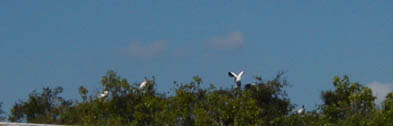
I am not a memfur of mewr lufurly society, but I want to share
this with mew and your memfurs. I live in Flurida and efury
year we have a family of storks that come and nest in the dead
branches of nearby trees and fly to the river, (in front of
the house)and dunk their branches and fly back to use them
in their nest. They are furry beautifur and furry big.
Meowmie took this pic of them this morning from our back
porch. Purrs, mewr friend Troubie.
The midi is playing "What A Wonderful World" by Louis Armstrong.
Your gardening activity for April is to mew or send graphics
about what you do for "birdscaping" in your own gardens. You may
also plant in the previous gardens. Mew to us girls,
Shirley and Sophie by clicking on the mail button below.
Send in your biographies for our "Getting to Know You" page.
May you hear the "whisper of wings" in your gardens.