Description : Tulips are spring-blooming perennials that grow frombulbs. Depending on the species, tulip plants can grow as short as 4 inches (10 cm) or as high as 28 inches (71 cm). The tulip's large flowers usually bloom onscapes or subscapose[further explanation needed] stems that lack bracts. Most tulips produce only one flower per stem, but a few species bear multiple flowers on their scapes (e.g. Tulipa turkestanica). The showy, generally cup- or star-shaped tulip flower has three petals and three sepals, which are often termed tepals because they are nearly identical. These six tepals are often marked near the bases with darker colorings. Tulip flowers come in a wide variety of colors, except pure blue (several tulips with "blue" in the name have a faint violet hue). The flowers have six distinct, basifixed stamens with filaments shorter than the tepals. Each stigma of the flower has three distinct lobes, and the ovaries are superior, with three chambers.[further explanation needed] The tulip's fruit is acapsule with a leathery covering and an ellipsoid to subglobose shape.[further explanation needed] Each capsule contains numerous flat, disc-shaped seeds in two rows per chamber. These light to dark brown seeds have very thin seed coats and endosperm that does not normally fill the entire seed. Tulip stems have few leaves, with larger species tending to have multiple leaves. Plants typically have 2 to 6 leaves, with some species having up to 12. The tulip's leaf is strap-shaped, with a waxy coating, and leaves are alternately arranged on the stem. These fleshy blades are often bluish green in color.

Cultivation : Tulips are indigenous to mountainous areas with temperate climates and need a period of cool dormancy, known as vernalization. They thrive in climates with long, cool springs and dry summers. Although perennials, tulip bulbs are often imported to warm-winter areas of the world from cold-winter areas, and are planted in the fall to be treated as annuals. Tulip bulbs are typically planted around late summer and fall, in well-drained soils, normally from 4 inches (10 cm) to 8 inches (20 cm) deep, depending on the type planted. In parts of the world that do not have long cool springs and dry summers, the bulbs are often planted up to 12 inches (30 cm) deep. This provides some insulation from the heat of summer, and tends to encourage the plants to regenerate one large, floriferous bulb each year, instead of many smaller, non-blooming ones. This can extend the life of a tulip plant in warmer-winter areas by a few years, but it does not stave off degradation in bulb size and the eventual death of the plant due to the lack of vernalization.
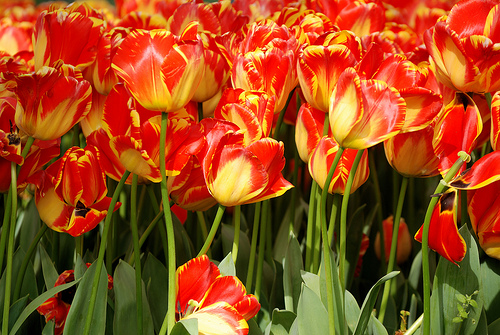 Diseases : Botrytis tulipae is a major fungal disease affecting tulips, causing cell death and eventually the rotting of the plant.Other pathogens include anthracnose, bacterial soft rot, blight caused by Sclerotium rolfsii, bulbnematodes, other rots including blue molds, black molds and mushy rot. Variegated varieties admired during the Dutch tulipomania gained their delicately feathered patterns from an infection with the tulip breaking virus, a mosaic virus that was carried by the green peach aphid, Myzus persicae. These aphids were common in European gardens of the seventeenth century. While the virus produces fantastically colourful flowers, it also causes weakened plants prone to decline. Today the virus is almost eradicated from tulip growers' fields. Tulips that are affected by mosaic virus are called "broken tulips"; while such tulips can occasionally revert to a plain or solid colouring, they will remain infected with the virus. While some modern varieties also display multicoloured patterns, the patterns result from breeding selection for a genetic mutation. In these tulips, natural variation in the upper and lower layers ofpigment in the flower are responsible for the patterns.

In culture :
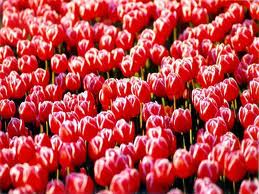
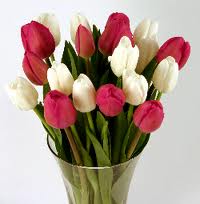
During the Ottoman Empire, the tulip became very popular in Ottoman territories and was seen as a symbol of abundance and indulgence. In fact, the era during which the Ottoman Empire was wealthiest is often called the Tulip era or Lale Devri in Turkish. In classic and modern Persian literature, special attention has been given to these beautiful flowers, and in recent times, tulips have featured in the poems of Simin Behbahani. However, the tulip was a topic for Persian poets as far back as the thirteenth century. Musharrifu'd-din Saadi,[clarification needed] in his poem Gulistan, described a visionary, garden paradise with 'The murmur of a cool stream / bird song, ripe fruit in plenty / bright multicoloured tulips and fragrant roses...' The Black Tulip is the title of a historical romance by the French author Alexandre Dumas, p�re. The story takes place in the Dutch city ofHaarlem, where a reward is offered to the first grower who can produce a truly black tulip. Today, Tulip festivals are held around the world, including in The Netherlands, Spalding, England.There is also a very popular festival, in Morges, Switzerland. Every spring, there are several tulip festivals in North America, including the Tulip Time Festival in Holland, Michigan, the Skagit Valley Tulip Festival in Skagit Valley, Washington, the Tulip Time Festival in Orange City and Pella, Iowa, and the Canadian Tulip Festival in Ottawa, Canada. Tulips are now also popular in Australia and several festivals are held in September and October, during theSouthern Hemisphere's spring.
 Home Page