 Rabbit CareRabbit Care
I would highly recommend going to a rescue group or a shelter. In a rescue group rabbits are already spayed and neutered and the same goes for most shelters. In a rescue group you can get detailed information about the rabbits. It might seem that you have to answer a lot of questions and usually a house visit is required but only this way they can gather enough information to find the right rabbit for you. After the adoption you have always people to help you if problems occur. I would also recommend getting an older bonded pair especially if you never had rabbits before. Like I have mentioned in the other article, rabbits are very sociable, but they are not always easy to bond. It can take quite a while and it�s not for the fainthearted. For more information about bonding please check the additional links. Please don't put a ginuea pig and a rabbit together. They might get along well but they are two different species. Imagine yourself living with a gorilla. Please put rabbits together and guinea-pigs should have a partner of their own kind too.Another possibility would be to check the black board at a vet�s office. I wouldn�t recommend a breeder or a pet store but if this is your choice, please check the surroundings carefully. How well are the rabbits cared for? Is the breeder asking you questions to make sure the rabbit will end up in a good home? How often does he/she breed? What happens to the rabbits they can�t sell or that come back? Rabbits should be at least 8 weeks old before they can leave their mother. And if you are set on a baby rabbit please still consider a shelter or a rescue group; they have baby rabbits from time to time.
Cages should be at least 120 cm/140 cm. As bigger as better. A lot of the cages, especially the �starter cages� you see in pet stores are way too small. A medium sized full-grown rabbit can�t even stretch out. The cage should have side doors and you should be able to open a door at the top. The bottom should be solid; rabbits don�t have pads on their feets like cats or dogs. Wire bottoms will hurt their feets and they definitely need a resting board. You can also use a playpen instead of a cage but you might need to put something on top, some rabbits are able to jump over it. You also need a litter box filled with woodypets, woodpellets or aspen. Please don�t use cat litter or pine, this can harm the rabbit. You might want to put in a hiding place too. Most rabbits use the litter box automatically for all or most of their business. But sometimes they are exceptions: Fred for example had used her litter box to take a nap but not as a toilet. I just filled the whole cage with aspen and gave her a small fleece bed instead. Outside of her cage she was very clean. Soon you will find out what works best for you and your rabbit.
Hay, Hay, Hay. That is most important. Rabbits should always have good looking (very green, not yellow) Timothy hay in their cage. Don�t get Alfalfa for rabbits over 6 month, its too high in Calcium. Often you will see very colorful pellets with seeds, corn etc. Don�t get this. Seeds and Corn are not good for the rabbits digestion and in some cases they can even cause an abscess in the rabbits mouth. Don�t buy sticks made from seeds etc. it�s the same thing. It says that they will help the rabbits teeth. Please don't get it. The rabbits teeth get worn down by eating hay. Get plain pellets with a high fiber Content (about 18%). I feed a handful of pellets once a day in the morning, some people even feed less and others don�t feed pellets at all. Vegetables are also an important part of the rabbit�s diet. Please feed small amounts first and don�t feed withered greens. You can also feed herbs and fruits. Rabbits should always have water in their cage.
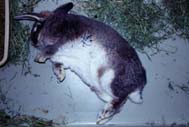
Exercise is very important. The rabbit should have at least two hours of playtime a day. Please make sure the play area is bunny proofed. That means there should be no cables or houseplants that are poisonous. Please be aware that rabbits can jump up pretty high and can fit into tiny spaces. If you are not sure how good your room is bunny proofed always supervise your rabbit.It is also a good idea to place a big litter box outside. Rabbits like to play too. You can use old cardboard boxes (cut some doors and windows inside), old phonebooks and paper rolls (from toilet paper) as toys
Never ever pick up a rabbit by its ears. You also shouldn�t stick your hand in front of the rabbit�s mouth. Rabbits can�t see very well if things are too close and might mistake your finger for a carrot. They are also very sensitive with their whiskers and touching this area might give them a little shock. Most rabbits don�t like being picked up, for that reason side doors at the cage come in handy. Just open the door or just open the whole top (you might want to place some towel on the open side door, so they won�t hurt their feets) and let the rabbit come out on its own. If the rabbit hops back in, don�t close the door right away. Let the rabbit go in and out several times. You can also use a little treat like a piece of apples or bananas to lure it back to the cage. Rabbits are pretty smart. With time and patience they will understand what you want. I feed my rabbits their vegetables or fruits at night and they will hop right back to their cages because they know I will put it there.
Rabbits are very sensitive. If anything unusual occurs it is always better to call a vet. Compare to dogs, diarrhea or constipation can become fatal in a rabbit very quickly.

Last but not least: With my articles I have tried to give a brief overview what it means to have a rabbit in the family and how to take care of it. There is much more I could have written to each topic but I have tried to keep it short and simple. Please visit the links for further and more detailed information.
