| The tough road to amazing grit By Florence Pia G. Yu Published: Gulf News, Friday Magazine Dubai, United Arab Emirates March 28, 2003 Pages 26 - 28 |
| With most people, MS causes loss of muscle control; vision, or hearing impairment; speech and walking disorders, among a plethora of serious dysfunctions. But Jackie, now 45, her unfaltering smile and upbeat disposition matching the casualness of her short blonde hair, denim shirt and black pants, belies a trace of the scars. She is among the lucky few who came away slightly scathed, she says, smiling. Propping her feet up a footstool, she calls to her cats: Fred, Barney, and Mitsy, a white Persian cat she rescued from the streets. Mitsy pauses near the cabinet where the TV, sound system and a stack of Jackie's aerobics videos are placed. Then the cat jumps on her lap, and she strokes its head. "I love animals!" she enthuses. "There would've been more, but not in an apartment!" She had been on her third year in a new career at a private health care company when MS hit her, Jackie recalls. It was just when she had wanted to break away from the depressing scenes, the stress and the erratic shifts at the hospital. "I had a pretty bad day," she recollects, snuggling into the chair. "I woke up and my body felt very heavy, almost numb, and it just felt awful!" She thought she simply strained her muscles or injured her back doing aerobics the previous day. She didn't have time to dwell on it much that day, though, as other concerns unexpectedly piled on her door. "My next door neighbor left her little boy with me while she went to buy medicine. He cried all the time! Then my friend rang to say her husband had left her and asked if we could go for lunch. All this was happening and I just felt so bad," she narrates. On her first trip to the physician, she was given anti-depressants. "I think he thought it was typical for a woman my age, or maybe because he knew my dad had recently died and that maybe it was a sort of a delayed reaction. And I felt so tired, so weak, I didn't have the energy to argue with him!" she says, with a laugh. When days passed and she didn't feel any better, she decided to see a specialist, who put her through some tests a few days before her 41st birthday. Not wanting to miss a piece of the action, she still headed on a holiday--a birthday bash for herself--and went snorkeling in the Red Sea. When she got back, the test results were ready. She was diagnosed with multiple sclerosis. "I thought I had spinal tumor. I have to say, at that time, MS didn't seem as bad. In a way it was a bit of a relief," she says. Within six months, symptoms sprang. "It affected my sense of balance and spatial awareness. I tripped a bit more. Bumped into things. I used to take the bus, and get up while the bus was still moving so I could get off, but just walking down that isle--it was like you're drunk," she describes. Her hands were affected most. "These hands felt numb," she says, stroking her cat, "and I couldn't do silly things like picking things up or putting on makeup. I couldn't refine movement. I find that at work--when I'd photocopy something--when I reached the machine, I didn't have the paper because I dropped it. I couldn't feel it in my hands!" She was given steroid therapy. She also took alternative medication and saw an acupuncturist, who recommended a no-wheat diet, and several supplements. Although she did improve, Jackie admits she crumbled emotionally. "You get pessimistic because it's unpredictable. You still think you'll end up in a wheelchair." It was difficult to tell family and friends about her illness. "It took me ages to tell my Mum because she was still depressed after dad died, and I had to find an appropriate moment," she says. As symptoms further surfaced, Jackie caved in to depressing thoughts of ending up being a useless dependent, which she vouches, is one of the biggest challenges she has had to deal with. Independence was, and still is, very important to her, and she wanted to do everything by herself. Used to being a woman on the go, MS made it difficult for her. "The trouble with me is I want to be independent and it's so frustrating that you want to be able to do things--like housework and gardening--but you haven't really got the energy. And you do it, but you make yourself worse," she tells. Fatigue, one of the most common symptoms of MS, drained her. "It's a horrible feeling. It's not just tiredness. You can't just go to bed, have a nap and you'll feel better. Your body just feels dragged down." Rather unexpectedly, MS taught her the art of compromise. Jackie says people with MS make the mistake of pushing themselves to hard to maintain a degree of independence. Here is where compromise sets in. "You have to realize that you may need help. You should be aware of your limitations." She had to cut down on certain things, like weekends out with girlfriends, cycling, gardening, giving dinner parties, and playing squash and badminton. "I needed my rest. But my friends, who are nurses, were really supportive. So rather than me entertaining them, they?d ask me to go to their place." She still persisted at work. "Although, it was probably not the best thing to do at that time," Jackie admits, chuckling. "You just have to do things. You fight it; you try to do as much as you can." It helped that she had supportive colleagues. Eventually she had to hire someone to train for her position in the company. "I realized that I wasn't probably going to be back to normal very quickly. So, I said, I've had enough stress, I am going to back down, and you can take over. I just went into the background, and sort of demoted myself!" she says with a laugh. Her biggest support came from her husband, who has stayed with her even if she was an emotional mess. They've been married for 25 years now. "I think I gave him a rough time. I kept saying things like, 'Oh, I'm going to end up in a wheelchair!' so Pete went along with me, thinking I'd know what I was talking about." She insisted on doing everything herself, unintentionally brushing him aside. "We had heated discussions," she admits, "and I think Pete used to get annoyed at me. But we never got into a big fight because he is so tolerant." She thought time was running out on her. "Pete said I spent a lot of money on clothes," she says with an impish grin, "although I don't really remember that!" She obsessed on going to as many holidays as she could. "I kept thinking I needed to do everything now because I might not be able to do in a few weeks time, or when I'm on a wheelchair," she says. "It's the unpredictability of MS that you have to come to terms with. You might be fine one day, and wake up blind tomorrow. But you can't let it worry you. Otherwise you'd keep thinking, 'Oh what am I going to wake up to tomorrow?' You can't live your life like that," she says. Jackie has learned that there is redemption after MS. It's been five years now since MS last struck, and she is still on her feet. Major symptoms haven't surfaced, although, the summer heat tends to make her feel sluggish and colds set her back for a week or two. "But I haven't really gotten worse. I'm optimistic I'll recover." Jackie says she doesn't think much about her MS now. She is busy living. Gone is her obsession for supplemental medicine. "I had, like, a basket full of these things and it would take me half an hour in the morning to take them all!" she exclaims, "so when I moved here I thought, this is crazy. I'm just going to leave them behind." She hasn't taken anything since. She feels she is well. "I just listen to my body." She hasn't seen a local doctor or joined a local support group either. "The last thing I want to be doing now is to sit and start discussing symptoms. There are far more important things to do. I just try to get on with it," she says. And she does get on with life. She still wants to do as much of things by herself as she can. "I couldn't get someone else to do it because--unlike here where people have maids--I'd have cleaned the house before they arrived! I couldn't bear for them to see a messy house!" she tells, laughing. In between tidying around the house; checking her e-mail; doing aerobics; swimming and cycling, she dares herself to life's extremes. Last year, she surprised herself by completing a 1,400 meter swimathon sponsored by a five-star hotel. "I just thought that would be a challenge. And it amazed me that I didn't finish last!" she says, grinning. "Although I collapsed into a heap afterwards! But, I was really proud of myself." She might take up sports again. "Although I wouldn't be up to my standards," she admits. "My hands aren't as sensitive and it would be difficult to grip the racquet--it might probably end up flying instead of hitting the ball!" she says, chuckling. Jackie is looking at life through a new perspective. "It's like a second childhood really," she tells, laughing. She savors every day that she wakes up to. "There were a lot of things in life that I took for granted, which I'm more aware of now. Things like doing the swimathon, or going parasailing. I did something called boom netting, where they have this net at the back of the boat and you just sort of cling on to it as the boat moves along? Maybe I wouldn't have bothered with these things before." Does she regret not having bothered having kids? "I haven't regretted it. I think we probably both maybe got a bit selfish and liked our lifestyle," she says with an impish grin. She is taking each day as it comes, injecting as much life into her daily routine as possible. She keeps in touch with family and friends through e-mail. She has taken a spoken Arabic course, golf lessons, and occasionally goes to the driving range to practice. She also does volunteer work at the British Veterinary Council, where she takes care of animals. "You can't take things for granted because it may be different tomorrow," she says. Jackie advises people with MS to listen to their bodies and use it. "You don't have to lose your independence, like give up work. If you can't physically get to therapy centers, log on to websites because these are a mine of information. No two people have the same symptoms, but it's good to share some ideas. It's important in the early stages." Looking at the bigger picture in everything, she refuses to dwell on depression. "There are always people worse off than you, aren't there? When you get over the depression stage, you realize that." Would she change a thing in her life, if she could? "I've had a good life so far," she tells, still smiling. "Like I said, it could've been worse!" |
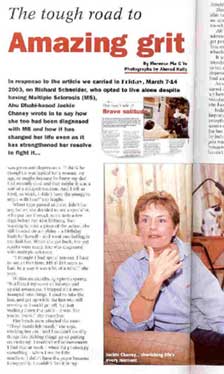
| Some 20 years ago, Jackie Chaney, then a nurse, could only guess what her patients with multiple sclerosis (MS) were going through. For 13 years, she had walked among them--patients who were usually in a wheelchair, left with some kind of debilitating disability, yet struggling for normalcy as they endured needle after needle of steroid therapy; and hours of intense physiotherapy while they labored to move almost-lifeless muscles. What Jackie didn't guess was that a few years later, she, too, would get it. It has now been five years since MS, an incurable disease of the nervous system, hit Jackie. She walks steadily towards the living room of her spartan yet homey flat in downtown Abu Dhabi, where she and her husband, Pete, had moved into from London a year ago. She passes by an uncluttered desk in a corner where her laptop is, past the sofa and the center table decorated with three aromatherapy candles, and settles on a cushioned chair. The use of her legs has been one of the miracles she is thankful for. |
| �2003 Writer's Block. All rights reserved. |
 |
| [ home . first dive . feature writing . poyen's write ups . advertorials . recycle bin . links ] |
 |