

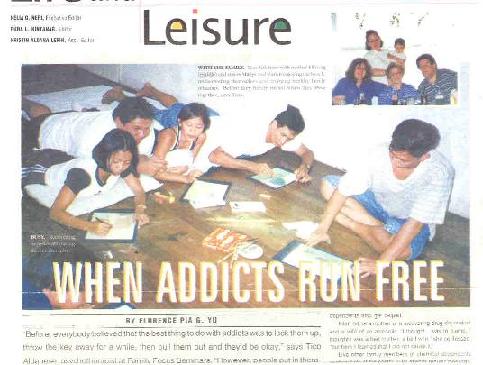
By Florence Pia G. Yu
Published in the Sun Star Daily
Cebu City, Philippines
March 28, 2001
Section B Pullout
"I'm having fun recovering because this is not jail, this is where I can share my feelings, my deepest problems, where I can show the real me," discloses BJ, 19, a recovered addict and alcoholic. Sober for a year now, BJ is now backing school as a first year psychology student. He hopes to help other people get out of addiction.
"Addiction is not a disease. Addicts are sick, addicts need help, they don't need to be jailed. They're not criminals, they're sick people and sick people need treatment, not jail," Tico explains.
Tico started at Family Focus Seminars as a reluctant patient. An alcoholic and a drug addict, he went in for treatment in 1998. "I've found a new life here. I could go out to disco, go outing, I even did things I've never done before, but healthy things, wholesome things, and it's fun," shares Tico.
"The treatment program tries to teach the individual how to be responsible with his life," he explains. Each patient undergoes a 90-day intensive program of group discussions, meditation techniques, physical fitness and recreational activities. The program is coined "live-out program". "Though the patients live here and sleep here, they don't spend the whole day here. They go out," explains Tico.
Therapy and work on recovery-related materials are done in the center, but the patients are given time to go out as a group for gym and lunch, and to do normal recreational activities. It is enjoyment while on the road to recovery.
"There is no locked gate. You are free to leave anytime you want," says Alex, 27, recovered chemical dependent. However, Alex has chosen to tough it out in the center because "it's more of a choice."
Alex says that although the group is able to go out and could easily go back to their addiction on a whim, they are able to resist the urge to use drugs or drink alcohol. When asked how they ditch the itch, he answers, "I know that it has helped me a lot in my recovery when I stopped all these things, so why should I go back there?"
Family power
Help is not only patient-centered. Families of dependents also get helped.
Pilar, 54, is a mother of a recovering drug dependent and a wife of an alcoholic. "I thought I was to blame. I thought I was a bad mother, a bad wife," she confessed, "but here I learned that I did not cause it."
Like other family members of chemical dependents, seeking help at the center, Pilar attends regular meetings.
Learning to deal with her resentment, guilt and self-doubt, Pilar says she is now in terms with the reality that is addiction in her family. "The family is affected and these are issues that they do not talk about in the open," she explains.
"I thought the action made the person. Here, I learned that he is a good person. It's the action that was bad. I learned to separate the person from the addiction,"she says. "A family who is in recovery together gives a better chance for an addict/alcoholic to recover."
Nothing changes if nothing changes
"I used to believe I was a very bad person," relates Tico. "Because of my drugging I hated myself. I hated my life. I hated what was happening to me, but I could not stop. I didn't know how."
He explains that seminars and therapy did a lot for him to gain the understanding and confidence in taking that step to change. "It's not the addict's fault, but it is his responsibility to recover," says Tico. He says at the center, the patients are taught to deal with their emotions and to deal with life. "Usually, we don't know how to take life with life's terms so we would run back to drugs and alcohol to numb ourselves from the experience," he says, "but nothing changes if nothing changes."
Kirk, 37, another recovered dependent, says, "All I knew was I didn't want to live with all that misery anymore."
James, 19, got hooked on drugs when he was only 12. A few months ago, he signed himself up for treatment.
"When I came here the first thing I saw was the door. I thought that when I went through that door, I would never come out again. I really thought I was stuck with drugs, and that there was no way out. But now there is."
�2003 Writer's Block. All rights reserved.