

(Appreciating Old Visayan Art)
by Florence Pia G. Yu
Published: Forward Magazine
Cebu City, Philippines
2nd Semester Issue 1999-2000
You make like Alicia Sylverstone--clueless--and decide to read a nearby poster to ease your utter lack of clue.� It says simply: Old Visayan Art.�
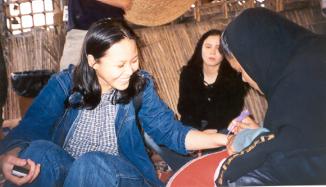
Suddenly, a man called George, with long hair, tattoo all over his arms, and wearing a wooden choker around his neck--which reminds you of an ethnic Ifugao (sans loin cloth, sans bare upper torso showing off rippling muscles--ooh, what a spectacle that could've been!)--comes to you and asks, "Pa-patik ka, bay?"
What do you do?
Do you cry,� "Yaks! Di ko oy! Ka-Bisdak an� nga design! " and dodge the pen threatening to� spew black ink on your skin?�Do you scamper to another direction or think that submitting to the process would make you commit the next fashion faux pas?� Do you roll your eyes heavenward, raise an eyebrow and say, "No way! di bagay sa getup!" Do you stick your tongue out in distaste because of the mere mention of the words, patik and Visayan?
If you think you are likely to do any one of the options mentioned above, then you are it. You are the person reeking of fish Rizal described.� A self-discriminating dolt.� A traitor to your heritage.� A pathetic victim of colonial mentality.. need we go on?� You.. you.. you deserve nothing less than a whack in the bottom!�
But let's not get nasty� (pity the person who gets to whack your behind).�
"Teenagers today seem to lack appreciation for their culture," says 28-year-old George Escalona,� local� tattoo artist.
George, collaborating with other tattoo artists, recently held a skin art exhibit in one of the malls here in Cebu; giving free henna tattoo of the Visayan alphabet.� They hope to revive the "dying art".
"I'm promoting old Visayan art for people to know about our originality, especially in our writings," he said.
George believes it is a way of learning about and appreciating one's roots. Most teenagers, he says, have been "westernized", hence the lack of interest. "Pangutan-a about oil painting, kahibaw kaayo sila.� Pero pangutan-a, "What is Visayan art?' magkanga-kanga," George said.
But why use the tattoo medium, when, in this conservative society, it is considered predominantly faux pas? Consider that if you have one you may get branded with a lot of names: Ex-con, drug addict, devil's advocate, delinquent.� You are likely to get admonished by the church, the school, and--drum roll, please--your mother.� You will not hear the end of their incessant nagging and sermon day after day after day until you resign to get your tattoo erased.�
But George explains, "Mao niy uso sa mga batan-on karon, millennium." Singer Madonna is said to have used henna tattoo in one of her music videos.
He is confident this strategy will sell.�
"Pirmero ma-curious sila.� So, they'll have one and realize na-a tay kaugalingong letra, kultura," he said.
Taking the form of inverted hearts; letter S's; jagged, convex and concave lines; dots, and crosses, the old alphabets do raise curiosity.
The tattoo process used is another thing.
It is called Patik--the native term for tattoo in the Visayas and Mindanao. The term was coined from the sound produced by beating two sticks together, which is how the tattoo was done.
To show how our ancestors (the Spaniards called them Pintados, or the painted people) did it, Goerge took two wooden sticks.� One had a nail-like object protruding at the end.� He placed this stick over the arm of� the only available volunteer (this paper's photographer), and using the other stick, proceeded to hammer lightly (for demo purposes only) on the first one. This supposedly caused small punctures on the skin, over which a black powder was rubbed� for the needed tattoo effect.
Now, you're probably thinking: Blood, blood and blood--yuck!� Thankfully, this gory process no longer applies today.� The art of tattooing has been refined to its simplest form:� instead of instruments with needles, an improvised tube pen is used together with henna herbal ink.�
The pen works much like an architect's technical pen. George simply draws the design directly on the skin.�
George explained the ink is a henna tree extract.� It is reportedly safe.� It washes off after a week--ridding George of unnecessary problems (read: blood; panicky, fickle-minded clients; and conservative moms screaming death threats at his ear).
At this point, a large crowd has suddenly materialized in front of the tattooing station.
Waiting for their tattoos to dry, customers Anne and Kathleen were squatting on a mat laid on the floor.�� "I feel like I'm in!� I feel like I'm really, really Bisaya!" rushed Anne, with a huge smile on her face.� Anne, 20, had a geometric design done around her ankle.� She called it a tribal wraparound.�
"Filipinos, especially Cebuanos, are real creative and artistic by nature," she declared.
"Yeah, it only shows nga ni-dagan gyud sa atong dugo ang pagka-artist," her friend, Kathleen, said while wiping off smears of henna ink on her hand with tissue paper.
Kathleen had three tattoos done--one circular design on her back, a little design shaped like an H on the back of her hand (which stands for letter K), and a ring tattoo on her right index finger.
Kathleen, a nursing student, used to have a� permanent tattoo, but had it removed when the school dean demanded for it.� After a costly laser removal, she is now for henna tattoo. "Ma-papas man gud siya after a week.� Unya imong parents dili bitaw masuko.� Ang school pod dili masuko."
That opened the topic on the censors--er parents.� Anne said her parents disapprove of her having a tattoo.� "My parents hate it, but I think I'm on my proper mind," she said wryly.
The ladies admit convincing parents is the hardest part.����
"Akong mom, suko," said Grace, a 26-year old.� She had a sun-shaped tattoo (tribal sun) on her foot.� "It's not a permanent tattoo man sad.� I can remove it anytime," she justifies.
However, Mrs. Shirley Calang, 35, a mother of two teenagers, isn't convinced. "Naghatag lang nag hugaw sa imong lawas," Mrs. Calang said
She believes having a tattoo is an unnecessary "graffiti" on one's body.� Mrs. Calang said she would never let her kids have one.
In front of her, George was still attending to several people who have queued for a tattoo.